The Prosperity Report № 17 · August 31, 2026
Motivation is a mood. A future worth building is the thing that actually moves you.
A 5-minute weekly report delivering proven strategies, actionable insights, and curated resources to help you grow your business, build your authority, and create your best life.
Good Tuesday. Most founders think they have a motivation problem. They don't. They have a clarity problem. You get consumed by customers, payroll, deadlines and the fire in front of you, and somewhere in there you stop reacting to a vision and start reacting to the present. Output stays high. Fulfillment quietly drains out. More discipline won't fix that, because discipline is a push, and pushes run out. What lasts is a pull: a future clear enough and specific enough that you want to get to it.
This week, block an hour and answer three questions on paper. What do I want my life to look like across mind, body, money, business and relationships. Why does that future matter to me. Who do I have to become to make it happen. Then take one decision sitting on your desk right now and ask what the person in that third answer would do with it. That is the whole practice. Clarity, focus, execution, in that order.

Key takeaways
From this week's solo session with George.
Motivation is not your problem. People spend decades chasing more drive, more energy, more hustle, assuming that is the missing piece. Usually the real gap is that there is no future compelling enough to be motivated by. Fix the vision and the energy shows up as a byproduct.
Stop drafting tomorrow from yesterday. Failed launches, financial setbacks and relationships that went sideways quietly become the blueprint for what you expect next. Your past can explain you, teach you and shape you, but it does not have to define you. Change the question from what happened to me to what do I want to create from here.
Get pulled, not pushed. Fear, deadlines, debt and obligation will move you, but only for a while, and they cost you something every time. A clear vision works the other way: it creates anticipation instead of urgency. Describe what an extraordinary life looks like across business, health, relationships, freedom and impact, not just the next revenue milestone.
Decide who before deciding what. Goals give you something to achieve, vision gives you someone to become, purpose gives you a reason to keep going when it gets hard. A million dollar company means nothing until you know who it lets you serve and what freedom it buys. Most people write the vision once and never look at it again, so put it on the calendar: reread it every Monday before you touch the week's execution.
Guest spotlight
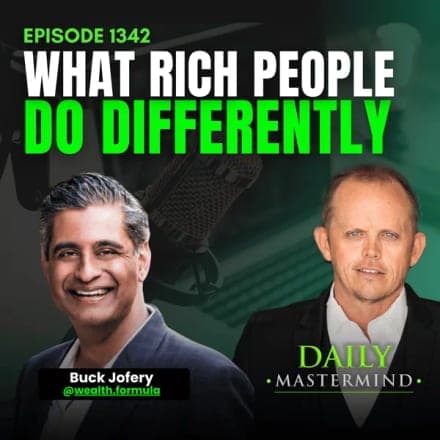
Buck Joffrey
A neurosurgeon turned real estate investor and host of the Wealth Formula podcast, with more than two billion dollars in transactions behind him, on why the people best at earning money are often the worst at keeping it.
The un-obvious part of this conversation is who Buck says the bad investors are. Not the timid. The founders. The same risk appetite that built your company gets misapplied the moment it touches your personal balance sheet, so you either shovel every dollar back into the business or hand it to an advisor you would never let run your company. His fix is structural, not emotional: build a second business around your money and give it goals, tracking and oversight like anything else you own.
“Entrepreneurs successful entrepreneurs are some of the worst investors out there and the reason is that what got us here is a lot of risk taking and a lot of crazy stuff that we did right.”
Three things worth stealing from the conversation:
- Run your money as a second business. You would never let an outsider operate your company with no oversight, yet that is exactly what happens when an advisor defaults you into cookie cutter mutual funds. Give your personal finances their own goals, their own tracking and your own active decisions. Buck's structure for it is mass, how much you actually invest, velocity, how fast you get your money back, and leverage, which he warns cuts both ways.
- Cut the outflow before chasing returns. Buck describes a urologist earning seven hundred thousand dollars a year in W2 income who felt stuck with no options. Buying a vacation property, running it as a rental and using a cost segregation study let a significant portion of the down payment be written off against that W2 income in the same year. For high earners the biggest lever is often not a better return, it is reducing what leaves through taxes.
- Buy what is on sale. He points to core inflation nearing the Fed's target and argues AI will act as a deflationary force, pushing rates down over the next three to four years. Real estate values track rates, which is why the asset class got hit while stocks ran hot. His example: closing on a forty five million dollar Dallas apartment building at roughly fifty percent of its 2021 valuation.
This week on the show
Resources & links
Buck's book, Seven Secrets of Eternal Wealth, is the long form of what he covers here. Before you buy anything, though, do the cheaper version: open a blank page and write the three questions from Monday's session, then answer them without editing yourself. Start here.
For the next 30 days, start every significant decision with one question: what would the person I am becoming do here. Write the answer down before you act. Reply to this email with the sentence that describes who you are becoming, in your own words, and I will read every one.
Three more conversations from the week. Spencer Carpenter on the KAOR framework and why he would rather reach 50 of the right people than 100,000 of the wrong ones (listen). Anthony Suppa on why a borrowed high evaporates by morning and earned wins do not (listen). Broadway producer Sue Gilad on 399 rejections and hearing no as not now (listen).
Where this leads
When you’re ready to go deeper than a weekly report, there are two ways in.
Group mentoring across mindset, marketing, authority, and automations. The room where the ideas in this report become your operating system.
Explore the Academy →A path from featured authority to your own podcast, to a full launch and media company, with ongoing monthly support. Built to make you the name people already trust.
Start the conversation →That’s your five minutes. Now go execute.