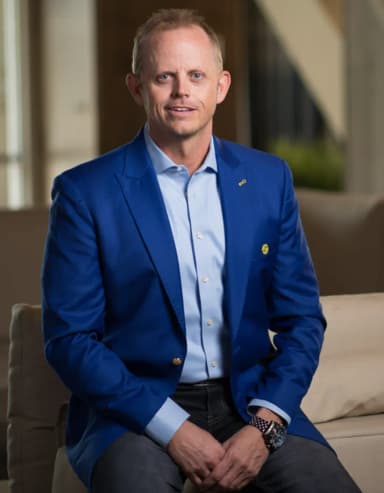
Anthony Suppa: [00:00:00] you dream so big. Everything is big that you wanna do. I'm like Well [00:00:05] I I'm not gonna shoot for something small.
I'll shoot for something really big and if I fall in [00:00:10] between great. If I don't and I failed I learned something. And if I did hit that mark [00:00:15] well guess what? Now I wanna get to the next mark. 'Cause even if I dreamt to be you know the [00:00:20] president of the United States there's gotta be something higher and better than that.
George Wright III: [00:00:25] [00:00:30] Okay, guys, Welcome back to The Daily Mastermind. George Wright III [00:00:35] Anthony Suppa. How are you doing, man? It's good to have you on the podcast.
Anthony Suppa: I'm doing great. Hello everybody. Hello Mr. [00:00:40] Wright.
George Wright III: we talked a little bit before, but I wanted to give everybody a little bit of your background on why I wanted to have you on the show, [00:00:45] what we wanted to talk about today. So guys if you're listening to this for the first time make sure you do me a favor and [00:00:50] subscribe or follow.
We've got a couple of really cool upcoming guests and a lot of stuff [00:00:55] that we're gonna be giving out so I wanna make sure that you're connected with us. Our goal is to [00:01:00] Monday hit mindset Wednesday we talk business, Friday's more lifestyle, and then we'll have [00:01:05] these interviews in between.
And the reason I wanted to ask Anthony on the show is he's a US Marine Corps [00:01:10] veteran entrepreneur serial entrepreneur. He's got a couple decades in restaurant and hospitality [00:01:15] but he started a charity called Slice of Charity, and it's supporting veterans military [00:01:20] families and children in need.
And he also has started a company called Veteran Ally for Commerce. [00:01:25] Now this company's really behind the mission driven opportunities and passion he has for [00:01:30] Slice of Charity but it also is gonna cover a lot of health and wellness. So they're just topics that I really like. [00:01:35] Now, Anthony, you were also named 2026 New York State Vetrepreneur of the Year, right?
[00:01:40] So that's that's pretty cool.
Anthony Suppa: yeah. I'm going up now against about 15 other people [00:01:45] across the entire United States, and we'll see. Hopefully we win it. You know, we got a couple of [00:01:50] interviews we
gotta do and
George Wright III: yeah, it's always good to have that if you have a charity and you're supporting a good cause like veterans and [00:01:55] so it's good to have that. I know you're not in it for that. But you have a background in the [00:02:00] Marine Corps and then went into restaurants. And so tell me a little bit about what made you decide to [00:02:05] go into restaurants, and then we'll kind of pivot a little bit to the charity.
But you've been working the restaurant for a [00:02:10] while now out of the Marine Corps. Do you kind of use a lot of your Marine Corps background in business?
Anthony Suppa: Without a doubt. I mean there's a lot of [00:02:15] discipline involved. One thing that you learn in the Marine Corps at least I learned in the Marine Corps is [00:02:20] everybody has to be managed differently. So each individual [00:02:25] person does not respond the same exact way to how you're speaking to [00:02:30] them what you expect of them.
Not everybody does well with pressure. So you don't [00:02:35] wanna put pressure on certain people. Not everybody does well without pressure. Maybe some people just do very [00:02:40] well when they're expected a little bit more. So that was a good learning experience throughout the Marine Corps, [00:02:45] is managing people, and I definitely took that
with me.
Discipline,
[00:02:50] without a doubt
George Wright III: yeah, I was gonna say you can't help but utilize that. I've known a lot of veterans that have gone [00:02:55] into business afterwards and so when you started a business I'm sure it was a real [00:03:00] foundation for what you're doing, and then you mentioned discipline so
Anthony Suppa: Yeah. You need some discipline, you need some drive. I [00:03:05] mean I think it's partially personality and partially the Marine Corps that is you don't ever [00:03:10] stop. You have something in your mind and you just keep going until you succeed in that mission. And, [00:03:15] you know, in business, I think that's a lot of people aren't able [00:03:20] to take the next step.
They have a good idea, they have a good concept, but there's a lot of [00:03:25] hard work and there's a lot of failure involved in it in the same breath. And as soon as [00:03:30] people fail, they don't think that their idea is good anymore, or they can't do it, and they don't have that [00:03:35] drive to just keep going and don't take the failure and don't accept no
as an [00:03:40] answer
George Wright III: Yeah. Well, you know, a couple decades having a restaurant now, you've obviously had probably some [00:03:45] ups and downs and failures and things like that. Is there anything that sticks out in your mind? I mean, especially you've gone [00:03:50] through COVID and all these things. What has given you that mindset of resilience to kinda keep [00:03:55] going versus just going into a different line of business?
Anthony Suppa: Well, I think I've always had that in me a little bit, but [00:04:00] in the same breath, it's you got to be willing to fail. Failure is [00:04:05] not a bad thing. Failure is a learning experience. That's what people don't realize. I mean, I've [00:04:10] failed. I've had a restaurant that we sold that was just wasn't doing well, so it's a failure, right?
You know, [00:04:15] but in the same breath, it was a learning experience. I was [00:04:20] much younger. I was in my early 20s or mid-20s at that point, um, and I learned a [00:04:25] lot within those couple of years of the opening that first restaurant. But again, [00:04:30] I say to people all the time, "Just try. Just do it.
Just reach out to that person or [00:04:35] just reach out to that company." What are they gonna do? They're gonna tell you no? Like who, what is okay, so [00:04:40] no. Or you know what? That one in 100 person tells you yes, [00:04:45] now you feed off of that. Like that's my big thing. I have a lot of [00:04:50] people ask me like, "How do you just have this, all this motivation?
You keep going," and like, "Do you listen to [00:04:55] motivational speakers or podcasts and things of that nature?" And, you know, the motivational [00:05:00] speakers for me is not
what drives me. I'm, uh, women are not like this, but I'm not for [00:05:05] that...
George Wright III: say I'm the same way actually.
Anthony Suppa: So like I tell people all the time, I'm like, [00:05:10] "Don't get that high from listening to somebody speak, because you get that high, you get all [00:05:15] excited that night, 'I'm gonna take over the world.'
Get that high from accomplishing [00:05:20] a goal." Doesn't have to be a big goal. But once you start being obsessed [00:05:25] with that high, that's the only thing that gives you that satisfaction. That's what drives you. [00:05:30] It's not listening to somebody being like "Oh, you can do this, and all you have to do is work hard [00:05:35] and wake up and take the world on."
And yeah, that's all good and great for that [00:05:40] night, but then when you wake up the next morning and you do nothing with it's because you got the high [00:05:45] easy.
You didn't work to get that
high. You know, and when-
George Wright III: Yeah, it's [00:05:50] interesting, 'cause most people that know me know that I'm not a big fan of motivation actually. I think it's just a door or a [00:05:55] gateway to get people to wake up a little bit, but it never lasts. You've gotta [00:06:00] find the discipline, the confidence the... You know like you said, your perspective is find something that [00:06:05] drives you and you also made that comment a minute ago.
I actually think that it is important for you [00:06:10] to, in the end view failure a different way. Now, everybody hears you [00:06:15] learn lessons in failure. Okay, yeah, whatever. But it's when your perspective of failure changes [00:06:20] that now you don't avoid it. You want it. You wanna push through it. You wanna fail five times [00:06:25] faster because it just takes you to the finish line quicker.
And that's a common trait of a lot of really [00:06:30] successful people so I'm glad you said that, 'cause your perspective on failure perspective on how to get [00:06:35] motivated that's what separates you from most business owners, right?
Anthony Suppa: I think so. Um, a lot [00:06:40] of business owners, I feel also they go into business to try [00:06:45] to achieve not working, right? Where
George Wright III: Yeah. Yeah. I want [00:06:50] leverage. It's like this is opposite of
Anthony Suppa: Yeah that's all good and great, but that's not the reality of it [00:06:55] anymore. If you wanna be... Something I've read once before, there's a difference between an entrepreneur and [00:07:00] somebody that's self-employed.
Somebody that's self-employed just goes to work, uh, [00:07:05] on a weekly basis and just does a job that they can be hired for. An [00:07:10] entrepreneur is somebody that wants to really grow and grind and [00:07:15] be up till 3:00 in the morning looking things up and sending out emails and getting up [00:07:20] at, you know, 8:00 AM with, you know, four, five, six hours of sleep.
And you just every [00:07:25] day you gotta just
keep going and keep going.
George Wright III: You love the thrill of it too.
Anthony Suppa: of it. I love
George Wright III: [00:07:30] you, you, grind
with it. So let me ask you a question 'cause you do you do the restaurant for a couple of decades [00:07:35] but then you decided to start this charity. Now obviously you have an affinity to to [00:07:40] veterans, but what made you decide to bite that off?
Because slice of charity that's not an [00:07:45] easy, that's not an easy path. So tell me what happened or why you decided to start this [00:07:50] charity and what's behind it.
Anthony Suppa: uh, what happened was for about 15, 16 years, I was [00:07:55] doing a toy drive for Toys for Tots, and it would do-- It was small. It started out with [00:08:00] like 40 people at the restaurant in East Meadow, and each year it was like it grew a little [00:08:05] bit. 40 turned to 60, 60 turned to 80. It got bigger and bigger, and it was like, "Well, we can't even [00:08:10] host this at the restaurant anymore."
So we continued to, you know, try to pack as many [00:08:15] people as, in as we can, and what happened was we made a relationship with [00:08:20] Gary from Oheka Castle. He owns Oheka Castle in Long Island, which is one of the most [00:08:25] beautiful places in the United States. And he allowed us to [00:08:30] utilize the castle for these toy drives.
And what happened was the, the first [00:08:35] year we did it, we had 1,500 people come out to the... Meaning the first year we did it at Oheka. [00:08:40] So now I'm saying to myself like, "This is wonderful." Like, I love doing this for the kids. I love being able to [00:08:45] bring 5,000, 10,000 different toys to whether it be Toys for Tots or the [00:08:50] hospitals or things of that nature.
And I was like, "I wanna see where I can go with this. I feel like I would be [00:08:55] really good at this." I'm really passionate about it. I mean, I say this on every [00:09:00] podcast that I go on. If you look into a child's eyes, if you look into a child's soul, [00:09:05] they are the definition of innocence. These children are innocent.[00:09:10]
They should never feel hunger. They should never feel pain. They should never feel being scared or, [00:09:15] or where their next meal, again, that comes with hunger, comes from. So [00:09:20] that's what drove me to actually open or start Slice of Charity, [00:09:25] because a lot of people for many years are like, "What are you doing? You take on so many different things, so many projects.
Like [00:09:30] you know now you wanna do a charity? Like you don't have enough on your plate? And I was like, [00:09:35] Yeah, yeah, yeah. And then finally, literally almost-- It's been about 18 months that Slice of Charity [00:09:40] got the 501[c][3], and what we've done in 18 months takes normal charities [00:09:45] decades or a decade to do. It's not normal how fast we grew, and I think it's [00:09:50] because of the
passion
and, you know,
George Wright III: You know, it's interesting to me because I [00:09:55] find that some of the busiest people are the most productive [00:10:00] on adding to their plate at
Anthony Suppa: Oh, yeah.
George Wright III: this charity
itself is like,[00:10:05]
um, you know, it, it's probably also built your business and everything else. So it's, it, [00:10:10] there's a, there's more than just the purpose and fulfillment behind it.
It's actually a pretty synergistic effect. [00:10:15] Wouldn't you, wouldn't you agree when it comes to doing something like that?
Anthony Suppa: Think good comes with good too. You know? Like, if [00:10:20] you do good, good comes to you. Where I you know, I run the charity with [00:10:25] my board a certain way where we don't have a payroll so you know everybody is volunteered. [00:10:30] You know maybe in the future that will change. That just means we grew so big [00:10:35] that we can't just do it on volunteers.
But we did our 990 every [00:10:40] year for two years which you know most people don't do a 990 within the first [00:10:45] five years. They just do like a postcard for the IRS. But we did so [00:10:50] much in such a short amount of time, we had to do a 990, and it was [00:10:55] 99.5% of everything we brought in went back out.
A [00:11:00] half of percent was used for administrative costs so like a lawyer [00:11:05] or the accountant. You know like these are things that you can't avoid. you know?
George Wright III: What did you have to [00:11:10] change like when you decided to bite this off? 'Cause you're a pretty busy guy as it is. What did you have to change? 'Cause I think a lot of [00:11:15] people are like, Look I would like to do more to serve others to serve my [00:11:20] passion to help and give back, but where do I find the time?
How did you adjust your schedule to be able [00:11:25] to make that happen?
Anthony Suppa: You gotta just incorporate these things into your daily life. You know like [00:11:30] again if you wanna do this world if you wanna in my opinion you wanna be an entrepreneur [00:11:35] you wanna be a business person there's not [00:11:40] real time off. People don't understand that. You know, someone will be like Oh you weren't at the restaurant for two days.
[00:11:45] What'd you go on vacation? Like no I wasn't at the restaurant but that doesn't mean I'm not [00:11:50] working. I'm constantly working. Oh, every minute of my day is work, you know? And [00:11:55] it's a good thing and a bad thing, you know? Like for your family life, you do have to [00:12:00] learn to separate at certain times which is hard to do but you do [00:12:05] have to take the time for your family.
It's not fair for them either. So you know that's why [00:12:10] incorporating it into your daily life is part of working. When you're out with friends, you're at a [00:12:15] restaurant you're at a farm whatever it may be you're camping you just start talking about things and you bring it up.
[00:12:20] And that might not be hard work but you gotta turn your brain on and you gotta work [00:12:25] and you gotta express yourself properly to who you're speaking
with and to get
their [00:12:30] attention.
George Wright III: Yeah. It's interesting the way you think as well, and I find this with a lot of really [00:12:35] successful entrepreneurs. Before the show, we talked a little bit about why you started [00:12:40] a company that you're really starting to grow now with Veteran Ally for Commerce. You said, "I did it because I also [00:12:45] wanted to be able to drive the charitable donations to my charity rather than just [00:12:50] rely on donations."
Help me understand why you wanted to do that. Like because that's a real [00:12:55] like "I'm gonna now take the ball in my hands and drive this charity in addition to [00:13:00] the succe-," 'cause you guys are growing substantially with the charity. What made you decide to do that [00:13:05] and there again, bite something else
Anthony Suppa: Ah again. Um 'cause I think that in one [00:13:10] hand it'll relieve certain pressure where if I don't have to be [00:13:15] so reliant on other people just giving me donations or [00:13:20] giving the charity donations, which I don't like to ask for. I'm like, I told you earlier, I don't like to be [00:13:25] like, "Hey, can you donate $5, $10?" Like, I do a lot of events.
[00:13:30] So, you know, we'll try to put something together where you're getting an experience with your friends, your family, your [00:13:35] kids, whoever it may be, where you're donating money technically, but you're buying, [00:13:40] we'll say, a ticket to something and at least again, you're getting something for your money.
With [00:13:45] Veterans Alley for Commerce, we're using the profits to really drive the charity [00:13:50] so that, again, we don't have to depend on grants, we don't have to depend on fundraising. It's just a
[00:13:55] bloodline for the
charity
George Wright III: You've got a pretty interesting journey, and that's [00:14:00] one of the reasons why I wanted you to... You know, besides the charity itself, but from the Marine Corps to [00:14:05] hospitality and restaurant to food to charity, driving events I [00:14:10] always like to ask really successful entrepreneurs what your unique talent is and what you, looking [00:14:15] back now, you know, Wayne Dyer says looking back on the tapestry of your life, you kinda take on different meaning.
What is [00:14:20] it that you find is your highlights and unique talent that you really have doubled down [00:14:25] on? Because I'm sure it's changed over time too, right?
Anthony Suppa: Yeah. I mean, I think people [00:14:30] say people need to have a vision, right? So I see something [00:14:35] and I have a vision in my mind of what this could be. I mean, everyone always says to me a couple different [00:14:40] things like, " you dream so big. Everything is big that you wanna do." I'm like, [00:14:45] "Well, I, I'm not gonna shoot for something small.
I'll shoot for something really big, and if I fall in [00:14:50] between, great. If I don't and I failed, I learned something. And if I did hit that [00:14:55] mark, well, guess what? Now I wanna get to the next mark." 'Cause even if I dreamt to be, you know, the [00:15:00] president of the United States, there's gotta be something higher and better than that.
[00:15:05]
Anthony Suppa: [00:15:10] Um, but also being able to multitask, being able to wake up every day exhausted and just [00:15:15] continue to grind is something that a lot of people have [00:15:20] said to me, like, again, like, "You, you, you put the stress on yourself. You take [00:15:25] these things and you put them on yourself. You constantly are taking more things to do on a daily [00:15:30] basis, and you just don't
you know, you don't stop."
And I, I can't-
George Wright III: [00:15:35] It's a good quality though because I think
people that are successful want more of [00:15:40] that, so they just wanna grow more to be able to handle more rather than take stuff off their [00:15:45] plate, right?
Anthony Suppa: Well I think so. You wanna take certain things off of your plate so that [00:15:50] you're in order to grow whatever you're creating. One thing that I've explained to, or not [00:15:55] explained, but expressed to partners and things of that nature, if you lock yourself in a [00:16:00] position in your business as somebody that you are paying let's just say [00:16:05] you know minimum wage a kid to do if you're locked in that position because you [00:16:10] gotta oversee exactly what they're doing, where you're basically that same position, [00:16:15] you're never gonna grow.
You're just a counter person in a pizzeria where it's not a [00:16:20] bad thing, but from an entrepreneur standpoint, like, that's not how you grow. [00:16:25] That's not how you you know get bigger and you know with Slice of Charity you can help more [00:16:30] people. You've gotta be out there. You've gotta put the responsibilities of certain [00:16:35] things on certain people and you have to accept that you're not gonna have that
[00:16:40] control
George Wright III: And I think, it's always a little different for everybody, but there's a point where [00:16:45] entrepreneurs, business owners hit a level of success that I believe they can only surpass [00:16:50] when they start to focus on success outside them and their business, which is that [00:16:55] service and relationships and things as well.
Would you agree?
Anthony Suppa: Yeah, I agree 100% because, I mean, [00:17:00] networking is key obviously, and with networking you have to [00:17:05] step away from what you're doing to get into that room. So,
you know, [00:17:10] it's definitely
important
George Wright III: Yeah, I love it. Well, is there, before we take off here, is there any advice you'd give [00:17:15] to
An entrepreneur or business owner that's like, "Look, I want to [00:17:20] grow, and I want to take on more, and I, I wanna... I have a big vision. Um, [00:17:25] I just don't know if I can do more. I just don't know if I can do it." Or is there any advice you would give to somebody? 'Cause you, you [00:17:30] definitely are someone who I believe continues to expand and grow [00:17:35] in your opportunities as well as your impact
Anthony Suppa: Two things. One, just do it. You'll figure it [00:17:40] out. Just do it. Small steps will bring you into [00:17:45] larger strides. And the other thing is, I truly believe this 'cause this is [00:17:50] like almost like my obsession is, don't get that high from somebody else's [00:17:55] success. Get the high from your own success, whether starting off small [00:18:00] again get on that phone call, get on that email, you know just reach out [00:18:05] and what do you need to get to succeed, right?
Don't be afraid for somebody to tell you [00:18:10] no or brush you off. And if they do either go on to the next or [00:18:15] don't take no. Say, "Oh, okay," and then reach out to them again. And it comes down to [00:18:20] having your own wins you know small or large whatever they may be. Have your [00:18:25] own wins. Don't go off of other people's wins and that,
that's
George Wright III: Yeah. [00:18:30] Yeah, that's good advice because I think so many people are looking for that outside recognition. And [00:18:35] not only that, but you're not gonna increase your own self-worth, confidence, and self-esteem by needing that [00:18:40] outside validation or wins. You gotta find it yourself. So I like that. I like that a lot.
So [00:18:45] Anthony, where's the best way for people to connect with you, check out Slice of Charity, and kinda learn a little bit [00:18:50] more?
Anthony Suppa: I mean, slicecharity.org if you want a little bit of more background information in what we're [00:18:55] doing and what we've done. But the best bet is to follow us on Instagram [00:19:00] because our Slice Charity Instagram kind of shows everything we're doing, every event we're having, [00:19:05] every delivery we're doing or the cause, and you just really get the inside [00:19:10] scoop of what's going on a weekly daily basis and you know, what what's coming [00:19:15] next,
so to speak.
George Wright III: Yeah. Well, we'll put links in the show notes 'cause you're going into a busy time of year too, [00:19:20] especially if you're doing charitable donations and toys, toy drives, and
Anthony Suppa: I am. And "M*A*S*H" is in the
same [00:19:25] exact busy time, which
is crazy
George Wright III: know, man. It's gonna be nuts. Especially... And restaurants and everything. So, [00:19:30] well, listen, I appreciate you joining us, man.
I enjoy the conversation. I think people will learn as well and be [00:19:35] inspired by your drive. So guys if you're listening to this do me a favor share the show. It'd mean [00:19:40] the world to us. I also really truly believe that it's never too late to start creating the life you're meant to [00:19:45] live and you can grow and you can expand your vision and you can do what it takes.
You have it in you. Most of us are [00:19:50] operating at like 40%, so you got a lot more in you so push yourself and I look forward to talking with you [00:19:55] again soon. Once again, this is George Wright III with Anthony Supa and we'll talk to you then.
[00:20:00] [00:20:05]