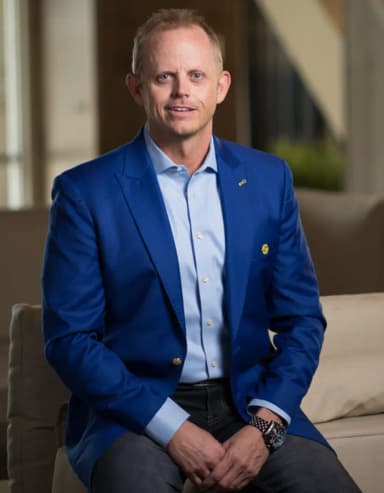
In Day 3 of his 13-part series on Napoleon Hill's *Think and Grow Rich*, George Wright III digs into one of the most misunderstood principles in personal development: faith. Not the religious kind, and not blind optimism, but a trained, intentional state of mind that every high performer must learn to install in themselves before the results ever show up.
George opens with something most entrepreneurs are reluctant to admit: deep down, many of them wrestle with a quiet voice that says, "Who am I to be trying this?" If you have ever felt that, this episode is for you.
What Napoleon Hill Actually Means by Faith
Hill defines faith as the head chemist of the mind, a phrase that reframes belief from something passive into something active and chemical. As George quotes directly from the book:
Faith is the basis of all miracles and all mysteries which cannot be analyzed by the rules of science.
But Hill is not describing wishful thinking. He is describing a state of mind that can be deliberately built through affirmations, visualization, and repeated emotional experience. That distinction matters. Faith, in this framework, is not a gift you either have or do not have. It is a skill you train.
Why High Performers Still Struggle With Self-Doubt
George makes clear that fear and self-doubt do not disappear when you reach a certain level of success. Even the most confident CEOs, coaches, and creators with millions of views still face that inner voice. What separates them is that they have used the principle of faith, applied through consistent action, to quiet it.
Imposter syndrome, George points out, is really just fear in disguise. It is the fear of losing what you have built or of looking bad. Whether you are launching a new offer, scaling past a plateau, or finally committing to what you really want, the root issue is the same: you are waiting for proof before you allow yourself to believe.
Why You Need Better Programming, Not More Evidence
This is the core insight of Day 3. Waiting for the world to validate your belief before you take action has the sequence exactly backwards.
You don't need more evidence. You need better programming.
Your subconscious mind cannot distinguish between a vividly imagined experience and a real one. When you repeat an emotionally charged affirmation, you are not lying to yourself. You are doing the pre-work that conditions your mind to act, decide, and show up in alignment with the result you want. Modern neuroscience supports this: repeated thoughts, felt with genuine emotion, rewire brain chemistry over time.
How to Use Auto-Suggestion to Install Belief
Hill's method, as George explains it, is straightforward and practical. You write a clear statement of your definite purpose, read it aloud every single day with real emotion, and visualize yourself already in possession of the result. The combination of the written word, the spoken word, and the felt emotion is what engages the subconscious mind and begins to override fear.
This is not a passive practice. It requires behavior. You have to show up, do the repetitions, and let the compounding effect do its work. Over time, your energy, your decisions, and your actions start to shift because your belief is transmitting power into everything you do.
The Faith-as-Decision Framework
George uses the image of rock climbers to illustrate a key point about faith: a climbing partner may tell you there is a handhold to your left. Whether you believe it is there does not change the fact that it is there. Faith, in this sense, is a decision to act on what could be true, before you have confirmed it yourself.
This reframes the entire challenge. You do not have to feel certain to move forward. You have to decide to move forward, and let the doing create the certainty.
Action Steps
- Write a two to three sentence affirmation that expresses your biggest business goal in the present tense, charged with genuine emotion.
- Read it aloud every day, not silently. The spoken word carries a different weight.
- When fear shows up during the day, read the affirmation again. Let the discomfort signal that you are stepping out of your comfort zone, then keep going.
- Visualize yourself already in possession of the result each time you read your statement.
- Return to this practice daily for at least the next week and notice how your decisions begin to shift.
Faith is not a feeling you wait for. It is a practice you build, one repetition at a time. As George puts it, the difference between staying stuck and moving forward, between doubting and declaring, comes down to whether you are willing to install belief before you have proof. Start today, because it is never too late to start living the life you were meant to live.