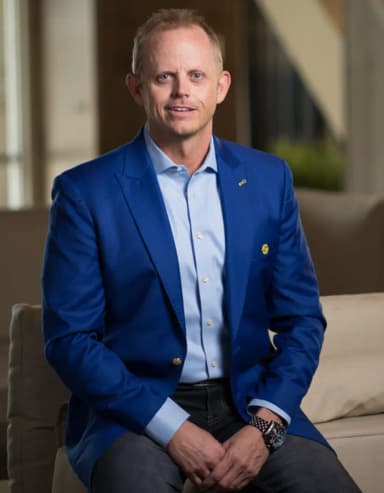
In this episode of The Daily Mastermind, George Wright III continues his series on controlling your internal world. George sets up a powerful audio teaching from Bob Proctor, one of the most influential personal development mentors of the last half-century. The episode is a tribute to Proctor's legacy and a deep dive into a principle that George says changed how he thinks about success: the law of vibration.
George opens with a reminder that you cannot control your external world, but you absolutely can control your internal world. Everything comes down to three decisions: what you focus on, what meaning you give it, and what actions you take. Then he shares a recorded teaching from Bob Proctor that explains why the law of vibration is the true foundation beneath the more famous law of attraction.
Why the Law of Vibration Comes Before the Law of Attraction
Bob Proctor is direct: attraction is a secondary law. The primary law is vibration. In the movie *The Secret*, Proctor quoted Wernher von Braun, widely regarded as the father of the space program, who stated that the natural laws of the universe are so precise that a spaceship can be guided to the moon with a fraction of a second's accuracy. Those laws, von Braun concluded, must have been set by someone.
The law of vibration is one of those foundational laws. It decrees that everything moves, nothing rests.
We literally live in an ocean of motion. Do you know that everything is an expression of the same thing: the leaves, the tree, the cement, the body, the clothes. It's all energy at a different rate of vibration.
Understanding this principle shifts everything. You are not a passive receiver of circumstances. You are a broadcasting station, and the frequency you broadcast determines what you attract.
How Your Brain and Body Generate Vibration
Proctor explains that your body is a molecular structure vibrating at high speed. Your brain is an electronic switching station. When you activate brain cells, you create a vibration in your body. Every thought, every emotion, every physical movement is rooted in this process.
This is why vibration has to be understood before you can take real control of your health, your relationships, and your finances. As Proctor puts it, if you want to master selling, you have to understand vibration first. He references Robert Louis Stevenson's observation that everyone is selling: a teacher sells ideas to a student, a parent sells values to a child, a child sells the parent on what they want. The professional who understands vibration learns to get on the prospect's frequency, to understand their world from the inside.
His old mentor called this empathy-ego balance: the ability to get into another person's mind and see the world from where they see it.
What Your Emotions Are Really Telling You
When someone asks how you feel, Proctor says they are asking about your conscious awareness of the vibration you are currently in. Feeling good signals a high, positive vibration. Feeling low signals the opposite. And the people around you matter because vibration is contagious.
The vibration you're in is going to dictate what you attract into your life. And if you're troubled, you're worried, you're going to attract a lot of bad energy.
This is the practical meaning behind old sayings like "misery loves company." Two people in the same negative frequency are drawn to each other because they are, in Proctor's words, both listening to the same music. A walk in the woods feels restorative because the vibration of nature is, as Proctor says, perfect.
How to Shift Someone Else's Vibration (and Your Own)
Proctor offers a concrete exercise. The next time you are around someone who is complaining or clearly struggling, do not match their energy. Start redirecting the conversation toward something genuinely good about them. Offer a sincere, merited compliment and slowly turn the subject in a positive direction. Watch what happens to their energy.
The reason this works on others is the same reason it works on you. Once you learn to shift another person's vibration, you learn the exact same skill for yourself. You are in control of how you feel.
Victor Frankl, the Viennese psychiatrist and author of *Man's Search for Meaning* who survived years in a concentration camp, described this same space: between any situation and your response, there is a gap. In that gap, even if it lasts only a millisecond, you can choose whether to react or to respond.
The Vibration of Doing What You Love
Proctor closes with one of his most striking points: people who do what they love never feel like they are working. They spend their entire lives in a wonderful vibration. And prayer, he says, understood truly, is the practice of putting yourself into a state of harmonious vibration with what you want.
You will attract to you whatever you're in harmonious vibration with. You are in control of the vibration you're in.
The restaurant you walk into and immediately want to leave, the room that feels energizing the moment you enter it, the conversation that drains you even when nothing bad is said: these are all expressions of vibration. Once you can name the principle, you can start working with it consciously.
Action Steps
- Notice the vibration you are in right now. Ask yourself honestly: am I troubled, worried, or in a good state? That honest answer is your starting point.
- Practice the Proctor exercise: find someone struggling and offer them a sincere, specific compliment. Shift their vibration and observe what shifts in you.
- Study the difference between reacting and responding. In every difficult situation, look for the space Victor Frankl describes and use it.
- Focus on one thing at a time. As George's quote of the day reminds you: to do two things at once is to do neither.
- Ask yourself regularly: what am I in harmonious vibration with today? Make sure your dominant vibration matches what you actually want to attract.
The law of vibration is not a mystical concept. It is a foundational law that governs every relationship, every health outcome, every financial result. Bob Proctor spent more than 50 years studying it daily, and George Wright III brings that teaching forward so you can start applying it now. It is never too late to start living the life you were meant to live.