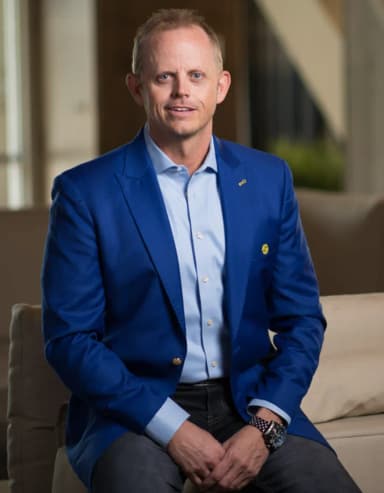
George Wright III opens this episode of The Daily Mastermind with a question that cuts straight to the heart of personal growth: what is actually holding you back from going after what you want? Drawing on Og Mandino's "University of Success" and the insights of his mentor and partner Robert Stuberg, George challenges listeners to rethink the very definition of success and explains how doing so can unlock the courage to live on your own terms.
The episode begins with a quote George attributes to Benjamin Hardy:
How you see yourself is how you act.
Why Most People Stay Stuck Inside Their Comfort Zone
George points out that most people, even those with genuine talent and ambition, stay stuck not from lack of ability but from lack of courage. Life outside your comfort zone is where success, adventure, and real growth live, yet fear keeps you inside the familiar. He asks: are you waiting for the right opportunity to appear, or are you willing to jump into the game and start taking risks?
The answer, he argues, matters more than any strategy or skill set you could develop. Because until you decide to move, all the knowledge in the world won't change your results.
How Risk Functions as the Cure for Fear
One of the most counterintuitive ideas in the episode is that risk is not the enemy of security. Risk is, in fact, the cure for fear. George compares risk-taking to investing: you weigh potential rewards against possible losses, and the higher the risk, the greater the potential reward. But more importantly, taking risks is what breaks the cycle of fear itself.
Og Mandino's insight on this point is direct:
Boredom is the legacy of fear.
The less action you take because of fear, the more bored and unfulfilled your life becomes. If your days feel like a treadmill, risk-taking is not the danger. Avoiding risk is. George encourages you to experiment, determine your personal risk tolerance, and start taking calculated steps outside what feels safe.
What Surrender Has to Do with Control
Here is where George gets into one of the most powerful paradoxes of the episode. Many people try to mitigate fear through control, carefully managing every variable and outcome. But this strategy eventually breaks down, because real growth requires letting go.
George illustrates this with concrete examples: learning to ski, learning golf, riding a bike. You can study the mechanics as long as you want, but at some point you have to stop micromanaging and just do it. The body learns by releasing the need to control.
This is the paradox he names directly:
The highest form of control is when one surrenders all control.
Facing your fear gives you more courage. Letting go gives you more control. That is not just philosophical abstraction. It is the lived experience of anyone who has ever pushed through a moment of genuine uncertainty and come out the other side stronger.
Why Your Definition of Success May Be Working Against You
George shares that early in his life, he had accumulated most of what the world defines as success: income, status, education, a family. And yet he felt deeply unhappy and unfulfilled. It was his mentor Robert Stuberg who helped him see why: his definition of success was wrong.
Stuberg had written an article titled "When Failure is Better than Success," which George read, reread, and credits as a turning point in his life. The article helped him understand that chasing external achievements without alignment to your own sense of purpose and happiness produces what Stuberg describes as the ultimate failure: success without fulfillment.
George went on to partner with Stuberg, becoming President of Success Systems International and co-founding the Stuberg Mentoring Academy, built around helping people combine genuine happiness with achievement.
How to Redefine Success So It Actually Empowers You
The practical shift George offers is this: stop defining success as winning or reaching a destination. Instead, define success as trying. When you accept that trying is succeeding, failure becomes just another step closer to your goal. It stops being a reason to stay still and becomes evidence that you are in motion.
This reframe changes everything. It removes the paralysis that comes from needing a guaranteed outcome before you act. It builds real, lasting courage because you are no longer risking failure. You are accumulating experience.
Action Steps
- Identify one area of your life where fear is keeping you inside your comfort zone and commit to taking one specific risk this week.
- Evaluate your current definition of success. If it is outcome-dependent, rewrite it around the act of trying and showing up consistently.
- Read Og Mandino's "University of Success" or Robert Stuberg's article "When Failure is Better than Success" to deepen your understanding of courageous living.
- Practice surrendering control in a low-stakes skill you are learning: notice how letting go accelerates your progress.
- Share this episode with someone who is waiting for the right time to take a risk. Talking about what you want to do puts it into motion.
Courage is not the absence of fear. It is the decision to move forward anyway, to redefine what success means on your own terms, and to trust that the act of trying is already a victory. It's never too late to start living the life you were meant to live.