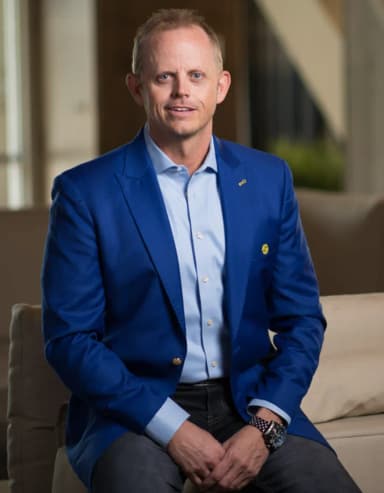
George Wright III opens this episode of The Daily Mastermind with a focused reminder: you are more powerful than you think, and your mind is capable of achieving anything you direct it toward. In a world full of distractions and daily pressures, staying connected to that truth is one of the most important habits you can build.
This episode is built around a single, urgent idea. You are not your circumstances. You are not your thoughts. You are the one observing them, and that distinction changes everything.
The Difference Between Knowing the Price and Knowing the Value
George opens with a quote from Oscar Wilde: "A cynic is a man who knows the price of everything and the value of nothing." It is a sharp observation about perspective, and George uses it to frame the episode's core message. The filter through which you see the world shapes every result you get. If you only see limitations, that is all you will find. If you train yourself to see possibility, that is where your energy goes.
You Are Not Your Thoughts
One of the most freeing ideas in the episode is this: you are not your mind. You are not the emotions running through you or the worries surfacing in a difficult moment. You are the observer of those thoughts, and that means you have the ability to redirect them.
Keep reminding yourself that you have the tremendous reservoirs of potential within you, and so you're capable of doing anything that you put your mind to.
George credits that idea to Bob Proctor, and it reinforces the episode's central argument. The limits you believe you have are almost always constructed, not real.
As the book *As a Man Thinketh* puts it: "A person is limited only by the thoughts that he chooses." You choose the thoughts. That means you choose the ceiling.
The George Danzig Story: What Happens When You Don't Know You Can't
George shares a story from Cynthia Kersey's book *Unstoppable* about a college student named George Danzig. Danzig arrived late to class one day and copied two math problems off the board, assuming they were homework. He worked on them for weeks, thought they were unusually difficult, and eventually turned them in. His professor woke him at 6 a.m. to deliver the news: those were not homework problems. They were equations that had stumped mathematicians for years, problems that even Einstein had not solved. Danzig solved them because he did not know he was not supposed to be able to.
He had solved the problems because he didn't know he couldn't.
That story is not just inspiring. It is instructive. The barriers you believe are solid often exist only because someone told you they were there. Younger generations push limits constantly, George observes, often because they have not yet absorbed all the reasons why something cannot be done.
Stop Asking If You Can and Start Asking How
George draws a clear line between the questions that shrink your thinking and the ones that expand it. Asking "Can I do this?" keeps you focused on your own limitations. Asking "What would it take?" or "How can I get this done?" shifts your attention toward solutions.
Remember, our thoughts create our life, but our thoughts are created by the questions you ask yourself.
That shift matters because the mind tends to find answers to the questions it is given. Ask it about problems and you get more problems. Ask it about solutions and it starts generating them. This is what George calls an abundant mindset, and it is a daily practice, not a one-time decision.
The 12 Prosperity Pillars
George closes the episode by walking through his 12 Prosperity Pillars, principles he accumulated over 25 years of working with thought leaders, designed to help people build the life they were meant to live. The pillars are:
- I create my life
- I take personal responsibility
- I act in spite of my mood
- I surround myself with positive people
- I focus on solutions
- I create an attitude of abundance
- I choose to be happy
- I always think win-win
- I am committed to lifelong learning
- I create daily rituals
- I attract success
- I visualize and manifest my life
These are not abstract ideals. They are decision points, daily commitments that shape behavior and, over time, shape outcomes. George's suggestion: keep them in front of you and let them guide your choices throughout the week.
Action Steps
- Start each day by reminding yourself that you are the observer of your thoughts, not the thoughts themselves.
- Replace "Can I do this?" with "What would it take?" and "How can I get this done?" in your self-talk.
- Review the 12 Prosperity Pillars and choose one to focus on this week.
- When you feel limited, recall the George Danzig story and ask what barriers you are accepting that may not actually exist.
- Share one of these ideas with someone in your life who needs a reminder of their own potential.
The work of unlocking your potential is not a one-time breakthrough. It is a daily practice of awareness, better questions, and consistent principles. It is never too late to start living the life you were meant to live.