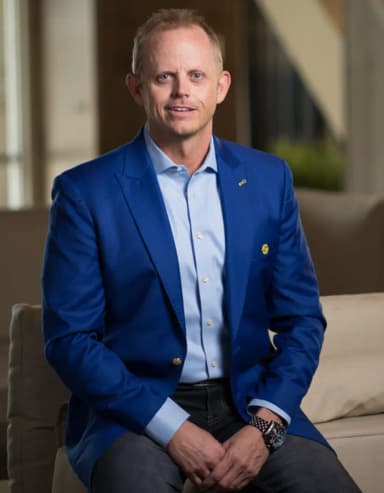
Welcome back to the Daily Mastermind, George Wright III with your daily dose of inspiration, motivation, and education. And we've got a great guest today. Take a little bit of coordinating for us to run him down in Hawaii, but Jeffrey Flam, how are you doing today? I'm doing great, George. Aloha. Yeah, it's, yeah, aloha. I wish I was there with you. Man, oh man. We should have been doing this as a lifestyle episode, which maybe it will turn into that. But for those of you just listening, we've got a great episode for you today. We're going to be talking about everything from cognitive function to masterminds to wealth and success and lifestyle to family. And I want to give you a little brief introduction of Jeffrey. I met him a while back. In fact, we live in very close proximity. But he's the founder and CEO of Infinite Mind. It's a cognitive training and reading enhancement platform. It's used by over a million people and a thousand plus schools and businesses, but he's a serial entrepreneur. He's got successful exits. He's a pioneer in the area of brain training and speed reading. He also has an amazing mastermind, which is highly, we'll talk about that a little bit today too, but highly focused on creating lifestyle and more than, you know, what I talk about all the time, which is just creating the life that you're meant to live. So Jeffrey, I appreciate you being on the episode today. Thanks for the invitation. Good to be with you. Yeah, so let's talk, let's just give a little bit of a landscape as to what led you to create Infinite Mind and what is your big focus and priority? I like how successful people think and getting a backdrop as to why you do what you do today would be real helpful for our audience. So give us a little bit of the background. Back in August of 1996, I was just going through my big exit, selling a benefits outsourcing company, a partner and I had developed, and we had grown up from just two of us to 1,400 employees. And we were managing the benefits for 23 million people. And ADP came along and made us an offer we couldn't refuse. And it made sense because everything we did came off payroll. We'd scan it every day and send out booklets to new hires to get them enrolled in their health plans and dental and everything. And then if they were terminated, we'd send out a COBRA notification. So everything we did came off payroll. So when ADP came along, it kind of made sense. And right that same month as we were making the exit, consummating the deal, I met a guy from Japan who had developed a speed reading program. And I was never a particularly good reader because I had lazy eye as a kid, which never changed. And so one side when I read would be out of focus and the other side in focus. And so as I would read, within 10 minutes, I'd have a headache. So to me, reading was really painful. I didn't like it. It was physically painful. And I found this program and did it a few times. And it felt like it awakened my brain. But after I did it a few times, it was in Japanese. But just watching the screen, high-speed imaging, and a lot of eye exercises, I felt like my eyes were strengthening. And I wasn't getting the headaches anymore. So I actually flew to Japan and went around to the schools that were using it and could see what it was and negotiated with him to buy the licensing rights for English-speaking countries throughout the world. So when I finished my exit, I had to stay with ADP two more years and run the company. So in 1998, two years later, I started building what we call Infinite Mind. and in 2000, we were ready, went out the market, started selling into companies to help executives read better. And then we had the tech bubble burst and all of a sudden all the companies put it on hold because it was a tough time financially in the business world. So I decided to do an infomercial. So we did an infomercial and just a fun story. I did the infomercial myself. I hosted it the first time. And six months later, I get this phone call and she goes, Jeff, hi, this is Pam Dauber. How are you? I said, great. And she said, Mark and I wanted to call and let you know what your program's done for our two teenage boys. They were both not doing well in school. We're worried about them. I saw your infomercial, bought it, had my kids do it. Now they're straight A students. So I wondered how I can help you. And I said, send me a testimonial and we'll put it on our website. and she said I was thinking I'm doing something more than that can I help you host the infomercial and I'm thinking gosh this lady's kind of aggressive right who is this yeah yeah who is this and I said do I know you and she said we'd never met but you would know who I am and I said who are you and she said I was Mindy in Mork and Mindy with Robin Williams and you go oh hi Pam I'm not really a star watcher so I didn't know her name and so what she did is she helped me host the show the next six years. So we shot a new episode every year. And that's where we sold over a million of copies of Infinite Mind. So it really got out there in a big way. But then in 2008, the economy crashed, people quit buying. So I shut it down. And people were moving to recording VCRs. So they weren't really watching infomercials anymore anyway. So it was a good time. So then I built an application to take it into schools. And so we've had it in over a thousand schools. You're pretty passionate about it. This is one of those things where it wasn't just a great opportunity that sprung from, and if you're listening to this, opportunities always spring from your own interests. But this was a great opportunity there, but you're pretty passionate about cognitive improvement, learning, and this is something that you've taken into your home as well as into the marketplace. What drives your passion for this so much now? I saw what it did for me personally. It took me from being a non-reader to reading. I could read a book a week. And I really liked it because I could get through a book in a couple hours. I had a whole bookshelf, like most of us, that I've read one or two chapters at the most in 90% of the books, right? And it changed that to where I'd really read a book. And the advice I give people, when you read a book, if you haven't gotten captivated and pulled in the first 20% of the book, chuck it. give it away to goodwill if the author hasn't really captured you and it's not what you're really passionate about then get something you are don't waste your time just because you bought the book get reading the whole thing if it's not good so i tell people find good books and when they're captivating read them much better than listening i do both i listen to books on audible as well and so i try to go through a book a week on audible but what i found is when i actually read with a pencil or highlighter on my hand and underline and take notes i remember far more plus i can get through exactly what i interested in and skim through the things that aren't that really interesting to me very hard to do when you're listening to books right so i so that's what one of the things that got me excited once I built the program and watched what it did for my kids, made them all super readers, super learners, to where they'd score really high on tests. Then I realized we need to get it out to everybody. So during COVID, when I realized kids aren't reading, they're behind, go pull up data on it. Every kid that's in grade school or junior high is seven months to 12 months behind on reading. They're They're behind. So I made a free version to put out there so everybody can read, learn to read well and read fast with higher comprehension. And it doesn't cost them anything. So we followed the Duolingo model, which is get everybody using it. And those that love it, that want to continue on, can upgrade to the premium version, which just is much more robust. It's full of games and a lot of brain games and things that help cognitive function. Yeah, I love it. I love it. So explain for those listening, what is the Infamite Mind tool? What is it and how does it work? And why does it make such a difference? Because I think a lot of people might think of training and studying, and it's such a simple process daily. So explain what the app is and what it does for you specifically. The creator of the exercises in the program that are highly effective was Dr. Kalamuda in Japan, and he has 10 children. And he wanted to figure out, he's an educator. He's got a double PhD in education. He's written over a hundred books on the brain and speed reading. Okay. So he's very well known author in Japan, but he started studying fMRIs, functional MRIs that are done at the brain back in the seventies. And he noticed something interesting that children's brains fire on both sides equally until they're about age eight or nine. And then the creative, the right side starts kind of becoming a little more dormant. And by age 18, 80, 90% of your brain functions, just your left side, it's going to what you know already. It's not in the creative stage. So he had this theory that if I do a left brain exercise, which is reading, and then do an imaging exercise, and then back and forth do multiple a day, I can get the brain to fire as a full brain on anyone at any age. So he created a program that did that. And so when fMRIs are done, guess what? In eight weeks, it will increase brain function by 15 times. So we're not talking 20%. The other most common brain training program out there, I don't want to say its name because I don't want to be disparaging, but the study's done on it increased brain function 20%. Ours is 1500% because it gets the full fire. So everything you do better, whether it's sports, piano, learning a foreign language, you'll learn it half the time. Yeah. Cause you're optimizing your brain, right? So the idea here is it's not just reading. It started with that passion, but it's something that when you optimize your brain and your cognitive function, everything follows that, correct? Exactly. So originally it was called IQ Advantage, E-Y-E-Q, because it was I and brain training. Okay. So it was called IQ Advantage, but people couldn't find it when somebody would talk about it because they're looking under the letter I instead of E-Y-E. So when we build it for brain training, we changed the name to the company name, which we've had all along, the infinite mind. So a lot of people, if they're looking at benefit of mind, don't find that huge history, but it's the same program, but adapted for brain training now. So what we've done is found out what things really affect the brain the most and focused on building those. And so infinite mind is totally brain training. Yeah. It's amazing to me that something that can obviously improve reading, improve cognition, improve comprehension. Really, especially for our audience, it directly relates to everything that's going to create results in your life. I mean, better cognitive function increases productivity, focus, you know, and at all levels, that's it. I really noticed when we talked and you commented on not just in kids, not just in people that the brain is still developing. I mean, this concept of neuroplasticity is now taken on where people know that they can affect their way of thinking, even at an older age. But explain to me how you've seen it affect productivity and focus by just having more cognition. The thing I noticed most is in the schools we put it in, we will raise their national test scores between 22 and 27 percent, almost always. And people go, how can you raise test scores an average of 25 percent on the whole test, not reading. We're talking math. Everything goes way up. And the reason is we don't teach any curriculum at all. What's changing is their reading speed and their ability to focus. Okay. When you can have a lot of straight A students take the ACT or SAT and not score high on the ACT, they'll get a 22 or 24 and they need a 29 or 30 to get into a major university, a very respected university. And so they're home crying because they're a straight A student and they couldn't get high enough scores on the national test. You haven't do this for eight weeks and they'll get a 29 or 30 almost always. Why does that happen? Let's look at that. Anybody who's taken standardized tests will remember this personally. You get in the test and if you're not a fast reader, all of a sudden you look up and you're running out of time on that section. So you're just filling in bubbles and stress, stress fills the mind of the body and adrenaline starts racing through the bloodstream. When you're stressed and adrenaline is released into the body, it pulls the blood from the brain into the extremities. It's the fight or flight serum. So the blood's left the brain and you're anxious. You are stressed. And so you can read a question two or three times and not even know what it says because you're stressed now what infant of mind does is once you have gotten so you read much faster you get through each section of the test in half the time and you have half the time to read all the ones you've marked that you're not unsure of and think them through and if you think them through without stress you can get it most of the time so a poll scores way up that why every kid should be doing it but the reason an adult should do it is the mental clarity When you start having memory fog you can think of people names you can remember things that happened just recently you really need to get on and get your brain working because the brain is no different than the rest of the body as we get into our 40s and 50s we start noticing we're not as agile as we used to be things ache we're starting to lose muscle tone the brain's the same way as we get get older and so it needs three things the same as the body adequate nutrition adequate sleep and enough exercise and if it's not getting all three it will atrophy and what happens is at the end of each cell in the brain there's little fibers and those dendrites all connect with each other like this and it's a chemical reaction in the brain that sends a chemical in the brain and that makes all of these vibrate and connect as you get older if you're not doing those three things sleep exercise and proper nutrition those dendrites start to atrophy just like the rest of the body they start to die off so your connectivity is there but not as good so you'll try to think of somebody's name and three minutes later it pops in your mind why because the brain's searching for the answer but the connectivity is not good so it comes after and what you'll notice is when when you do infinite mind a month, you don't have those kind of days much anymore. You don't have that memory fog. And so I tell people, because I'll turn 74 in a month, right? And people go, how do you do so much or remember so much? And I go, I think staying active and work is one thing, but I think doing infinite mind regularly is the thing that keeps me pretty alert and strong cognitive function. Yeah, it's a practice. It's an ongoing practice that you use. So tell me, for people that are wondering, what is the time that's involved in the process? In other words, I think a lot of times people think, ah, it's like learning a language. I don't have time for that. But what you've said and made very clear in this technology is it doesn't take a lot of time. It's just consistency. So what is involved with this training that you're talking about? George, the first time you do it, you need about 15 minutes because what it's going to do is establish your baseline. Where are you at right now? And so when I talk about it in a conference, I will notice everybody going on their phones, downloading and start doing it in the conference. I go, whoa, whoa, don't do it right now. Because if you're not alone where you're undisturbed and you keep looking up and listening, your speed's gonna show you really slow. Yeah, it's not accurate. So you want the first time you do it, you wanna be somewhere where you're undisturbed so you can really find out where am I truly. Because the rest of the program, it's measuring against where you started. So it'll say, congratulations, you're 74% better than where you started. Then it'll go, you're 82%, then 90, and then 120, and then 240. And most people will triple their reading speed and increase their comprehension by 62% in eight weeks. Now, the first time, 15 minutes, after that, seven minutes a day. Every 10 sessions, it tests comprehension again. So it has a story you have to read and answer 10 questions. And it's measuring your speed and comprehension and coming up with your effective reading speed. So every 10 days, it takes 10 or 12 minutes. But normally on the exercise days, it's seven minutes. The reason I was so blown away by this whole concept is that I think that when you're a, whether you're a business owner, founder, husband, wife, spouse, builder, leader, whatever it is, you know, productivity and focus is important. Your cognitive decline, if you're in an older age, is something that's important to you, memory, longevity. And so daily practices are super important. And this is something that you can, you know, kind of set aside and say, I can do this and it will affect all these areas of my life. So I think it's important. And I think it's very amazing what the human body can do. And like you said, proper nutrition, sleep, exercise, but incorporating a daily practice that can basically check all these boxes is so important. So I appreciate you kind of breaking that down for us. I want to, with a little bit of time we have left, I want to shift into a little bit of leadership because I tell people to listen to the podcast that, you know, success leaves clues and that you're, you know, the way important and successful people think is a big deal. And so you decided to start a mastermind. And I'm curious why. And it's called the Zenith Mastermind. I'm curious why you decided to put that together and the purpose of it. Well, what started it is after I sold my company, I was asked by every university in the state of Utah to come speak at their entrepreneur series or in entrepreneur classes. and one thing they tell all of these kids is find a mentor, take them to lunch, take them to breakfast, you know, tap their brain. So I would get constantly phone calls of young people wanting me to go to lunch with them or breakfast with them and I was doing a lot of coaching and then other people who are my age or even middle age who have got businesses would want to tap my brain. How are you doing all this? Because I have several companies successfully I run. I have a property management company I run. I'm a development company with two partners. We built three business parks and the number one resort in Hawaii. It won on USA Today. It won best resort in Hawaii last year and best swimming pool in America for six years in a row. It's called Koloa Landing, K-O-L-O-A, Koloa Landing. So people ask, how did you succeed at all these things? And really, I started sharing all these tips with people, what I did to become successful. Now, I've had a lot of failures along the way. I've had a lot of, especially if I invest with other people. Oh, I got a string of them. I found when I control things, I do much better than if I give somebody else my money. So I try to do things myself more and more now. But I was always going to lunch with these people. I didn't have enough lunches anymore for the number of calls I was getting. So I decided to do it in a little more formal way where I can teach people and bring others in that are like me that have been successful, not just in business. They've got successful marriages, great kids. They're strong in their faith. They're balanced. So they're happy. And I bring those kind of speakers in every other month in Utah. And we have a dinner speaker series. And so we have about 300 and some odd people that have attended. We bring in at 70 to 100 every other month. and have a speaker. And then we do a retreat once a year. And this one's the Dominican Republic, March 8th through 13th this year. And so we'll take up to 60 people to one of those. And I bring in great speakers. We have workshops. Couples love it because wives normally don like masterminds Their husbands are busy talking to everybody and they sit there Well on this one you in on all areas of your life talking about it individually and as couples and setting goals together And if you set goals and start changing little things little steps along the way the outcome's huge 10 years down the road. But you've got to be intentional. What do you want your outcome to be? Because if you don't do certain things, that's not going to happen. It's like people that don't have a religion. I say, you know, if you discover religion and your kids are teenagers, good luck getting them to go to church with you. It's too late. The world's got them. The world will have their hearts and souls by the time they're a teenager. They're out drinking, partying, drugs, whatever. You've got to start at a young age. And it's the same with so many things in your home. You've got to start consistently, have dinner together, put away cell phones at certain times. You know, it's a cell phone pre-zone during dinner. You don't have it in the bedroom. So we talk about those kinds of things that will help everybody in their marriages that they get better outcomes. And it's very lifestyle based. You've got the purpose behind it, not just being to grow business, but that's really a result of it. And so that's interesting because I think that the impact, you get to a point where impact is very important, but also at a very basic level, the family, the home, then into your business, into life and into the local area and where you can create impact there as well. So yeah, I love it. I love it. And I think that it's very interesting how most of your endeavors have stemmed from your passions, from things that you're excited about. How big of a key is it that you love doing what you're doing? I have a reason to get up every morning. I watch people who've retired and they're not doing a lot, maybe golfing or pickleball or whatever. But if they're not doing a lot, they lose that real zest for life. They're just kind of getting through groundhog day, another day, the same. So I always tell people, find things you're interested in, especially in service in the community. Service is the greatest, brings the greatest joy when you're out serving others. So I teach people as they get older what things they can do to make their life especially meaningful. Let me ask you this question before we take off. How should leaders be thinking about their cognition and how they're showing up in the marketplace right now with this new AI world? I always like to ask that question because it's almost like the tools out there are designed to help you think less lately. And being the field that you're in and the company you have, I'm curious your thoughts on, from a leadership standpoint, from an impact standpoint, what advice do you have for individuals that are starting to adopt all these new technologies that are available to them in the marketplace? I'm one that I read the latest books. And as I read them, here's what I do is I underline in the front cover. I write everything business related. So when I see something, oh, we should be doing this. I'll put marketing idea, page 72. I write that on the front cover. Anything that's for me personally that I want to work on, I write it inside the back cover. So when I look at a book, I can remember the things that were really important to me in that book. and the best way to do it in your business, we used to do this at our company when I had more employees at Infinite Mind is all executives, we had a lunch, an executive lunch every week with our meeting after. And I would assign everybody a book in their area. They'd have to choose a book. So if they were in IT, they had to choose a book on AI or something. If they were marketing, they had to get the latest marketing book. They would each have to read a book a month and then report back And they would have 20 minutes to take all their takeaways from that book on how we can better our company because of that book they read. So every week we'd rotate. One week it'd be our marketing guy. The next week it'd be the CFO. The next week it'd be our CTO. We would rotate through and everybody would talk about the latest books and how we can incorporate that into our company. It takes somebody. You've got to have your people good readers to do that. Yeah, lifelong learning. That is such a huge part. I don't know if you can see it here. And for those of you on the podcast, you probably can't, but I developed this poster after about 30 years of working with global brands. And one of the key prosperity pillars, there's 12 of them, is I believe in lifelong learning. And lifelong learning is not just reading and studying, it's practice. But whether you're using that in a leadership capacity or yourself personally with your cognitive abilities, it's just so important for growth from a personal development standpoint, but also for effectiveness in the marketplace. Man, you have got some powerful ideas. I'm actually excited to maybe have you come back to our, you know, speak to our academy. But in the meantime, Jeff, where can people find you? Where's the best place? And I'm happy to put some links in the show notes as well, but what's the best place for people to connect with you? On the company for speed reading and brain training, it's infinitemind.io. And for Zenith Mastermind, it's ZenithMastermind.com. Great. You've shared some powerful concepts. And as always, I really appreciate your time. And I think for those of you that are listening to this, I'll put some links in the show notes. I would encourage you, no matter where you're at right now, you might be feeling stuck. You might be feeling like you're crushing it. But find ways for you to focus on what matters most. Focus on things that can help you to be, you know, put your own oxygen mask on first, right? Help others around you by helping yourself. So working and investing in yourself and your learning, I always say it's never too late to start creating the life that you were meant to live, but you've got to do the work. So, Jeff, before we take off, is there anything else you'd like to kind of add for our audience? Yeah, I would sit down and write down where you'd like to be in five years in your major areas, your fitness, your faith, your marriage, family relations, all of those important things. I would sit down and really write down where you want to be in five years and then think of what it's going to take to get there. Because if you don't, the years slip by quickly and nothing changes and you don't get to the places you want to be. I totally agree. I think that's great advice. I think it's very helpful for people and recognize that, you know, clarity comes through execution. But you've got to start by getting clear on what you want. Where do you want your life to be in five years? So that's great advice. Well, listen, if you're listening to this, you've learned anything, you've been inspired or motivated, please share the show. Help us to spread the message. These are things that can help individuals that are out there. And hit me up on the Daily Mastermind on Facebook, Instagram, pretty much everywhere. Let me know what you're working on, what you're winning at, what you're struggling with. That's what we're here for, to help you with your mind, body, money, business, create the lifestyle that you're meant to live. And look forward to talking with you soon. Have an amazing day. Once again, this has been George Wright III. Have a nice day. The following program match.