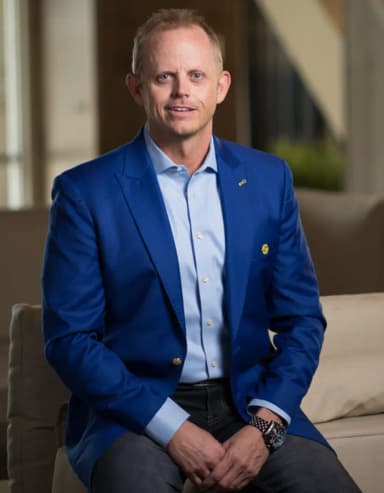
All right, welcome back to The Daily Mastermind, George Wright III with your daily dose of inspiration, motivation, and education. And I want to start out by asking you a question. What if being wealthy is not the same thing as having money? Think about that for a minute. Most people define success by income, lifestyle, or even net worth. but decades of research show that many people who look wealthy never really experience true prosperity. Think about that for a minute. Today I want to share with you a powerful idea from one of the most respected researchers on wealth in the world and then we're going to dive into some content. The insights that you're going to hear are from Dr. William D. Danko. He's a friend of mine, someone I've known for quite a long time. He's the co-author of the New York Times best-selling book, The Millionaire Next Door, and also the author of Richer Than a Millionaire, a book focused on prosperity, meaning, and legacy. He's a renowned researcher who studied how ordinary people actually built wealth and a professor emeritus with decades of empirical data, not just opinions. So he's not a motivational speaker. He's a researcher who followed the data, and the data tells a very different story about wealth, which I think you're really going to enjoy. Now, I sat down with Dr. Danko on the Franklin Planner podcast, and we had a pretty good conversation that went way beyond money. We talked about discipline. We talked about frugality. We talked about intentional living. But one idea stood out above all of the others. True wealth, real prosperity, requires more than accumulation. It requires character, restraint, and generosity. And the belief, you know, it doesn't come from theory. It comes from living and lived experience of thousands of people that have been researched. And in this moment that I'm going to share with you, I'm going to share with you an excerpt from the interview I did with Dr. Danko. This one refers to references from Benjamin Franklin's essay, The Way to Wealth, which was written as far back as 1758. Franklin argued that no matter how disciplined and successful you are, you don't truly have wealth unless you are charitable. And Dr. Danko explains how caring for his brother, who is paraplegic, and choosing sacrifice over convenience completely reshaped his understanding of prosperity, and he will go on to talk to you even more about what will happen and how you create true wealth. And then this clip I'm going to share from you from the Franklin Planner podcast, he explains why wealth without generosity is not complete and how intentional sacrifice leads to true prosperity. So I'm going to play this clip for you now, and then I'll come back at the end of this. The Millionaire Next Door gives the outline and philosophy of how to build wealth. But to really have true wealth, you must be charitable. And where did I get that idea from? Well, dealing with my brother, and no doubt our friends in the Franklin planning business have this very short 3,500-word essay from Benjamin Franklin, Richard Saunders, A Way to Wealth, written in 1758. And in this essay, he says, no matter how frugal and prudent and focused and industrious you may be, you do not have true wealth unless you are charitable. and that really was profound you know because again getting back to my brother I would hire health care aides on his behalf and that generally worked but Friday Saturdays and Sundays for a 20-year period I was basically under house arrest I was the aide and that's when I said, look, I got to get rid of my Mercedes. I bought a wheelchair van, and that really opened up a lot of horizons for him and me. And quite frankly, I got really great parking. There's an upside to that. Really great parking. But I would do it again in a heartbeat. but during those periods when i would be the number one guy caring for him uh we would talk about life you know because look we came from the same genetic stock and here i am a best-selling author phd you know world traveler and doing all sorts of great things and here's a guy who couldn't even scratch his nose and, uh, yeah, I did it, did a total care, but anyway, he was still pretty articulate. He was a college graduate and we would talk about what's it all about, you know, hand. Yeah. What's crazy is your background. Uh, and the reason I started with that, just to give the context for our listeners, I want to talk about three core things today. You wrote this multiple New York Times bestselling book co this book The Millionaire Next Door which talks about building wealth And then you have a core concept that I really love about the golden rule and really you know ways that you can create a pathway to true prosperity And you then co-authored this final book called Richer Than a Millionaire, which really talks about what's more important, right? So I want to break all three of those down, but I believe that they all came from this foundation of background that you had. Would you agree? Yeah, yeah, yeah, they really did. You know, I've always been a pretty good student. And again, some of the advice my mother gave me in my very young years, because my father only had a 10th grade education and my mother was a high school graduate. And my mother said, Bill, stay in school. And I took her literally. I never left because when I went to the university, that's where I met Tom Stanley. I was one of his students in a consumer behavior class. And that marketing course really opened my eyes to the power of marketing because it talked about, you know, anthropology, sociology, psychology, and the whole milieu of what it means to be a customer. And how do you understand the needs of a customer and therefore meet their needs and add a profit, you know, the whole idea of marketing, right? Yeah. Yeah. And so that one course, well, Tom Stanley, he was he didn't even have his PhD yet when he taught that course you know he was ABD all the dissertation but he really opened some people call it all but dead too no but no but all the dissertation but he finally he saw my work ethic and I mean I happened to get an A in his class but he invited me after that class to participate in his very first study of the affluent market. So it really started in 1973, the in earnest, you know, doing questionnaire surveys and so forth. And then he went on to another school, but he encouraged me to get my PhD, and I did at Rensselaer Polytechnic Institute, and came back to the faculty at the State University of New York at Albany. And I was there for 31 years. So I never left school. Well, and look, I mean, you've had decades and decades of research. And you and I have known each other for quite a while. Yeah, at least 20 years, at least. Yeah, I mean, geez. Let's break down the millionaire next story. You know, this is, look, let's say 25 years later, decades of research. What would you say are the core habits of ordinary millionaires that still hold true today? And let's talk just a minute about that book. Yeah. And The Millionaire Next Door, it really comes down to the basic mantra of when you're young, you work for money. And when you're old, money works for you. And so what you need is an entrepreneurial spirit that really helps. and get this mechanism for creating income. And once you have the income, you get it through your head that I have to be a saver. And when you're a saver, it means you're frugal. And this is so easy when you're in graduate school, if you just act like a graduate assistant for a big portion of your life and not have a flamboyant lifestyle, It can really help build wealth. And, you know, so from my own personal perspective, you know, yes, I've been extremely successful because I always lived like a graduate assistant in so many ways. You know, buying used cars and being a saver. and the rewards were I was able to get my three kids who are all in their 40s now, get them out of college debt-free, help them launch their careers. One of my sons is a PhD mechanical engineer. My daughter is a PhD mathematician, faculty member at a university. And another son is a computer systems analyst with a major aerospace company. and so they all have successful careers because and i love it when my daughter once said when she was getting her phd i said christy why in the world are you putting yourself through this i mean she has three kids also she goes dad i saw you do it i can do it so intentional living bottles yeah parents are role models that's for sure and they're watching what you're doing. And when, so yeah. But you're talking about these common habits of ordinary millionaires, right? Frugality, early savings, avoiding lifestyle inflation, that type of thing. That's right. And this idea of being directed, you know, having a focus, you know, like staying in school, building a career and creating this consistent flow of money that you can then invest across a diverse set of assets and, well, successfully. Well, and I think that right now it's more applicable than ever, and that's why I was going to ask, you talk a lot about, talking about the average person now, right? We have listeners that are seniors We have listeners that are younger But you talk about a common theme that I wanted you to just you know bring some value to And that is this idea of self economic scarcity and intentional living. And I bring it up because with Franklin Planner, we talk about lead your life and a lifestyle of planning and stewardship and long-term thinking. How does self-imposed economic scarcity, which is a common theme of the book, apply today and to these principles you're talking about. Yeah. It applies more than ever because what we have is a society. First, I love America and I love our Western values, but we have such a consumer-driven economy and we have this bigger, faster, better mentality. We need a new car every couple of years. No, you don't. You know, let me repent on one of my sins right here. You see my $40,000 Rolex? They say, well, how can that be $40,000 of stainless steel? Let me tell you the story. It reminds me every day about what a dumb decision it was to buy this in 1993. I was doing a seminar in Zurich, Switzerland. And after the seminar, I was walking down the Bahnhofstrasse with some of my students. we go past a jewelry store and I said, you know, I need a Rolex. You know, I had a pocket full of Swiss francs. I was young. I was wild. 1993. Gosh. But less than $2,000, I bought it. And why did I call this a $40,000 watch? Because over the next 25 years or so, from 1993 to last December, had you put this, had I put this into a, just an S&P 500, 10% growth account, it would be worth over $40,000 today. So. So it's a $40,000 bad decision, truly. Yeah. Yeah. But it's your mindset, right? I mean, look, people, people need to, to realize that how you view your life, if you're leading your life and you're being in control of what you're trying to create in prosperity in your family and things like this. Every decision has consequences, but also every decision has a return, right? It does. I mean, I look cool, right? 40,000. And when I got home in 1993, my wife said, you did what? So I had to put up with a little bit of the static, but it's been a very reliable wristwatch. I'm glad I have it. It reminds me about that principle of living below your means and having a better use for your money. You know, my physician, I saw him a couple of weeks ago. He says, you know, because he's read The Millionaire Next Door, and he said because of that book, he moved out of a high-end neighborhood in New York, and he moved to a more, what you might call an upper blue-collar type neighborhood because he says, you know, they're just regular people. Yes, he makes a very good income, but he doesn't want his kids to be brought up in this. I need more because all my friends have more. Yeah, it's a great, it's a great philosophy to not only talk about, but to show that your actions, whether you're older with children, and that's why I say, you know, we have a lot of our listeners that have kids and grandkids and the examples and things that are set, not just for them, but their way. And this common theme of self-imposed economic scarcity is so key, right? But I also like, go ahead. No, well, with the kids and the grandkids, there's one of the key chapters in The Millionaire Next Door is about economic outpatient care, about how you subsidize your adult children, because they get kind of used to these yearly gifts. And you create a cycle of dependency. You think you're doing them a favor by easing the burden, but they have to struggle a little bit as well. I'm generous with the kids, but they don't ask me for money. And they don't know when the generosity is going to occur either. And so they can't count on it. by dialing. Well, it's important though, that if we're being intentional and we're trying to create impact and legacy, it's important to have these key rules. And it leads me to the other one I wanted to talk about, which is, you know, the golden rule. And I love how you referred back to Benjamin Franklin and, you know, a way to wealth, but, you know, a pathway to wealth and wellbeing, this idea of the golden rule, you know, your research shows that the golden rule, loving your neighbors yourself is not only a moral principle, but it correlates with greater prosperity as well. How does that, how does the data support that? Yeah. Well, in richer than a millionaire and other empirical study that I do with my colleague, Rich Van Ness, we're both emeritus professors and we have oceans of free time. But really, it wasn't until when my brother died in 2015 then I really had lots of more free time to devote to the book. And the book came out in 2017. But the basic concept of it, it was based on discussions of, you know, look personally I have taught over 10 students in 15 blocks over a 31 period And uh yeah I got to know a lot of them you know quite in depth And when I look at their struggles about what do they want to do for a career and how like there are like a drift on the high fleas of life, you know, not knowing what direction to take. that really helped motivate the book again along with franklin's you know thinking uh in the way to wealth about you must be charitable and it and that became the basis of the of course the golden rule award i created named after my parents and now it's been uh 25 years in the making it started in 2001 and most recent reward award last week or two weeks ago was given out and what i'm trying to do is encourage students to be recognized for being generous with their time it's not based on grade point average it's not based on money well although they do get it's a two thousand dollar scholarship, but nevertheless, half of it goes to a charity of their choice and half goes to their tuition payments. It's just a mechanism for me to encourage this idea of the golden rule and being a giver instead of just a taker all the time. So I'm just trying, my one small part of the universe, I'm trying to encourage at least 25 students. But it goes on every year. I'm still on the committee that selects. But this idea of the economic outpatient care, look, especially Appendix 3 of The Millionaire Next Door gives a litany of about 150 job titles of people who have become very wealthy doing ordinary things, be it farming, being a mechanic, being an attorney, being a university professor. There's no such thing as a bad job. I think Earl Nightingale once said that. There's no such thing as a bad job. If you put your heart and soul into it, you can really develop it and become kind of the leader in that particular sphere. So once the parents make this money, there are four things they can do with it towards the end. What are they going to do? Spend more on themselves? No, they already have a frugal lifestyle. Are they going to give it to their kids? Oh, my gosh. And deaden their senses and let them think, you know, look, they were born on third base and all they have to do is just enjoy this gift or die with a huge estate tax. That's no fun either. But the fourth thing that's logical is that you can be charitable with your money. All right. I hope you enjoyed that audio. So, you know, this insight is so powerful. Dr. Danko reminds us that wealth is not about appearances. It's about how you live, how you give, and what you leave behind. And, you know, true prosperity really must include living below your means, avoiding lifestyle inflation, being intentional with your money, and understanding that every financial decision has long-term consequences. Wealth isn't just what you accumulate. It's what your money allows you to become. and how it serves other people. So what you just heard is just only a short part of the moment that had a lot more deeper content and meaning in the conversation that we have. And if you want to hear the full interview, the full conversation, which goes through the habits of ordinary millionaires, why self-implosed restraints create freedom, and how generosity can play a role in long-term prosperity, I'm going to put a link in the show notes, and I encourage you to go check out the full interview with Dr. William Danko on the Franklin Planner podcast. You can find it right now on your favorite platform, pretty much every platform. And before we go, I want to just express a little bit of gratitude. We have been climbing the charts like crazy, and it's because of you, the listener, that we're doing so well. You know, in the top 30 on business entrepreneurship on Apple charts, we now have a couple of top podcasts, the Daily Mastermind and the Franklin Planner podcast in the top 100 on Apple. There's tens of thousands of podcasts there. So here's what I want to say. I appreciate you. I know that you have amazing talents. No matter who you are, if you're listening to this podcast, you are supporting the show, but you are also showing that you're willing to take some initiative. You know, the reason I started the Daily Mastermind is to create a mastermind for individuals just like yourself that want to build and develop and grow their mind, body, money, business, and lifestyle. And so I want to just ask you, are you building wealth? Are you building a life? Thank you for listening to the show. Do me a favor and share this show. But also hit me up on The Daily Mastermind and let me know what you're working on. I want to challenge you to reach out to me. I want to challenge you, tag me on The Daily Mastermind or contact me directly. I challenge you to reach out so that I can do things to be able to help you and I can do things to be able to help take your business and life to the next level. Have an amazing day, and I'll talk with you soon.