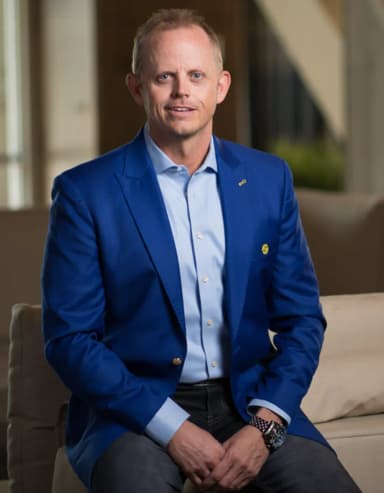
Welcome back to The Daily Mastermind, George Wright III with your daily dose of inspiration, motivation, and education. And today we're going to be talking clarity and strategy. I've got a great guest on with me, Lee Kragian. How are you doing today? I'm doing great. How are you, George? Good, good. Listen, Lee and I met at a board of advisors mastermind. This guy has a lot of things going on. I want to give you a little bit of an introduction, but today we're going to be sharing some really good business strategies. So I think you guys might want to, you know, grab a pen and paper, but just to give you a little bit of background on Lee's the co-founder of Encompass Pay. He helps businesses recover lost revenue from credit card processing, but he works with companies, you know, millions of dollars in revenue, helps them to increase their margins without raising prices or selling more. And, you know, he oversees a nine figure payment portfolio with clients saving millions and millions of dollars. In fact, some of them exceeding 15 million annually. But he's a specialist in compliance systems and he's known for simplifying the whole process and the idea of how to create actionable steps to be able to increase the revenue for your business. So Lee, I'm really excited to have you here. And what I would love for you to do is just real quick, help us to understand how you got into this field. What brought you into this category? Because you've had a lot of business experience. You've got a lot of success. Why is this your focus right now? It was a natural extension to a company that I've been running for 30 years, which is Alternative Capital Solutions. And we were in the consumer finance business and still are to this day. But payments are far more ubiquitous than niche consumer financing products. And it was a natural extension. A lot of my existing clients are now, in addition to being consumer finance companies, that I do business. George, help me. You can edit this out. I screwed up a little. It's all good. Yeah, just keep going. Keep going through it. So a lot of my consumer financing companies are potential candidates for encompass pay as well. Yeah, and you know what I find is interesting, and you kind of helped me to bring this to my awareness. And one of the reasons I wanted to highlight you on the mastermind is a lot of entrepreneurs might be doing a ton of volume, but they think they need more revenue. And, you know, but you say that they're maybe losing three to five percent already. So help me to break down why this is something that they need to look at. You know, this idea of profit leakage and this area of finding hidden revenue. I think in 2026, people are becoming more and more familiar with companies that are placing a surcharge. That is the industry term. It's called surcharging. When you go to use your credit card to buy their goods or services. One of the simplest ways of mentioning this is like gas stations. You'll see a lot of gas stations that have a cash price and then they have a credit price. And there's usually a 10 to 20 cent disparity between those two prices. So what's the oil company basically saying? Hey, if you want to use your credit card, we don't have the margins to no longer sponsor your points, miles, or cash back. So they're flipping the paradigm and they're saving boatloads of money by instituting what we've trademarked as fair charging, but what the industry calls surcharging. So this is an opportunity hidden inside businesses that might be processing millions and millions of dollars where they could be. And is it, Lee, isn't it kind of a paradigm shift though? Don't a lot of businesses feel like, oh, I can't pass those costs on to my customers. And yet they just are eating those costs, right? So is it hard for business owners and entrepreneurs to wrap their head around that? Sometimes, but in reality, they might say, well, we'll just raise our prices to cover that. Now they're sort of penalizing the people that are paying cash check, debit or ACH and not credit card. Yeah. Yeah. And in a sense, they do. They just raise their prices. And yet that's not really a most effective way. Now you've been doing this. How long have you been doing this with fair charging? Five years. And so you've had some unbelievable successes with companies. Who are the types of companies that you're working with right now? So we've targeted private equity because their portfolio companies are processing tens of millions, hundreds of millions of dollars worth of volume every month. And they're just losing a lot of revenue that this simple paradigm shift would solve. But why are businesses, and I'm hoping as our listeners listen to this, why are these problems going unnoticed? Why are they ignoring them? Why are they not trying to find the solution? Is it just that they have other things on their mind? They don't recognize the simplicity of it. What has been the biggest challenge with businesses adopting a philosophy like this? Well, I think it's become more and more commonplace over the last four or five years. Certainly when I got into the business five years ago, it was more of an anomaly. Now, it seems like everywhere you go in the course of a day, I bet you if you bought four or five things on your credit card, whether it was at the coffee shop, the auto repair, wherever you might spend money, I think you'll notice that a lot of companies are surcharging, that doesn't mean they're doing it legally and compliantly. And that's a big deal. Rule number one is you cannot surcharge a debit card. And what's interesting, I want to actually dig into the legal compliance part of this, but I wanted to ask you a couple other questions for people that might be listening to this and saying, okay, I get it because you're right. You don't even question if charges are getting added for hotel rooms, for even average stuff like prices at gas. Now, you expect the sign to change prices for cash or not And so we do know this but we haven implemented it And it does take a little bit of a paradigm shift So at what revenue does this start to impact a business Is there a certain level where you know you considerably losing money or whether you want to a certain level where you want to implement these types of strategies or is it at all levels? I mean, it's all levels. We're not really targeting, like take for instance, a restaurant, maybe they're doing 50 or a hundred thousand dollars a month. That's not really our target audience. Plus there's companies like Toast and that focus on the hospitality. industry. So we're pretty selective about who we're going after. And we're typically going after companies that are doing at least millions of dollars worth of processing, if not tens of millions, hundreds of millions, and in some cases, billions of dollars worth of processing. Because this is something that you can initiate. I mean, I don't want to say immediate, immediate opportunity for them, but it's a fairly quick process, right? 100%. And there's nothing that they could do. They could hire a new sales team, They could have a new marketing initiative. They could create all new collateral. But there's nothing they could do to shift this paradigm so quickly and drop lots of money onto their EBITDA by just flipping this paradigm. Yeah, I think you just said it really eloquently, and that is most businesses are trying to do the heavy lift. I'm going to hire more salespeople. I'm going to increase my pricing. I'm going to do all these things to create more revenue or EBITDA. But at the end of the day, there's a very simple solution. So let's talk about why most people aren't doing it the right way or how they can get into trouble because you mentioned legal and compliance when it comes to this whole approach. What is the problem that most businesses are doing that you're trying to solve? The legal and compliance, rule number one, as I mentioned earlier, is you cannot surcharge a debit card. So a lot of times, and I know I've had this happen personally and probably you and your listeners have as well. You have somebody come to your house. They fixed your drain. They've opened it up. It's 200 bucks. You hand them your card and he says, hey, Lee, can't you write me a check or give me cash? I'm going to have to go out to the car and get my reader. And I'm going to have to charge you a $10 fee for processing your credit card. He's already breaking laws that he doesn't even know exists. And $10 on a $200 charge is not, the maximum is 3%. That exceeds the maximum. What if I gave him my debit card instead of my credit card? He doesn't really differentiate between the two. So again, they're just breaking laws. They don't even know exist. And you've tried to, with your model, help to overcome these, and we can dig into more of those, but walk us through your fair charging model. Just walk us through in simple terms how it actually works, how you apply it, implement it into a business. So we're no different than the processing relationship that you already have. We are, you're a merchant processor. If you want to adopt fair charging, you would come join Encompass Pay. We would set you up with a new merchant account. But this merchant account is going to charge you a half a basis point, excuse me, 50 basis points for credit, whereas you're probably paying Stripe 3% or more for that same transaction. Yeah, and at the end of the day, that's one of the things I wanted to kind of highlight in this conversation as well. because most business owners, they're so busy, focused on growing their business, they don't think through these little pieces. And as you've identified, these little pieces add up to, in some cases, millions and millions of dollars. You've had that happen with multiple clients. So once you incorporate a merchant account and save them money, obviously, from that standpoint, how do you recommend a business incorporates the surcharges or the fair charging to their client base if they're not doing it right now? Well, typically we'll ask for a statement from their existing merchant processor. In 24 hours, we'll do a deep dive and an analysis on that statement. And side by side, we'll show them down to two decimal points that based on the volume that this statement that they've just presented to us is articulating, that we would save them $16,487.92. I mean, that specific. So it's usually if we can get our hands on a statement, that's the holy grail. So having that analysis kind of helps a company to recognize and identify the opportunity prior to even implementing the strategies, right? 100%. We want to be as transparent as possible. And that's our value prop. So why wouldn't we want to articulate that? Provide a side-by-side analysis so they can see exactly not what they think they're paying, but what they're actually paying. because there's usually a disparity in the merchant's mind as to, oh, yeah, we're paying 2.54. In reality, they're not paying 2.54, but we'll articulate that for them. We'll also tell them what their debit to credit ratio is. So we'll provide a lot of information that they probably don't know off the top of their head. Give me an example of when you say most business owners don't really know what they're paying because they do think like, okay, I know I'm getting charged this by Stripe or whatever. When you say they're not really paying that, what does that mean? There's other charges. So that it's sort of like your APR, you know, in a mortgage, you might have a 4% APR, but your actual rate is higher because they're blending in all the other ancillary fees. So it's not really four, it's 4.36 or something like that. Yeah. And like anything else, not just from a pure cashflow and revenue standpoint, but compounded over time, this adds up quite a bit. And it's interesting to me how, I mean, I think it's maybe no different than most things in life. Most people don't look at the detail. And I found the most successful people do manage the detail because over time it compounds. You've even mentioned that you've helped companies recover millions. Can you give us examples of and maybe you can or can with the business name but can you give us examples of how you done that for companies Sure I can say names but we had one of the largest private equity companies that we worked with They had one of their portfolio companies doing 600 million in processing We showed them where they could drop 14 to $15 million under their EBITDA. After about four to five months of hand wringing and nail biting, and the sky is going to fall, none of which happened. They finally adopted it. And in fact, they did drop somewhere upwards of $15 million onto their EBITDA, which gave the private equity company pause to say, geez, who else do we have in our portfolio? They brought another company doing about $800 to $900 million in processing, dropped about $19 million onto their EBITDA year one. And now the same private equity company has subsequently brought multiple other portfolio companies of theirs. And let's say they're coming to buy your company and you're a hundred million dollars SAS company and you're paying Stripe 3%. They know that they can flip this paradigm tomorrow. They're paying you 8X for your company. And what do they just do? They buy your company, they pay you the 8X, they implement fair charging, they drop 2 million, 2.5 million onto their EBITDA. They just created $16 million in enterprise value just by flipping that paradigm. Wow. Yeah, it is interesting to me. the, and this comes back to your knowledge, right? You've been around businesses long enough to know that it's not just simply creating or finding revenue or profit linkage. It becomes a multiple, especially if you're looking at exits, especially if you're looking to, you know, finance new growth, any of those types of things are directly affected by this in a multiplier, not just simply finding revenue. So if someone's doing, let's say, north of a million dollars in revenue in their business, what are the first signs that they have that they're leaking some profit? Where do they look? I mean, where we would look is their merchant processing statement, because I don't know the nature of a specific business until, I mean, it could be mostly cash. It just really depends on the nature of the business. But that holy grail is really their existing merchant processor statement. And we can glean a lot of information and provide a detailed analysis, again, down to two decimal points as to what they would save every month based on this volume that they presented to us. Yeah, it's interesting as you and I have had conversations, it's made me think a little bit differently on how I view payments because most view it as a cost. You tend to look through the lens, wouldn't you agree of it being a strategic profit center versus just a cost? A hundred percent. I mean, most businesses are looking at it at a cost and that's what fair charging does is articulate that it's not a cost unless you make it one. It doesn't have to be. Yeah. So I'm curious because, Lee, I want to kind of shift gears just a little bit. You've got this amazing experience with business. You've done, you know, you own several companies. You do a lot of things. You also are part of a lot of networks and you have some really good connections. what are some of the trends that you're seeing in business right now? Is there anything, and I'm leaving this kind of general for a reason, is there anything you're starting to notice about businesses? Because I always find that processors like yourself have a unique perspective because not only are, you know, zeroed in on helping companies to save and increase their, you know, drop their expenses, increase their profit. You also see what's working and you see where people are struggling and where challenges are happening. What are some trends that you're seeing in the marketplace right now? Has anything come to mind? Nothing really. But I think that the fact that a business has this opportunity, once they understand it and they get a clear sense as to what implementation would look like, it's not hard. I mean, this isn't brain surgery. We're just merchant processors, but we do have a unique value proposition. And I think more and more companies, and I think COVID expedited this. Again, five, six, seven years ago, Fair charging didn't even exist because we hadn't trademarked it yet. But surcharging was this industry term, and it sounded very punitive, and very few companies were afraid to adopt it. Now it's become less and less so. COVID expedited that. And as I said earlier, I mean, you'd be hard-pressed to go out, spend a day out, and about use your credit card four or five times and not get hit with at least one surcharge within the course of the day. And even though that's the case, I'm curious because now you've gone through this process with so many different companies. You mentioned the private equity group that right off the bat, you were able to show a huge value and yet it took tons and tons of effort to get them to finally adopt. what do you, we know why we know businesses don't like to change what they're doing, but what are some of the ways that you are able to get businesses over that hump? Because it is, I like how you use the term paradigm because it really is a mental block. It's not an operational block because it's not a difficult thing to implement. How do you help businesses get past that mental block? Like what are some of the ways you've been able to do that? The Holy grail is the statement. And once somebody is looking at two things side by side, and you're actually showing down to two decimal points how much they're going to save. We've all heard in sports, you can't coach speed, you can't coach height. I can't coach this. I mean, black and white is black and white. You either get it or you don't. I mean, I don't know how else to describe it, but it's that transparent and it's that profound. I guess it does boil down to finding specific, tangible ways for someone to go, okay, when you see the forest through the trees here, it's very black and white. And it's also the audience we're speaking to, George. If we're speaking to the CFO, whose bottom line is his domain and responsibility, I mean, they're going to be a lot more open to this than maybe the sales manager. Oh, no, people aren't going to buy from us if we do this. So it important that we speak to the right audience And you know the C usually a great place to start And the CFO if we had to pick one person it be either the CFO or the CEO Because even though generally, you know, a CFO or legal doesn't, you know, they're not the best to make business decisions. I think you're right. It's like anything else in success. When you identify a problem, you make a decision and then you go figure it out after. It's different than trying to figure out all of the detail before you make a decision. And so when it comes from the top down, it definitely happens. What is your future vision of what you want to try to accomplish with Encompass Pay? I'm curious where you're planning to take this and what the goals of the company are. On the beauty of this business and why I like it so much, it's infinitely scalable. I mean, I could sign up Uber today and Airbnb tomorrow and they'd say, hey, Lee, great job. what else you got in your pipeline. So it's ubiquitous in nature, infinitely scalable. And I know the impact is profound. So it's fun to shake things up a little and be a little bit of a maverick, if you will. It's interesting, even Stripe, as an example, as big as they are, they do not have a legal and compliance or charging program, which boggles my mind, but it is what it is. And that plays to our advantage, not to our disadvantage. and I yeah no I hear that and I think just adding like I went to this conference a number of years ago was an Elevon conference and they're one of the biggest processors on the planet certainly in the top five and I was sitting at a table and I was people were introducing themselves and I said hey I'm Lee Cragen and I came here to learn about surcharging and I was immediately I don't want to say ostracized but I was certainly the red-headed stepchild like this business and this industry is pretty staid and there's not a lot of forward-thinking people in it. And I'm not trying to generalize, but going to a conference, being one of 12 people, I was the only guy that raised his hand that said I was here to learn about surcharging. They had one half hour segment in the whole day and a half on surcharging. So it's just not that adopted by the industry in general and I still can't figure out why. You know, one piece of feedback from outside looking in, I think it's very similar to several things like taxes and estate planning and structuring entities. Most people are like, ah, you know, it sounds like a lot of work. I don't know how to benefit, but the super successful and the ultra high net worth, they prioritize simple systems that are scalable and duplicatable because they recognize the compound effects on their business. You know, 2%, 3% for that entrepreneur or business owner, CEO chasing shiny objects or getting excited about the attention his business has doesn't seem like a lot. But the truly successful CEO knows that 2% and 3% and 4% and 5% compound over time and that if your business isn't built on that foundation, you are missing. You know, keeping more of what you already make is way easier than making more. It really is. Couldn't agree with you more. I think that's just the law of success, right? So I wanted to ask you this question before we take off, because I've seen what you do and how you do it and the groups and the circles that you travel in. You seem to prioritize masterminds and you seem to prioritize your network. And our whole purpose of the Daily Mastermind is clarity, focus, and discipline for entrepreneurs, founders, and business owners. Why do you prioritize masterminds and networks and relationships like you do? I'm a firm believer that nothing happens without relationship. It's the foundation for everything, business, personal, or otherwise. And I've also heard, and I don't know, I'm quoting somebody, I'm not sure who, but your network is your net worth. So I love going to events. I love connecting with people. And if there's a good fit, let's do it. And if there's not, that's okay too. I mean, that's why they make chocolate vanilla and all those other flavors, something for everybody. Yeah. And I noticed that about you and a lot of successful individuals is that they're not in it for with them, you know, for what's in it for me. They're in it for the relationship and the network. And they know that opportunities come because of that, not the other way around. You don't get value and then create opportunity. You create relationships. So I appreciate you saying that. And I really am glad you're here because this is a topic that I think if business owners would put a little more attention in, they would get far more value. So where can people connect with you, you personally or whatever? or your business, where's the best place for them to go learn more about, you know, fair charging? Encompasspay.com. And my email address is Lee at Encompasspay.com. And my phone number is 760-271-6472. Great. I'll tell you what, we'll probably bleep out your number because you'll probably get too many phone calls, but this just shows you guys what kind of guy Lee is. I mean, he wants to help. He wants to create value. And I really do appreciate you being here. And for those of you listening for the first time, make sure you go subscribe to the podcast. You don't miss any episodes. But do me a favor and just share this show. If you've gotten any nuggets of information out of this, you feel benefit you or got you thinking a little bit differently, shifting your paradigm about processing and money and systems in your business, which I will double down on this idea that successful people don't focus on the expenses. They focus on the opportunities and the revenue and things like that. So that's what we're trying to accomplish here. But do me a favor and share the show and then let us know what you're dealing with, what you're working on. We want to celebrate your wins. We want to help you with your problems and your challenges. So hit me up on The Daily Mastermind on Facebook, Instagram, pretty much anywhere. And I'll look forward to talking with you soon. Once again, thanks for listening to The Mastermind. You've been hanging out with George Wright and Lee, and I appreciate you being here. Have a great day. Thank you.