The Daily Mastermind
ALL EPISODES
Episode 345 · Mar 2, 2021

How to Change Your Paradigm on Failure, Courage, and Action

Listen

George Wright III opens this episode of The Daily Mastermind with a set of insights he captured while listening to an interview with Marc Randolph, co-founder of Netflix. What he scribbled down that day became a framework for rethinking how you approach fear, failure, and the advantages you may not realize you already have.

The ideas are not abstract. They are practical filters you can apply to your business, your mindset, and your day right now.

Why Blockbuster Failed (and What It Means for You)

One of the most striking points George shares is the real reason Blockbuster lost to Netflix. It was not that Blockbuster failed to see what was coming. Marc Randolph's take cuts through the usual narrative:

They lacked the courage to take action.

Blockbuster knew exactly what was happening. The problem was that moving to streaming would have hurt their existing store business, upset vendor relationships, and disrupted Hollywood deals. They chose self-protection over bold action, and that choice cost them everything.

The lesson is direct: knowing the right step and refusing to take it is still a failure of courage, not a failure of knowledge.

The Entrepreneur's Hidden Advantage

George uses the Blockbuster story to make a second point that every small business owner needs to hear. The things you think are weaknesses are actually strengths. Large companies are slow. They protect existing revenue streams. They cannot afford to upset partners or pivot quickly.

You can.

Being small and nimble means you can take the risks that large organizations are structurally unable to take. The next time you feel discouraged because you lack the budget or team of a bigger competitor, flip the perspective: your size is an advantage. Your willingness to move fast and accept risk is something no amount of capital can fully replicate.

Stop Falling in Love with Your Ideas

George identifies what he calls the key insight from Marc Randolph: most entrepreneurs fall in love with their ideas. And ideas, by themselves, count for nothing.

You have never found a super successful company that has become successful because of their idea, because the ideas always take a path that's windy and up and down.

Facebook, Google, Netflix itself: none of them succeeded because they got the original idea exactly right. They succeeded because they were willing to act, adapt, and keep moving regardless of where the path led. The idea was just the starting point, not the destination.

Letting go of attachment to a single idea is not giving up. It is the move that keeps you in the game long enough to find what actually works.

Fall in Love with the Problem Instead

Rather than managing failure or protecting a favorite idea, the framework George takes away from Marc Randolph is to fall in love with the problem you are trying to solve. When you are obsessed with the problem, every attempt becomes a data point rather than a defeat.

George reinforces this with the example of Thomas Edison, who never described a thousand failures in creating the light bulb. He described a thousand ways it did not work. That reframe changes everything about how you show up each day.

I'd like to focus on the problem I'm trying to create a solution for. And then the things that you do are just trial and error along the way.

When the problem is your North Star, the specific ideas you test are experiments, not bets. You stay objective. You stay open. You stay in motion.

How to Break Through Paralysis and Take Action

George closes with what he calls Marc Randolph's most direct piece of advice: break down and do it. Whatever your idea is, test it as quickly, as cheaply, and as thoroughly as you can. The principle of failing five times faster is not a cliche here; it is a practical directive.

Paralysis often comes from over-investment in a vision. You become so attached to how you imagine the outcome that you cannot tolerate a path that looks different. Releasing that attachment does not weaken your pursuit. It frees you to take the action that will actually move you forward.

Action Steps

  • Identify one decision you already know you need to make and ask honestly whether fear or comfort is the real reason you have not acted yet.
  • Write down the core problem your business or idea is trying to solve. Keep that statement visible and use it to evaluate every next move.
  • Run a small, low-cost test on your current idea rather than waiting until conditions feel perfect.
  • Stop measuring progress by how well you preserve a single idea. Measure it by how much you have learned about the problem.
  • Remind yourself daily that being a small entrepreneur is a structural advantage, not a handicap. Use it.

Changing your paradigm is not a one-time event. It is a daily discipline of choosing courage, releasing attachment to ideas, and staying focused on the problem worth solving. It is never too late to start living the life you were meant to live.
READ THE FULL TRANSCRIPT

Welcome back to the Daily Mastermind, George Wright III with your daily dose of inspiration, motivation, and education. I'm excited to be with you today. We have so many things that have been going on, and I hope you're having an amazing day. I want to start you out with the Daily Mastermind mobile app quote of the day. So if you haven't downloaded the mobile app, I'd encourage you to do that. Troy's been filling that with quotes and some great 4K picks, and so those are things you can share on social media as well. The quote of the day today is by Grant Frazier, and it says, Life is full of obstacle illusions. Let me say that again so you can catch it. Life is full of obstacle illusions. I love that because that's exactly what life is full of. Today I wanted to share a thought with you. I know we do that every day, But I was listening to a great podcast today. I listened to Ed Milet's podcast on occasion, and I was listening to him interview one of the CEO, well, the CEO of Netflix, who was a co-founder of Netflix. And he was talking about some things that I started scribbling down notes furiously, and I thought, man, I got to share some of those ideas and those thoughts with you, because I think it's so important that when you learn things, that not only you learn them, but you teach them. And on top of teaching them, you also really internalize them into your life. And so as I was listening to this interview with Mark Randolph, who is the CEO of Netflix, and by the way, Netflix has now 200 million global subscribers, 200 million subscribers, and they're over a $250 billion valuation. So these guys know what's going on. Obviously, there's probably nobody listening to this that doesn't either subscribe or use Netflix for sure. But there were some big takeaways I had, and I loved his perspective, so I'd encourage you to maybe check him out. He talked about various ideas I wrote down, like changing your paradigm. For example people used to always ask him you know what do you think Do you think you know Blockbuster versus Netflix Did Blockbuster really miss out on the opportunity and did they just miss it Did they miss it or did they make bad decisions And I really liked Mark response because he said no I think they knew exactly what was happening and he said, and I thought this was great, but they lacked the courage to take action. They lacked the courage to take action. And I thought that was huge because so many of us lack courage, even though we know what answers we need to take and steps we need to take in our life. And when he said they lacked courage, it totally makes sense because as a big company, they would literally hurt their current store business by trying to move online. They might hurt their vendors. They might upset Hollywood or whatever it is. And because of that, they lacked the courage to take action. And that really brought me to the second thought that really hit hard for me, and that is, as an entrepreneur, that gives you a big advantage. We all know that it's the kid in his basement or somebody out of their garage that can now, with the power of social media and the internet, make a difference and literally overtake large companies. And that's for a couple of reasons. Number one, you're slow, you're nimble and small. Sorry, not slow, small and nimble. But also sometimes, you know, more of a risk taker, more willing to take risks. So this just is something that I think is important as far as a filter on your perspective in life. Because you might be thinking, man, I don't have all the money a big company does. I don't have all the advantages and resources. But what you need to realize is that is an advantage. It's all how you look at things. It is an advantage to be an entrepreneur. And I think that's a great reminder for those of you that are small that are saying, hey, it's just me. I don't have anybody helping me. Hey, that's when you can take risks. That's when you can really push things to the next level. But the key thought I want you to not lose here is be willing to take and have courage to take action. Another thought I wrote down is, you know, Ed had talked to Mark and said, how do you deal with failure? Because most people that are successful have had to have failures and how they deal with failure is an important thing that you can learn And when he asked this question I thought and I never heard a response like this I really enjoyed this about him. He said, I don't look at it as failure. He says, that question has always really eluded me, and that question has never really made sense to me because I don't view things as overcoming failures. You know, we always talk about on this podcast and others, you know, fail five times faster and look at failures as learning. He says, no, you have to change everything, your perspective on failure. And he went on to say, the problem with most entrepreneurs is they fall in love with ideas. And ideas don't count for anything. How many of us have had this great idea and we just knew we wanted to take it to the marketplace? We had this great idea we wanted to make happen. He says, I don't fall in love with ideas. You have never found a super successful company that has become successful because of their idea. because the ideas always take a path that's windy and up and down, whether it's Facebook, Google, any of these. None of them were able to predict where things were going to go. It wasn't their ideas. It was their willingness and ability to take action and move past their ideas. So he made a really interesting point, and this is a thought I want you to consider. Consider rather than falling in love with the process or rather than falling or changing your perspective to deal with failures, Fall in love with the problem. Because when you fall in love with the problem, the ideas just become ways for trial and error to create a solution. A great example of this is like Thomas Edison. Thomas Edison never talked about a thousand failures to create a light bulb. He talked about a thousand ways it didn't work. And so much like Mark did here from Netflix, he says, I really like to not focus as how am I to overcome failure. He says, I'd like to focus on the problem I'm trying and get obsessed and fall in love with the problem I'm trying to create a solution for. And then the things that you do are just trial and error along the way. And so that a great point if you really think about it And I just hammer it home with ideas don count for anything Ideas don count for anything And then the other thing he said is the key to success and this is a common message but this is one I want to end today with, is the key is to just break down and do it. Break down and do it. Whatever your idea is. So this follows up that thought he just had and I just talked about, which is just test ideas as quick and as fast and as hard and economically sound as you can because it's like many people say, fail five times faster, fail your way to success. Get through these trial and errors because that's what's going to help you to create the success that you're looking for. Don't let your vision of the idea you have or the vision of what you want to create paralyze you from taking action and blind you from being willing to be open to whatever path that you need to take. So those are just a couple of key thoughts. I really hope that you'll maybe check out that podcast, but I hope those are things that might help you. You need to think real hard about how you can change your paradigm on taking action. Make sure that you realize and recognize that there are advantages of being a small entrepreneur over a big business. Don't look at what you don't have. Look at what you do have. This nimble ability to take action and have courage. And then also, rather than looking at how to deal and overcome failure, fall in love with the problem. Fall in love with the process. Because the ideas, and by the way, don't get too attached to any one idea. Because that's going to be the death of your progress. So those are my thoughts for today. I'd like to encourage you to hit me up on the Daily Mastermind Instagram or Facebook and send me some feedback. Let me know what it is that I can help you with. What is it that I can do the most for you to help you make changes and really go to the next level? Because I would love to get you some contacts, go through some interviews, get you some resources, and we can do it right here on this podcast. So I hope that's a message that'll help you. I hope it's something that inspires you to take action. And I look forward to talking with you more tomorrow. Have an amazing day.

About the host
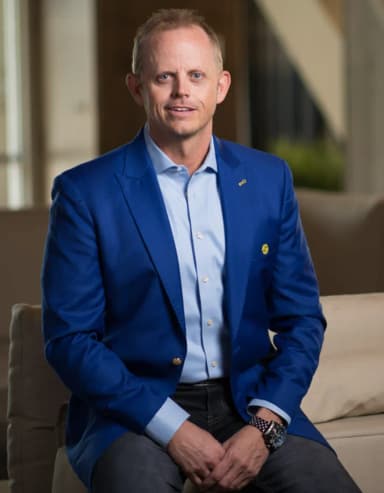
George Wright III, host of The Daily Mastermind

George Wright III

George Wright III is an entrepreneur, investor, and the host of The Daily Mastermind. Over more than two decades he has founded and scaled several multimillion-dollar companies and built a renowned seminar business that put some of the world's biggest names and brands on stage. With 25+ years across marketing, sales, and executive leadership, he's made a career of turning bold ideas into results — and momentum into lasting growth.

Today his mission is singular: empower driven entrepreneurs everywhere to master their mindset, unlock their potential, and live their ultimate destiny. Through The Daily Mastermind, George shares the Prosperity Principles and strategies that help people create massive change — in their business and in their life.

MORE ABOUT GEORGE