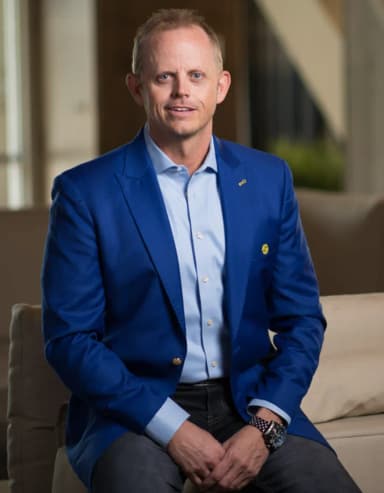
Everyone faces hard days. Whether you are dealing with work pressure, relationship strain, financial stress, or the simple weight of life not going the way you planned, the real question is not whether tough times will come. The question is how you show up when they do. In this episode of The Daily Mastermind, George Wright III walks you through a practical, grounded framework for pushing through difficult times, breaking out of victim thinking, and taking purposeful action even when you feel stuck.
George opens with a quote by Tony Robbins:
Whatever you focus on is what you get.
That single idea sets the tone for everything that follows. When life gets hard, most people focus on the problem. George argues that even your attempts to fix a problem can keep you anchored in the wrong mental state if your attention stays glued to what is broken rather than what is possible.
Why Most People Stay Stuck in Difficult Times
The biggest trap during hard times is playing the victim. It feels natural: something happened to you, it was unfair, and now you are reacting. But George points out that this reactive mode keeps you powerless. Drawing on a principle from Stephen Covey, he highlights the small but critical gap between stimulus and response. That gap is where your power lives.
Most people skip right over it. Something happens, and they immediately react from fear, frustration, or anxiety. The simple act of becoming aware that you have a choice in that gap changes everything.
How to Create Certainty in an Uncertain World
George's partner Robert Stubberg frames the core challenge clearly: your ability to deal with uncertainty is a direct measure of your success. But George takes it a step further. It is not just about tolerating uncertainty. It is about actively creating certainty for yourself when the world around you is unpredictable. That is the real edge.
This means operating from a mindset of abundance rather than scarcity. When you focus on problems, you contract. When you focus on solutions, you open up to possibilities that were always there.
The Step-by-Step Framework for Pushing Through
George lays out a clear sequence of steps that work for him and can work for you.
Take a step back. The moment you pause and acknowledge what is happening, you stop being a passive reactor and start becoming a conscious participant. Awareness is the first act of empowerment.
Take a deep breath. Three to five slow, deep breaths change your physiology, and your physiology changes your mind. Body and mind are directly connected. This is not soft advice; it is practical and proven.
Take courage. Remind yourself of your core principles: the resolve to follow through, the belief that you can handle this, and the willingness to step into the unknown. Courage is not the absence of fear. It is deciding to act in spite of it.
Create a plan. It does not need to be a perfect plan. As George's mentor Jason Brown puts it:
Start from solution.
Build your plan from abundance, from the assumption that there is always a way forward, not from the panic of trying to fix what is broken. That subtle shift in starting point changes the quality of every idea you generate.
Move into your fear. This is where most people stall. George is direct: you have to move toward the uncomfortable thing, not away from it. The moment you step into your fear, you have already made progress. You are already outside your comfort zone, and that means you are already winning.
Disconnect from the outcome. Anxiety spikes when you obsess over whether your actions will work out. George reminds you that games are won by scoring in the present, not by projecting future results. Give yourself credit for the step you are taking right now.
Take action. Move in any direction. Momentum matters more than precision at this stage. When you are operating outside your comfort zone and giving your best, that best is enough.
Why Disconnecting from the Outcome Actually Moves You Forward
It sounds counterintuitive to say "disconnect from the outcome," but George explains the logic clearly. You can only win in the moment. The future has not happened yet, and the past is behind you. The only place where you have agency is right now. When you stop trying to control what has not occurred yet and pour your energy into the present action, you become dramatically more effective and far less anxious.
This is not passive acceptance. It is strategic presence.
The Role of Patience and Self-Credit
One of the most overlooked pieces of this framework is patience with yourself. George encourages you to give yourself credit for the steps you are taking, even small ones. A single tiny step in the right direction still moves you forward. Compound that over days and weeks and the progress becomes undeniable.
Most people withhold credit from themselves until they see a big result. George flips that. Credit the action, not the outcome, and you will find the energy to keep going far longer than if you wait for external validation.
Action Steps
- When difficulty hits, pause deliberately. Take a step back and name what is happening before you react.
- Take three to five deep breaths to reset your physiology and clear your mind.
- Build your response plan starting from solutions and possibilities, not from the problem itself.
- Move toward the uncomfortable situation rather than away from it. The step into fear is already a win.
- Disconnect from the outcome and give yourself credit for being in motion, not just for reaching the destination.
Hard times are not the exception. They are part of the path. George Wright III makes the case that your ability to respond with awareness, courage, and present-moment focus is what separates people who keep moving from those who stall. The tools are simple, but the discipline to use them takes practice. Start with one step today. It is never too late to start living the life you were meant to live.