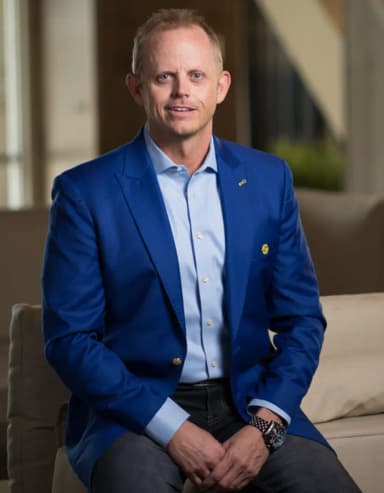
Welcome back to The Daily Mastermind, George Wright III with your daily dose of inspiration, motivation, and education. And I am really excited today because we're joined with an amazing individual, somebody that's going to share a lot of knowledge with you. We're going to be able to touch on everything from leadership and business. So let me give you a quick introduction of our special guest, Marty Strong. He's a retired Navy SEAL, combat veteran, CEO. His business background just goes all over the place, but we're going to get into that. But he's a speaker, author of nine novels and three business leadership books, which we'll talk about. But his most recent book, Be Different, is now in pre-sale. So we're going to get into it. But Marty, thanks for coming on the podcast, man. It's good to have you. Yeah. Thanks for having me, George. Yeah. I know too, busy guys like us, it's tough to coordinate sometimes. I feel like I say that a lot lately, but man, I'll tell you what, we talked a little bit before, but I'm excited to dig into some of the knowledge that you have. And I love different perspectives. You were a Navy officer, a SEAL, a CEO. You've worn so many different hats, sometimes at the exact same time. Give us just a little bit of the backdrop on your story. And because I think most people are going to ask right out of the chutes, what made you decide to go from military to business? Were you always a business guy? And just give us the backdrop on it for a second. Sure. So I was born in Nebraska and I was there until I was about 11 years old. And my father was started working for the Army. He wasn't in the Army, but he was an employee of the Army. And we ended up spending four years in Japan, and I ended up spending two years in Hawaii. And then I got back to Nebraska, and I joined the Navy when I was 17, and made my way to the SEAL selection course in Coronado, California. And we had 126 guys start. 13 of us original students graduated. I happened to be one of them. Most unlikely person you'd ever think to be a SEAL. I was like 125 pounds. When I started, like 128 when I graduated. I spent 10 years as an enlisted SEAL and got my undergraduate degree in business administration and then was selected for Officer's Canada School and spent the second 10 years as an officer and I'm getting my MBA and got out after 20 years at 80% disability from various injuries. One of them was a parachute accident. Then went to work for United Bank of Switzerland as a portfolio manager. Did that for eight years until 9-11 happened. And then I decided to sell my practice and go work off and on for the government and different contracting companies that had contracts with the government, mostly with anti-terrorism, kind of terrorism things. And then I got picked up by a government contracting company. And eventually I ended up being the CEO of that government contracting company. And then I bought a healthcare company in 2016. So that was a pure entrepreneurial, not even early stage. That was essentially a startup. One employee when we bought it. And now that's thriving and it's much, much larger. And I'm the CEO of that company as I'm sitting here. So you've had, you're like me, you've had several careers, several different phases and seasons of your life. Do you feel like that they led to each other or Or were they total pivots for you? Because leadership, especially in the SEALs and in military, obviously extends. And we'll get into that, but extends into business. But you went from military to banking to business. Did you always just have a sense of entrepreneurialism? Or did you find yourself looking and so you pivoted into business? Two answers. The first one, I've always been a lifelong learner. And I like Louis Pasteur's quote, chance favors the prepared mind. so when I was an enlisted SEAL I wanted to learn how to be the best SEAL I could possibly be and I read everything I could about military history military tactics I used to talk to anybody and everybody they've been in any kind of combat situation I was just a sponge and as I evolved as a SEAL um I got into mission planning which is mostly creativity which is what I write about in the third book it's very innovative most of the set piece battles that you see in movies and everything. SEALs don't get involved in that. They get the Mission Impossible package. And then you have little information or the information you're given is wrong. And you have to come up with some guesses that are thrown up on the wall and everybody agrees to them. So that whole process, it doesn't sound like business. It's a lot like startups. It's a lot like you're doing a startup over and over again. Okay. What do you have with the market is the tactical environment. Your team is the people you're going to have to pull a company together. Your product is, or services, whatever you're going to be doing on the mission. And then you might be in a completely different role six months later, six months later. So you're in a constant state of learning that process. And that was a very easy segue when I was managing money because I was managing money, which are stocks, which are representations of companies. So I understood the importance of leadership, long-term planning, short-range optimization, organizational structures. I got to read lots and lots of analytical reports and see how analysts actually slice and dice companies, strengths, weaknesses, etc. And a lot of them matched up with the same kinds of things I learned in training SEALs or leading SEALs. So being a student in the SEAL team of those particular categories of learning prepared me in a strange way for the next job. and then sitting down and dealing with 1600 clients and the way the markets would be roiled by external geopolitical events and all that. I found that I was leading these emotional people through the Sinai kind of a thing. Logically, they didn't understand how money worked and they needed somebody to emotionally pull them in and say, hey, the plan's good. Let me talk to you about the history of the markets. Let's talk about your plan. You've got a solid ship that's on this stormy scene, you're going to be okay. Something I'd never had to do in the teams because everybody around you is so solid emotionally. They're looking at you and smiling when things are at their worst. So I learned a lot there about human nature and how people treat money. That prepared me for going in and leading in business organizations. Yeah. So you've really evolved to that point. Look, I think most people, even if they're not familiar with the detail back of the military, know that to adapt and plan strategy and execute are all common traits of military, especially successful SEAL teams. So you got those skills, but did you have specific strategies and frameworks that you used in the SEALs that you applied to business? Did you find that there were specifics you could use to apply to business? Or did it just help develop you as an individual? Like I'm looking for maybe anything practical or strategic that you used in business from the SEALs. Two things. One's at an operational level, the other one's at the tactical level. At the tactical level, SEAL teams are very small units, so everybody gets cross-trained, multiple categories of cross-training. You start off, you're trained as a SEAL, a fighter, but then you also have to learn parachute operations, and you start as an apprentice, and then you eventually become a master at that area. And then maybe a couple of years later, you're moved into engineering. So it's boats and engines and fast boats, all kinds of things, pushing boats out of airplanes. And so you start to move through all these categories. You are a SEAL warrior, but you're picking up all these skill areas, apprenticing, even though you're a master in this other area, you're apprenticing over here to the point where you become a senior enlisted SEAL. And you usually have about four or five of the seven categories under your belt. So you've got a well-rounded, but also mastery, which allows you to then train the next generation and understand the importance of that type of kind of apprentice journeyman master kind of progression. And that is almost completely missing in business. So as soon as I was in business, I was astounded that people were brought in based on their resume. They're thrown into a cubicle or thrown into a part of the org chart with a title and it's execute. And there were so many things they hadn't done before and so many categories they'd never been introduced to before, exposed to before. Or they were only an apprentice, but now they're supposed to be a master. And I was watching all these people failing. So in every organization I've been in, I've tried to set up that kind of redundancy, bench strength, cross-training model. that I learned in the SEAL teams. And I'm sure the Green Berets do the same thing. You can't go in with eight guys and do the kind of wild variety of missions we would do. And now you've been, but you've been a CEO in business. So I was going to ask you to clarify something for me because I think sometimes in business, people go back and forth between, should I be a generalist or a specialist, right? Should I dig down deep and really get a skill down or should I be trying to learn other areas? You're not necessarily, it sounds like, saying you should be a generalist. What you're saying is that having that cross training gives you perspective And I don know if in the SEALs or in military this is the case but ultimately do people become the most successful in business that you been exposed to by specializing or really digging deep into skills? Or are you saying they should broaden themselves overall? In business, I'd use apprentice, competency, level of competency, and then master. I don't think like leaders, I don't think have to become masters. When I was going to college, my accounting professor had everybody raise their hands. Who's going to be an accountant for a living? And he said, okay. And he passed around the clipboard. Everybody put their names down. He goes, okay, I'm going to run you guys through the coals. Everybody else, I'm going to teach you how to be smart enough to hire a really smart accountant. So he was going to make us competent enough to understand how to hire a competent. And that's the level you need in business, especially if you're ascending to some leadership. Be competent enough to be able to pick out an accountant, a CFO, a supply chain manager. You need to know enough about your business. At that level, you'll really flail if you're only an apprentice or you're completely unaware of what's happening and you're taking everything on trust. So the strategic crossover is scenario-based learning and scenario-based training. And that is the class where the military learns and prepares for things that may or may not happen. They have contingency plans. They work through an entire mission set that you may not be going on, but it's on the war plan or whatever. You go back a year later and you rethink everything based on the new information, new assumptions, clean it all up, put it back on the shelf. I'll tell you that when you actually go, nobody ever pulls off the shelf, you end up winging it again. Yeah, it never ends up being what you think, right? But same as business, right? But what you do is you learn and you train everybody, especially the leadership group, you train everybody how to think that way. So everybody's always in a mode of thinking in a contingent way. They're thinking about the storyboarding of a problem, the storyboarding of a change of the situation. So for example, if you had a trained group of people like that, and you can do this tabletop all day long, you can just have everybody in a room and say, okay, XYZ corporations are our main supply chain for making the GWIS 5000. Here's the problem. You've got two hours to figure out how we're going to deal with this problem. The problem is supply chain just called us up and said, we have no raw materials. So we're dead in the water in production. Go. Now it's a made up crisis. Yeah. It's just all the military training is a made-up scenario most of the time. So everybody's got to struggle and figure out how do we do this, and they're not used to thinking on their feet. So you do that every so often as training for the leaders. Then the real crisis hits. Now you have a mechanism. I can tell you that any special ops team, when you get a call, you need to come in here right now, and you all get in there, and they give you the problem. Nobody sits there and goes, what are we going to do? Or how are we going to do it? Everybody just goes, got it, because they're used to the practice. The leaders are used to it. Yeah. I love that. No. And preparation only comes through that. That's a great principle in business, I think, is having the ability to maybe do some training because the preparation, obviously, like you talked about the competency, the preparation, and then that ultimately comes down to execution. But you can execute a lot better if you're prepared and you're competent in the area. It makes me wonder, because you've been in both scenarios, military and business, SEALs are really well known, as you've mentioned in the past, at handling incredible stress. And then that stress might be easier managed because of the preparation and competency, but handling incredible stress. In what way do you feel like maybe you could give our listeners or business owners, high achievers, CEOs and companies? That's what we deal with all the time, right? Unlike professional athletes where you've got limited stress and then recovery is like constant stress and a little bit of recovery. What have you learned from your military or even the business now that you've been doing quite a bit with a lot of different people over time? To handle stress, what are some things that you can recommend or give as strategies to deal with stress? I think along the lines of the strategy part that I just covered, at the technical level, the operational level, at the senior leadership level, you should be practicing failure the way I mentioned. Now, in the military, they do casualty drills all the time. If you're on a ship, if you're flying planes, whatever, driving a tank, you are in a constant state of somebody saying, OK, this is shut down or that just shut down. What are you going to do? And OK, the officer just got shot. What are you going to do, Sergeant? Hey, the sergeant got shot. Corporal, what are you going to do? There's a constant process of making everybody comfortable with everything falling apart. So by definition, most stress, human stress is related to the fear of the unknown. right so if you start to make the unknown a part of your training part of your reality then when it happens if you click into an automatic mode of acceptance and you start doing your job or you start working the problem you start running down the diagnostics or you start to make a new plan reinvent the company or reinvent the division start ordering trucks to make that's the new supply chain delivery system you buy 50 right or render trucks and that's your solution. You don't just sit in a corner, crawl in a fatal position and hope somebody else comes up with an idea. Yeah. You used a term and you probably use it so much you didn't, or maybe you did coin this, but I've never really heard it that way. I always talk a lot about failure and failing five times faster and learning to view failure differently. But you said practice failure. You didn't say practice executing, practice delivering, you practice failure. Is there a reason or did you intentionally used that term practice failure? I did. And that's because it's part of the military training process and has been probably as long as the military has been around. There's a famous scene, I think in the movie Glory, where one of the African-American soldiers is trying to load a gun and there's somebody screaming. Oh, actually that was in the movie The Last Samurai. And Tom Cruise is screaming at the guy while he's trying to get the rod to the gun and everything. and he can't shoot because he's so shook up that's the kind of thing he's trying to get him prepared for the fear of battle because he's going to have to he's going to have to do that procedure in that environment in that situation so it's practicing for failure is not yearning for failure yeah it what it is it's how to inoculate psychologically how to create psychological resilience for the moment and i'll tell you that an interesting thing from the seal and i think most spec ops guys like this, we train in trauma care, even though we're not the designated medic who went through all the fancy schools. We train to do emergency tracheotomies and we train to do all kinds of stuff. And we train, train, train, train, train. And those are always, okay, this happens to SOTA, what are you going to do? This happens to SOTA, what are you going to do? And then whenever anybody actually gets hit, the medic can't even get a hand in edgewise because everybody around the guy who's hit, bam, they're on it. Is it ready to react? They're sticking with it. They're stabilizing. And they don't even realize how automatic doing the right thing was. Unless you're on the outside, I've seen it so many times, watching it, or you're the medic watching everybody else do your job. It's what you train them for. It's why you prepared them for the moment. And they didn't have to think about it. They didn't have to have a plan or a meeting or anything. So yeah, you can instill that in people by practicing failure. Yeah, I actually really like that because I think you're right. Stress is really fear of the unknown, but ultimately for a lot, it's fear of failure. And the more you can practice for failure and the more you can execute in really challenging situations, the more you're going to not necessarily know exactly what to do, but the more comfortable you'll be in the situation. And business, obviously, especially given the last two, three, four, five years, man, it's been nothing you could predict. So I think that's a really good point. I'd love to push a different direction now because I know your military kind of pulls throughout all your business career as well. But what's the biggest difference, do you think, between the stuff you've seen in organizational leadership versus military leadership? Like in organizations, what's the big difference maker? And I don't know if there is a different one in the military versus business, but in business leaders, do you feel like there are leaders that are just born leaders? Do you feel like you can train and create leaders? Is it all about the leadership organization? But what's the big difference you've seen in working with a group of individuals in military versus group and business, you know, as far as the difference in paradigms and mindset? There's two primary differences at the human level. When you're in a military unit, you are, you're a volunteer who's willing to sacrifice for a mission. But really the cliche is that you're really there to show you the people all around you that you can measure up and you've got their back. And that a very deep kind of philosophical and emotional focus on the outcome That doesn exist doesn exist in the commercial world Yeah It almost impossible to instill it Other than an individual founder type person this is why you get these extremely driven individuals, but I'm sure I've read every biometric I could find on everybody, I've read four on Elon Musk. The frustration is nobody else feels that way. Because almost inherently people are self-motivated, not team motivated. So the first time I worked for a corporation And at 4.35, I heard this roar. And I went to the window and it was all the cars firing up the parking lot to leave. And there was no, if the project was like this close and it was due today, people would just drop their pencils and walk. And I was stunned because this was after I managed money for a year. So I didn't have people reporting to me like that. I was focused on the market and my clients. But now I was in an organization and to have an entire division leave at 12 o'clock because their boss gave them that day. And then everybody else is going to that division, knocking on the door, calling, whatever. Hey, we need help. The baton's sitting outside your door. Hey. And they're not there. There was no cross current of commitment. And then later, I ended up ascending in that organization and I would bring that up all the time. The second thing is I think that it's something that's teachable. I think a leader, if they start thinking that as the culture is going to be more like an ant farm than an orange yard. Everybody's going to communicate. Everybody's got to integrate. Everybody has to have empathy, which cross training helps with, by the way, not just cross training within a small group, but cross training. So you bring in people from supply and accounting and marketing and you bring them in a room and you create like a fusion team and you bring them through that. what-if exercise, that contingency exercise. And they start realizing how much of a problem thinking one way, the impact on the other group. Otherwise, they don't know what each other do. They'll never know. Yeah, siloed. Yeah. And they see it as a linear thing. And when they're done, they walk away. They don't realize that it never really ends until the solution is completed and it's executed and you move on. So leaders can affect that. Leaders can create that kind of dynamic. And they've got to pick the right people, which is also hard when you jump into an organization that's in place. But you can say in HR, go ahead and look at the resume and align the specs with the requirements technically. But we also need a person in accounting that's willing to do project work. We also need somebody in marketing that's willing to talk to a finance person. We need these kinds of mindsets. So when they get in, they're comfortable working together as teammates and project. And that essentially, that's something from the military that you don't also seeing commercial world, but it is something you can develop. Yeah, that's one thing that I think has made a lot of military background professionals very successful is because they come into an environment in the marketplace and they bring that with them. And I think it makes a huge difference. But like you said, I believe you can train that as well. It's interesting because in your first book, I think Being Nimble was your first book, correct? First business book. So Being Nimble, you write about, and I love this perspective, how crisis and chaos can actually create opportunities to shine. Most people, they're thinking crisis and chaos. If I can get through it, I will be more skilled. I'll be more notable, whatever. But using the words opportunities to shine and maybe even develop as a leader. Tell me a little bit about that. What did you mean by that? I'll give you a flash of the military example. Then I'll go to the business example. So the military, if you've done a fantastic job training your team, you've trained everybody and you go into combat and everything is executed perfectly and you weren't required, then you've done a huge part of your job. You've got a well-trained unit. What most leaders are concerned about is the second half of their job, which is when things don't go well and leadership's required in combat. That moment of truth when you have to say something, do something, make a judgment call, make a decision and you have very little information and every officer wonders how they're going to do in that moment. And by doing that, they see an opportunity to either succeed or fail. And if they don't fail, they get a confidence that from that point forward, they never really look at it the same way. They see it as I'm capable of doing that. When that moment comes, if that moment comes and in a moment, it's going to come less frequently if I've trained everybody else around me, my subordinate leaders, or they're already making these sub-level calls and they're short-circuiting my need to jump in and be a leader, right? Yeah. That means I've got a really great team. Almost puts me out of a job kind of a thing. Yeah. Yeah. Now think of it in the commercial side, same thing. If you were willing to have everybody train their replacements and have everybody think that the person behind them someday is going to be in their seat, not to replace them so they don't make a living, but so that they can jump up there if somebody moves up, moves up, moves out, whatever. Then everybody starts getting trained for that moment and everybody ends up being tested as a leader. And the opportunity may be you're overwhelmed, don't have enough people, don't have bandwidth. Some key person quits and leaves and there's this vacuum. That moment for everybody is an opportunity to shine. It's an opportunity to execute and show that all their training and preparation was time well spent. It's an opportunity for the leader to see that and hope that's exactly what happens. If I was a leader and I did all the things I told you and, you know, say the COVID thing happened and they were going to shut down everything, and I walked into a room and before I could say anything, there were already guys up on the whiteboard rethinking the entire organization and how they're going to work in this new paradigm. I'd sit back and have a huge grin on my face because I would have succeeded. And so a bad thing was an opportunity for everybody to shine, even if it's a bad situation because they're prepared to and they can execute. So that's, and the other version of it is obviously opportunity associated with business development or business growth or market penetration. Somebody else stumbles. You can, if you're nimble enough and you're quick enough and you see it for what it is as an opportunity and not just all risk, then you have to lead. Yeah. And I think all true leaders, real leaders, they want to always grow and evolve. And you don't grow and evolve unless you are put in situations of chaos and crisis. And I think that it's a balance, right? You want to be able to have chaos and crisis and have your team oiled machine, execute perfectly. You could sit back, but yet you also want to develop as a leader, which is outside your comfort zone, which is so you want both. And I think that if you have both, then that's where you can truly not only shine, but grow as an individual and help others grow as well. So I love that perspective. Let's talk for a minute because as we get ready to wrap up, I want to talk a little bit about your recent book that's coming out because you had the book, Be Nimble and Be Visionary, and this new one is Be Different. So tell me just a little backstory on that. Why did you decide to write this book? What's different about this one? And what's the principles that you talk about in this that apply to business? Sure. So I'm on a couple of boards, and one of them is Best Robotics. Best Robotics, been around for 31 years. It's It conducts about 20 to 25 robotic competitions around the United States every year. And it's for 12th grade kids. And they raise money and the kids don't have to pay a penny. There's several other robotics competitions out there, but you have to pay a couple thousand per kid. So it's great. Great for young people. And I was brought in to help with strategy. And eventually they asked me to be on the board. So I went to the meetings and I went to some of the competitions. and I got exposed to brain science and things that were going on in the area of innovation, creativity. And I noticed that none of the engineers were telling the kids what to do. And that in the competition, if there were 17 teams, there were 17 different robots. So these aren't kids. They have to come up with their own solution to the dynamic of the competition. And then I watched them doing the rapid prototyping in between the 10 rotations that they make, and they're allowed to fix and modify things. So it's like little NASCAR pit crews with Dremel tools, and they're feeding off of the observation in the last round. And they're helping each other. And I asked one of the engineers, I said, who taught them how to do this? Who taught them how to communicate and collaborate? Who taught them how to feel comfortable in the short amount of time to get all this stuff accomplished? The assessment, the analyst, the analytics, I think, nobody. I said, so all these kids just came up with the robot and they're acting like, if you saw these kids, you'd say, I would love to have a company that, well, yeah, right. They ran that way. Our leadership team were named. And then it dawned on me that the reason that they were doing it was because nobody taught them how to do it the wrong way. Nobody settled them with rules and compliance and obedience to somebody set of white lines And so I started going down that path of looking into it And the more I looked into it the more I found research that innovation and creativity isn something that goes away because you older It goes away because you conditioned to stop doing it And there are studies out there that support that So I thought okay so SEALs are all about bending, breaking, and ignoring the rules to get the job done if they have to. And entrepreneurs, a lot of like an Elon Musk, whatever, they're the same way. They're talking about breaking the law of a government. They're talking about breaking the laws of perception and the shackles of the way it's always challenging thinking. Yeah. Yeah. So I wrote the book based on that. I wrote the book first three or four chapters talk about how much conditioning you've really gone through that you may not even realize you've gone through. And then I give a couple of examples, give the poor, the poor SOB that raises his hand on the first day in the first conference room event in his first job and comes up with an idea. You fight out real quick. You're the new guy. Shut up. You don't have the rank, the title, the experience to be saying anything. Maybe in three or four years. By that time, you're so conditioned to not take a risk. You won't have ideas. Yeah. You go with the flow, right? So the rest of the book is about how to, once you accept that's the condition that you're in, how do you open up your mind and how do you start to breathe again intellectually and become creative and reignite that creativity that you had when you were six, seven, eight years old. But when you told somebody that you wanted to be a rock star or an astronaut and they shot it down five seconds later, you know, and you don't do it this time. This time you actually say, no, let's run this one. Let's see what this comes up. What does it look like at the other end? Yeah. So let's say you're a CEO or a business owner right now, because obviously it's different if you're part of the line level positions of a company. But let's say you're a CEO and owner and you want to start to foster an environment of creativity, even if whether you've been that way in the past or not. How do you foster that level of creativity and thinking while maintaining execution, discipline, and systems of what you have? Do you have any specific things you would recommend? I talk about it in the other two books, too, but there's kind of an analogy, and that's if you have a squad of Marines, they have to charge a hill, and the hill is critical to the whole battlefield. And if they don't take that hill, another group is going to end up getting decimated. And so they rush across the open ground. They all know what the mission is. the officer shot, the sergeant shot, the corporal leads them, they take the hill. The first thing they're taught to do is to dig in, check ammo, make sure nobody's wounded, and call in, we've got the hill. The second thing is to prepare to take the next hill, because that's what you do with the infantry. Somebody's going to say, that was great, now there's another hill that's crippled. So there's always a hill, right? And so you get into a mindset, and should as a CEO or C-suite person, that whatever you think you achieved in the past, wherever you are, your business model, for example, or even the strategy that got you here, you can't just hug it and hold on to it like it's a buoy. Because it was probably the greatest thing in the world to do in the context of when you started, maybe even the context of the intermediate time. But now you're in charge of a BlackBerry. And you don't care. It's outdated. Because you're the guy who came up with the BlackBerry. It's your baby. It's your model. So you have to basically step outside of that thinking because you're doing it to yourself. You're restricting your thought. You're restricting what your company can be, where it can go, what it can do. And you're also restricting what kind of culture you might have to shift to. The difference between hybrid, all virtual, where everybody's got to be here. Man, you would believe that the angst of people that were younger than me and that say, hey, you can't, everybody's got to come in. You got to make sure they're working. You've got to see that they're working. We're conditioned. Yeah. And look, you want people to execute. You want people to be accountable. So sometimes it's counterintuitive to say, I don't want them to think out of the box. I want them to get creative because if they're not doing what they're supposed to be doing, there could be room for failure. I guess I've found over time that the first thing you got to be able to do is give them permission to fail and give them a little bit of grace or flexibility to fail. Because, and it's hard when you're a personality and you're a driver and an executor to allow failure when it's deviated outside the guidelines of what you want, but you almost have to have that, right? To be able to foster an environment of creativity and that. So the environment changes, the game changes, and you don't change, you're a dinosaur. And if you don't know it, then you're an impotent dinosaur. So be aware that the world changes, the universe never stops changing. And the way you ran an offense in in the NFL in the 1950s would not work in 2024. What's crazy is, no, you're absolutely right. In fact, it's almost escalating and changing more and more faster and faster. So it's interesting because I looked at your books when we, because we have hundreds of requests to do interviews and I looked at your books and I thought, be nimble, be visionary, be different. Man, that's almost like the mantra for today's business is all of those things. You have to be nimble, you have to be visionary, you have to be different. And how you do that, it sounds, and I think people listening to this, You got to understand Marty's a very specific, detailed execution background, right? With the military and CEO and things. So the books are going to give you a lot of that. So I'd highly recommend you check them out. So as we go here, let me ask you this. Where's the best place for people to find you? And I can put links in the show notes, but where's the best place people can find you? Where do you recommend they start to build and diversify their skills and competencies with the information you have? So MartyStrongBeNimble.com has access to all my books. It also has access to my speaking programs. I'm on Amazon and Barnes & Noble and all those book sites under Marty Strong. So the books are progressive. They don't have to necessarily be written in order. But if you're more focused on leadership challenges of the operational nature, I'd say Be Nimble. If you're having a hard time trying to figure out how to convert a vision to a strategy or you're not sure what strategy is anymore because everybody just adds 5% growth and calls it a strategy, then I would read Be Visionary. And if you really want to either, for personal or professional reasons, want to figure out how do I shake myself out of the doldrums and open my mind and become as fluid as the fluid environment that I'm operating in, that would be different. Yeah, and I highly recommend because at the end of the day, guys, listen, success leaves clues. Marty's had a lot of background, a lot of life experience, but also business experience in these areas. And I think that how you think is as important as how you execute. And these books are very much about how you think and how you execute in the same tone. So once again, I appreciate you being on, man. I look forward to having you come back maybe with our Academy Mastermind. And we'll probably have more content. I wish we had more time because I wanted to dig into some of your novels and things like that. But we'll have to do that on the next episode. You're a busy guy, so we'll have to get on that pretty quick. Is there anything you want to leave our listeners with before we take off though? any last thoughts, strategies, ideas? This is what I say to veterans when I'm talking to them and they're leading the service. They think they're, the best days are behind them and they don't know how they're going to end up being as good at what they were doing in the military out in the civilian world. And it's a matter of perspective. I'll ask somebody, you're 38 years old and I'll say, how long does it take to get a degree in engineering? Or how long does it take to get a degree in, to get a law degree? Or how does it, and then, okay, and they answer, and I said, that means you'll be 44 years old when you're a lawyer. the only reason you're restricting yourself is because you put restrictions on yourself. So you can change that channel at any time in your life and become whatever you want to be. Prepare for it, do it. You could do it for eight, nine years. And then you're only what? You're not even 50 years old. Switch gears, pick another lane and go for it. I think if everybody thinks that way, they'd stop thinking that the one job, the one college degree, the one path is the only way it's not. Yeah, that's so great because I try to end most of my podcasts with the same phrase and I want to kind of plant hope and motivation and inspiration for individuals. And I think you're absolutely right. I say it's never too late to start creating the life that you're meant to live, whether or not it's executing at a higher level in business, whether it's creating more of a future of purpose, passion, legacy, impact, whatever it is, it really isn't. So I love how you think. And listen, guys, do me a favor, share the show, go check out the show notes. I'll put links in there for his website, as well as the books, check out the books. And remember, it just takes all out massive action, but you've got to be able to really dissect and look through how it is you approach business and life. And I hope that's something that has given you a lot of ideas and inspiration today. So join us tomorrow. I look forward to talking with you again. This has been The Daily Mastermind. Have a great day. ARD Text im Auftrag der Stream