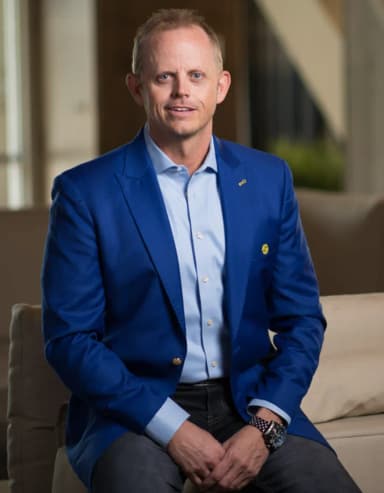
All right, welcome back to The Daily Mastermind, George Wright III with your daily dose of inspiration, motivation, and education. I'm excited to share a story with you today. I've got a great guest here, Jeff Luther. Welcome to the show. Thanks, George. I appreciate it. No, it's great to get together finally. You know, we both have a lot going on, but I wanted to feature your story because you're someone that's built multi-million dollar or multi-million dollar business, but had a real wake-up call. And we're going to talk about that. But before we go, I want to make sure people have a framework of who you are. So if you're listening, appreciate you being here. I'm excited to share some things with you today that'll bring you some value. Jeff is a high-performance coach, entrepreneur. He's the founder of All Can, No Can. It's a company where they, you know, basically help drive leaders to regain more clarity, control, and purpose. He is the local president of EO in Charleston. He's survived a major cardiac arrest, but this is after building a multimillion dollar inspection company. So Jeff, do me a favor. We can jump right into your story because I thought it was very inspiring, but tell me a little bit of the backstory that brought you to this point in time where you really had to pivot and grow. Oh man, June the 5th, I ran my first overnight ultra. It was a 50K and ended up being like 33.8 miles. June the 12th, I suffered sudden cardiac arrest at a CrossFit gym working out with my partner was my 16 year old son. It happened again, July the 29th. And then August, my wife of 23 years gave me the gift of divorce papers. Wow. Divorce I didn't want. So that's how I got here. You had a successful career. You built a multimillion dollar business in a tough industry. What did success look like up to this point? And was this out of the blue? I think there's a lot of entrepreneurs dealing with burnout, stress, and anxiety. They're probably very successful at what they do. And then something they weren't expecting happens, which is your story. So how did you get to this point? You had built a pretty successful business. Tell us about what your day-to-day was coming up to this point. Yeah, that's a good question. You know, success for me was the hedonic treadmill, right? So you set one goal. Like when I started the business, my goal was to make a hundred thousand dollars in a year. You know, that was the goal. And then I would figure out what was next. Well, you know, I hit the hundred and that wasn't enough. Then I hit the 250, that wasn't enough. The 500, then the million. So success to me was the burn, the grind, being at the office before anyone else, leaving after everyone else. And that was the success. And I built that business up over 3 million and it still wasn't enough. I was constantly chasing that success and realizing now, you know, success is in the action to me now, but then it was in what's next. What am I going to do next? Okay. Well, that wasn't enough. I'll go run an ultra. Well, that wasn't enough. Now I'm going to snatch my body weight. Well, that wasn't enough. Now I'm going to run a sub five mile. Well, that wasn't enough. It was just a constant, the constant pressure. So did it take this wake up call to kind of shake you out of it? Or did you feel like it had been burning up to this point? Like you were feeling not just not fulfilled, but maybe starting to feel that stress and anxiety was building up. Did you, did you feel that coming on or was it this sudden event in your life? And tell me what happened when this event happened, what was going on in your mind? Yes. I'll quickly tell you, no, that wasn't the wake up call, but what I was doing, George, is I was controlling my pain. Things were rattling around at home that weren't great. The business wasn't fun. And that was a pain that I had no control over. But when I put my running shoes on and I go put 20 miles in, then I could control that pain. So that was, I mean, I know that sounds ridiculous, but that's where I would hide. And then I would hide at CrossFit and I would hide at weight training because that was the pain that I could control. The other things I couldn't control, I couldn't control that I got to a million dollars and it was unfulfilling. I couldn't control that I had 30 employees and it was unfulfilling. So it was building and I kept pushing. And then Saturday, June 12th, 2021, I was working out and all of a sudden I felt this really rapid, intense heart rate in my neck, but it would go for maybe five or 10 seconds, like a flash and it was gone And then it happened that Saturday I was like ah this will go away in a second And I was doing wall balls at the time and it didn go away So like it go away I going to take a knee and I not the take a knee guy I'd rather fall over. So I took a knee and it didn't go away. And then I was on two knees and it didn't go away. Then I had to lay down. The last thing I saw was my son's white Metcons, his shoes. He was walking towards me and I was like, Jeff, you have got to get up, dude. You got to get up. And I couldn't. my brain was sending my body a message. It was like, I had no hydraulic fluid. I couldn't move. And that was it. I was out. And you literally were gone. Like that was your situation, right? So what happened? How did you take this? What was your immediate after this reaction? Because your doctors told you to stop everything, slow down. Like what happened? Yeah. So my immediate reaction when I woke up was, Hey, I passed out. I couldn't piece the night together, but had this horrible taste in my mouth, like a hangover. I don't really drink. So I was like, oh my God, I must've gotten drunk last night. And I passed out at this workout. So compressing all this, I was shocked with an AED two times while I was, while I was out. The first time it didn't work, you know, I flatlined. So they were doing chest compressions, all those things. Fast forward, go to the hospital. Three days later, they gave me a diagnosis. They said, this happened because of this heart disease you have ARVC. and it's exacerbated by exercise. Exercise damages your heart where it actually makes other hearts healthy. You'll accelerate your death by exercise. So it's time to stop. I've had an ICD implanted, subcontaneous ICD, interior subcontaneous interior cardiac defibrillator. And that's what I left with from the hospital. And I was like, who am I now? You were told to slow down, avoid stress, accept all your limits, but you have been pretty adamant about the fact that you made a conscious decision to rebuild instead of retreat. What did you mean by that? Yeah, I was given a choice. You know, when I tell my story, people are like, oh, you must be so grateful. Oh my gosh, you know, God's got a plan for you. I was like, no, I'm bitter and I'm angry and I'm mad and I'm sad and all these things that aren't positive. But also when things like that happen. People can't get where you are. And I don't mean this terse, but people don't care what happens to you. They care how you respond. And I've got three boys that are the most important people in the entire world. And they were watching and they wanted to know how was I going to respond. And I had a choice. I could either live dying on the couch, not doing anything or I could die living how I wanted to. So I chose to die living. You know, those are the things that make me happy. That's how I live. That's how I connect with my kids. I had to choose. What do you think was the big lesson takeaway you had out of this from your journey? What happened after that, that you now bring into your framework of what you talk to other founders and entrepreneurs and executives about? You choose, you still choose. Take the information. I would never encourage anyone to be reckless with their help. I did a lot of research, a lot of studying, a lot of consulting. I hired a coach that was an expert in my disease. You still choose. Listen to the information, but that's not the end. And the thing that I learned, two big lessons for me was I finally got to a place, I know this sounds like common sense, but I got to a place where gratitude was a real struggle for me. And I never knew that before, but once started finding gratitude, all the other bad things couldn't share that real estate in my mind. Yeah. That was huge for me. That's great. What was the, like, you had to been in place where you were really in fear as well. What was that happening for you in that scenario? Constant. I was in constant fear. When it happened the second time, George, I became paralyzed with fear. Like I, I was scared to drive. I was scared to take a shower because I didn't want to be in a bathroom by myself where someone might not find me. I just knew it was going to happen again. Wow. And how did you turn that beard more of a catalyst? How How did you turn that into something that could help you rather than shut you down Because a lot of people deal with fear right now I had to take one step And that was a big lesson for me. If you take a step, the ground will find you. You're not going to fall forever. The ground will find you. It might find you like it found me on my face, but it found me. I stopped falling and I got back up. You take that step, the ground usually finds your footing. It is tough because I think people are dealing with situations and challenges, especially if you're a high, you know, achieving entrepreneur, business owner, you know, C-level executive. You're very dominant driver. And so being told to step back or even deal with fear and anxiety. I also think when you step into your fear, that really takes you to the next level as well. But, you know, for someone that might be listening right now who feels like whether they're dealing with fear or maybe they've just lost some momentum. they feel like mentally or physically in their business they're stagnant they're not going anywhere what would you recommend is the first decision for them to start taking back control and moving forward you were hit with such a tough situation everyone's dealing with a lot of different things but what would you recommend from your perspective as the first decision they should look at to focus on regaining their control and direction yeah we have this great gift between our ears and we have this great enemy between our ears right? The brain sometimes is broken and thankfully the brain finds danger for us. So, you know, we're going to stroll through the woods and go, Oh, look at these pretty berries. I think I'll eat these. We have to know there's danger, but what our brain also does is it catastrophizes. It finds that fear. So, okay. You know, I went through, what if it happens again? What if it happens again? What if I do exercise and what if it happens again? Well, I had to be fair to myself. And if I'm going to ask myself the question of what if it happens again, then I ask myself the question of what if it doesn't? What if it doesn't? Okay, then play that out. And I think a lot of times with that fear of moving forward, it's because we see the danger. We see the problem. Okay, what if I do fail? Well, what if you don't? Yeah. So be fair. Ask both sides of that question. It's great that you say that because I know you talk about emphasizing for leadership, asking better questions. And asking better questions to yourself is probably the first place to start. What are some of the powerful questions you think leaders should be asking themselves or their teams right now? We always ask things like, how's your job? What do you think they're going to tell you? Oh, my job's great. Maybe we ask, what does a perfect day look like for you around here? How do we get more of those? A lot of times, like my favorite question to ask a new employee used to be, how are we treating you? And here's why that was my favorite question. Number one is because I knew what the answer was going to be. And number two is because it made me feel good to hear it. But then we start, hey, what's our onboarding process look like? Or how do you feel now that you've gone through training? Because those answers tell the tale. And sometimes those answers are the things that we're scared to hear because maybe we're not doing a great job. That's what I encourage. I love it. I mean, because, look, the answers come from questions, but better questions will create better answers. And I think a lot of people don't stop, right? So a lot of high performers, and maybe you have some recommendations here, but how do we help high performers stop running and grinding and working on autopilot and start actually leading with clarity and purpose? because that's kind of the big takeaway I felt from your message is you were grinding and moving and you were getting success. You were creating success, but you were just constantly not fulfilled. And it took this situation to be a wake up call for you. But I think a lot of high performers are just running on autopilot. So how do we help or what do you do in your particular leadership and coaching? Maybe that's different than others to help people start getting clear and running on purpose again, rather than just the grind. Yeah. So it's that list. And that's one of the big struggles that entrepreneurs and founders have is we make that list of all the things that we either need to do, have to do, want to do, or are going to do. That's our performance. That's our dopamine. One question that I try to get entrepreneurs or founders or folks that I work with to remove from their day is but what would they think A lot of times that our driver I think I think I'm lazy. I think I think I don't care. I think I think I'm not engaged. Then focus on what is important. What's the goal? EOS is one of the systems we ran. And at any time when we're making a decision, we could go back to that 10 year target. What's the 10 year target? And then you back up from there. is this to-do list going to get me to my 22% profit that I want this year? Driven with total clarity. I do think people lose track of that because they get so busy. As the president of EO in Charleston, you're surrounded by driven founders and entrepreneurs constantly trying to balance their ambition with actual meaning. What do you think is one of the biggest reasons that businesses are experiencing burnout right now? What would you suggest for businesses that are feeling burned out? Is that just a lack of clarity around their purpose? From my experience, it's comparison. You know, I have a $6 million business. Well, he's got an $8.5 million business. Why am I not as good as him? I drive a 911. Well, he drives a 911 GTR 3. Why is my car not as nice as his? That's the biggest thing I see now. That's twofold, George, because one, you have the comparison, which comparisons are going to steal the joy of your own accomplishments. But then we have that diversion of focus, right? and then we don't admit it. So then it's hard to find the cure, so to speak. Yeah, it's almost like people are operating out of maintaining those expectations instead of purpose towards an ROI and a drive and a business or their goals. So I agree. I think a lot of times it's unconscious and it just starts to become autopilot for people. I don't think most people notice it at all. When you do notice it, that's when you just start feeling burnout and whatnot because you're comparing your business, you're comparing everything else and you're not driven by what you want to accomplish, right? And then in my business, with my home inspection company, building that business, it was always revenue, top line, top line. And then one day we'll talk about that word that starts with a P. I can't, it's like, what is it? Profit? Something like that. Yeah. You know, and you're building and you keep going. If you have a $2 million business at 25% profit, that's probably better than a $3 million business at 5% profit. if you get quiet and find out really, really what you want, then you start to get some clarity around the things that you need to do to get there. As a co-host of the Franklin Planner podcast, a lot of times we'll talk about leading your life with intention and what matters most. And if you can continue to remind yourself of that, ironically, most of your business and life and relationship, they'll all come together too. But when you're leaving that to the tail end and it doesn't get the attention, it's not going to. That's one of the things that drew me to your story. By the way, for those of us, I know we're kind of short on time now, but I'm going to put links to Jeff's website because I want you to check out his story and learn more about the frame of mind because you might be dealing with that. Jeff, for people that are maybe, whether they're experiencing burnout or not, or lack of fulfillment, or whether it's just individuals that are looking for a shift because they're feeling stuck, what would be your final recommendation? or what would you have to say to somebody who is in that scenario right now? What does your life look like in a year? Ideally, if that's what you want. And I always like to work backwards. What's standing between you and that life right now? What are those obstacles? Yeah. Say them out loud. Because once we say things out loud, sometimes they don't seem so big. Yeah. But a lot of times we don't just drill down to what do you want your life to be like? What are you trying to accomplish and start with the end in mind? I think that's a big timeless principle that I've learned over and over that sometimes we lose track of. So I think that's huge. Absolutely. Well, I appreciate you being here with us. I really do appreciate you taking time. And for those that are listening, I want to make sure that they share this show because I do. I think that the more you address clarity and purpose and direction, the more the rest comes along and gets done. So, Jeff, thank you so much for being with us here on the show today. I appreciate it. For sure. Yeah, thanks for giving me a platform. I appreciate it, George. Thank you. Yeah, you're welcome. And listen, guys, remind yourself every day, it's never too late to start living the life you're meant to live. You just got to start taking action and you've got to stay focused and clear on what your goals are. So have an amazing day and I'll talk with you tomorrow.