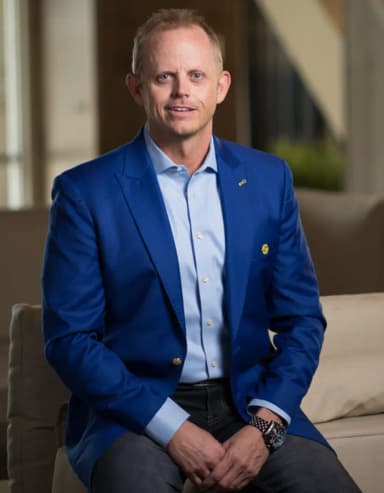
All right, welcome back to The Daily Mastermind, George Wright III with your daily dose of inspiration, motivation, and education. And today we've got a special treat. I am excited to pick back up on our Prosperity Report interview series. And we've got an amazing individual today. Let me just give you a quick kind of very rough broad stroke introduction of this gentleman. Doug was born partially deaf, nearly blind, and crippled. So that'll set you up for a pretty interesting conversation. But he graduated from Dartmouth College in law and practiced for 22 years. And he likes to say he's a lawyer turned peacemaker. So after leaving law, he's really developed his time into this groundbreaking work of de-escalation, de-escalating anger. He's affected thousands of lives. This is a gentleman who's been attorney of the year, lawyer of the year, but he's a mediator, trainer, coach, speaker, bestselling author, has four books out. But I love this concept we're going to talk today about peace and conflict. Doug Knoll, it's great to have you here. How are you doing today? I'm doing great, George. Thanks for having me on the show. Oh man, I tell you what, as I was studying a little bit and learning more about you, and we talked a little bit before the interview, I got a really cool perspective from you. And it's one of those perspectives where there's some individuals that have chased success and others that have just pivoted from one thing to another spectrum. And I feel like going from a lawyer to peacemaker is like a complete pivot. Give us just a little bit of the backstory before we jump too much into all these amazing topics today. Give us a backstory of what prompted you to pivot from a lawyer to a peacemaker. Talk to me a little bit about that. Okay. It didn't happen overnight. Let me put it that way. As you said, I went to Dartmouth College, did my undergraduate work, English lit major in those days, if you didn't go to med school, you went to law school. So I came back out to California, went to law school, worked for an appellate judge for a year, and then went into private practice in central California. And I joined the firm in September of 1978 and tried my first jury trial in November of 1978. And my second jury trial was the defense of a $36 million dollar securities broad case in the Southern District of California federal court, which was a seven-month jury trial in San Diego. That's how my career began. I was trying cases when most of my colleagues were peers were still in the law library doing research memorandum. So I did that for 22 years. And in the 80s, in my 30s, I took up the martial arts. And I earned my secondary black belt when I turned 40 and my teacher said, go study Tai Chi. So I began to study Tai Chi as a martial art. And Tai Chi has two very interesting paradoxes. One is the softer you are, the stronger you are. And the second paradox is the more vulnerable you are, the more powerful you are. That's crazy. That is actually a really good principle for business, but in life in general, I love that. And here's what's really weird. I got it. I did not get it. I was a secondary black belt, hardcore trial. I'm a big man, 6'1", 215 pounds, very fit. For me, litigation was war just by another means, right? So the idea of being soft to be strong and vulnerable to be powerful really did not sit until I had practiced and studied Tai Chi enough as a martial art that it really did start seeping into my stomach. So until in the late nineties, I was in a courtroom cross-examining somebody. And the thought came to me, what the heck can I do in any year? And that's when I started to question my work. And after that trial, I had a vacation plan among many other things. I do whitewater kayaking and rafting, and we had a trip planned on the main salmon of the night. So I spent 10 days on a raft and I really thought about how many people I really served as a trial lawyer. And I could only count five people in 20 plus years that I had served. really served. They came out of the system that they've been going in. I said, I'm not going to do this anymore. I'm not sure to serve 10 or 15 people over a 40-year career. I had no clue. He came back to town, drove down out of the mountains the Monday after the vacation, and I heard the one and only public service announcement for a new master's degree in peacemaking and conflict studies being offered at Fresno Pacific University, which is- Wow. So long story short, I enrolled. I was a full-time master's degree student, a full-time trial lawyer, and a three-quarters time law professor at our local law school. And that all occurred from 1998 until 2001. And had many discussions with my law partners about where I was going. They hated the idea that I didn't want to try cases because I was the second largest earner in the firm. I was one of the geese that laid the golden eggs. And the idea of me doing something very different that nobody had ever thought about before. Being a problem solver, not a problem creator, didn't suit well. And so it ended up, I never got angry and I learned it a lot in my master's program. But eventually I gave him a week's notice and walked away from $10 million and opened up my own professional practice as a mediator, arbitrator, and peacemaker in November of 2000 and never looked back. Best decision I ever made. Yeah, it's funny. I would have never thought that this idea you had of taking Tai Chi is what kind of led you to that. But it's funny because I've heard the thought and I studied martial arts for a little while. And the idea of being soft to be hard, that is something that kind of makes a little sense. But the vulnerable to powerful, that's an interesting concept we're going to have to come back to at some point because I don't think, I think that's probably even sometimes more difficult for people than being soft to be hard because they understand that allowing that, allowing things to happen, can happen, but being vulnerable, that's something that almost is counterintuitive to being a leader, to being this and that. And then as an attorney, the last thing you want, you want to have power, but you don't think of having it through vulnerability. So this is interesting because that little segue makes a lot of sense though, into this whole emotional concept. So I really like that a lot. And I think that's an interesting pivot. And I think you're right. It probably happened over time, but I also like, and I want to make this kind of this point to the listeners that you also felt this kind of need or this calling to do something that served more, that created a more significant outcome. And sometimes that's the voice you have in you that allows you to tweak a little bit about what you're doing because you're still very active in things related to practice and leadership and law and things like that. But making that pivot also, would you say, brought you some more fulfillment in what you're doing and the skills and talents that you have? I help more people in a week today than I helped in 20 years as a trial lawyer. Yeah. And I've learned that meaning for me is service to others. That I am serving others in three profound ways. And that to me is more important than money or status or recognition or celebrity being celebrated. To me, that is the most important thing. I love that. It's funny. I was listening to a colleague of mine this morning and he has a really big podcast. I listen to him every once in a while. And he had this episode on what's the meaning of life, right? What's the meaning of life? And everybody's trying to find purpose and passion and meaning for life. And he said something that I've said a few times, which is it's sometimes you're just not asking the right question. And I believe the question that we should be asking is not what's the meaning of life or what's the purpose of life, but it should be what meaning can life have for you? because I really believe we can decide what purpose, meaning, and things we want to create in our life. And it usually almost always comes back to creating impact. And I love what you said there because for you, the meaning became serving others and you felt like you got more out of that. And this kind of leads us to this conversation. I want to get into a couple of core topics because I want to talk today about emotional intelligence. I want to talk about leadership and things like that. But I love the phrase that you have. I read it first on your website where you said, how to listen others into existence, how to listen others into existence. You also say there's a power in listening to emotions, not words. So I want to talk a little bit about emotional intelligence and emotional competency and what's the difference. So can you dig into that a little bit for us and help us to understand the difference in some of those amazing phrases that you have? They started, well, it started at the 50,000 foot level. So emotional intelligence was a term that was coined by two professors, one of whom now was the president of Yale, Myers and Slobe, back in the late 1980s, early 1990s. They were studying all, they were looking at human intelligences other than cognitive intelligence, which is measured by the Stanford-Binet IQ test. And they came across the idea that there's a thing that's called emotional intelligence. And then Dan Goldman who was at that time a New York Times science writer picked up on their studies and published his book in 1995 Emotional Intelligence EQY is more important can be more important than IQ And he built a whole new industry and made hundreds of millions of dollars off of this stuff. And so emotional intelligence, and he made all these claims for the most part of unsubstantiated. And when you read the literature, the academics just fringe at the commercial side of emotional intelligence. And emotional intelligence has become such a, like a phrase that people just hear, and I don't think people even understand what it is anyway. So yeah, let's boil it down. Emotional intelligence is a test that measures three skills. So you can't learn emotional intelligence. That's the first big myth. If somebody says, I will teach you emotional intelligence, turn around and walk up. Because it's a test. It's an assessment. It is not a skill. It tests three different competencies, fundamentally. One, emotional self-awareness. Two, emotional self-regulation. and three cognitive and affective empathy which are skills these are all skills that can be learned and what i have i teach people fundamentally okay i'm i'm gonna just interrupt you for just a second for two reasons number one i actually thought emotional intelligence was always referred to and i've read a ton about it as something that you can change right and what you're saying is that's not the case it's a test right but these things are skills that you can learn which affect the results of the test, right? So keep going with you. Correct. So you can develop, when you develop emotional self-awareness, self-regulation, and empathy, you will score much higher on the emotional intelligence test, such as the M-set, which is the Meier-Solodi-Karubi-Social emotional intelligence test. That's the gold standard test for this stuff. And you, if you start out and you're scoring low, you've been learning skills that will actually allow you to do much, much better on the test. So fundamentally, how do you learn these skills? What I have learned is that if you learn, if you practice cognitive empathy, which I'll come back and talk to you about it in a moment, that automatically teaches you emotional self-awareness and self-regulation. And the way you learn cognitive empathy is by learning a skill called affect labeling. And the way I developed this was really rounded out. I have a master's degree in peacemaking and conflict studies. I have a law degree, pretty smart guy, pretty well educated. But the one thing I didn't have from all of this was how to call him an angry person. And I was getting called into a high big dollar, high emotion conflicts, family business conflicts, partnership disputes, places where litigation was going to destroy well, but the emotions were so high that people could not see their way through to finding peace. And how do I call these people? And I stumbled across, actually, I didn't stumble. I had an epiphany in 2005 in a very difficult mediation. And I learned that if you listen to people's emotions, magic happens. They immediately start to bomb down. I didn't know why it worked. I just figured I tried it and it worked. I have an insight to this. And I just started playing with it in my mediations. And I just saw this miraculous results. In 2007, a brain scanning study came out of Matthew Lieberman's lab at UCLA. And in that brain scanning study, we found Lieberman showed what happens when you tell somebody what they're feeling, when you apic label them. And what happens is as you apic label somebody, the emotional centers of the brain are inhibited while the right ventral lateral prefrontal cortex is activated. It turns out the right ventral lateral prefrontal cortex is the part of the brain that creates emotions in the first place, the abstraction of emotion. Literally what happens when you label somebody's emotions called affect labeling, you literally lend your prefrontal cortex to somebody for the 90 seconds it takes for their brain to calm down and get organized. And it happens in every single brain. It doesn't matter what culture you're in. It doesn't matter the language. It doesn't matter. If every human brain is hardwired for this, you can be really angry towards, I start ethic labeling you. You cannot help yourself. You will calm down. It's not something you can control. You can't fight it. Okay, so let me ask you a question. I want to tie this back around and bring it back to this conversation, this topic. But I think for the listener's benefit here, what people have to understand, and if you're any kind of a manager or leader at all in an organization, in a business, this relates to family, friends, relationships, whatever, right? Then you're dealing with conflict. You're dealing with high emotions. You're dealing with things like this. And you have to understand, I believe, and I truly believe this, how to avoid conflict, how to deescalate conflict, and even how to manage conflict. And so that's why we're talking about this. And you're saying this affect labeling is a process by which you can do that. And so I want everyone listening to this to really understand that whether you're currently dealing with a situation or needing to, or whether you want to avoid things, this is the kind of skill that's going to directly relate to what you want to do. So when you say this, just tie it down for me one more level. When you say labeling, and this is a scientifically proven thing process that happens in everyone's brain. So when you understand that, it really helps people to realize it's not just some kind of ambiguous skill set. This is something that literally neurologically affects people. What is the process of doing this? Now, I don't know if this ties directly into the book you wrote, but you literally say how to calm an angry person in 90 seconds or less. Is this what we're talking about? Let me just let me close the loop here on emotional intelligence and emotional competence. What I learned, I had no idea when I started working with this and teaching it about any of this stuff. I didn't know about emotional intelligence. I didn't know about emotional competence. I learned a lot. But what I've learned over the years is that when you develop this skill, you automatically become emotionally more self-aware and you are much more competent at emotional regulation. So in other words, as you practice ethnic labeling, you are developing emotional self-awareness, emotional self-regulation, and cognitive and affective empathy. It happens automatically. I love it. I love it. So I'm going to repeat back to you because sometimes I get it slow, but I love the fact, and I hope everyone's listening to this, that emotional intelligence is a score. It's a test that you have. You've got to develop these three key areas. But if you can do the one thing that you're learning, this effect labeling, this is a process, this is a skill you can learn that will affect all three of those things and make you much more emotionally competent. Is that kind of what you're saying? Correct. It's absolutely amazing how it works. That's huge. That's interesting. It's so incredible. So how do you, so let me ask you this, because you've dealt with some real high deescalating violence type human conflict. The stuff's going crazy. Do you basically say, hey, give me an example of going through this effect labeling. Give me an example. And I don't know whether you can give me a story or just give me a scenario that happens and how you do it. Because I know this is something you teach and we'll talk to listeners about how they might be able to get some of that learning from you. But give me a scenario of how that breaks down. All right. I'm going to, I'm going to say George that right now you're really pissed off at something. Okay. Think about a time when you were pissed off. Okay. All right. George, man, you were really pissed off. You're frustrated. You're angry. You feel completely disrespected. Nobody's listening to you. You feel completely ignored, completely unappreciated and unsupported. And you're concerned and worried. It's, it's making you anxious. And you're just disgusted and offended by the whole situation. And you're a little embarrassed that you've got so much else that's going on and you don't know what to do about it. You're sad, you feel disconnected and hopeless. And sometimes you just want to give up because it's so distressing. And at the bottom, you feel completely abandoned and all alone and rejected. You feel completely betrayed and you feel completely unlevel. And everything is just really piling up on you to overwhelm. How did that suit with you? Yeah, I'll tell you, and being a really good observer, I felt like it went from you're acknowledging what I'm feeling, but you're leading me down a path to other emotions that shift me, which I think at the very heart of it, in order for you to be able to even do that effect labeling, you have to have a level of awareness to say, okay, this stuff's getting out of hand. Somebody's got to, I got to step in, I got to deescalate this. So there's that part. But then you, you really do try to help me feel understood and what I'm thinking, because look, we've all been in that scenario where we've been completely angry and we just want to make our point. And even when someone's agreeing with you, you still want to make your dang point and just hammer it home and get your emotions out. And so I also noticed that rather than just accepting it, you, you continued with the process of talking about it. You kept me going down that rabbit hole of emotion and I didn even know what to say at the end I don know if you get into a scenario like that where people are like yeah and they just I can see how I could jump on and pile on that at all Or you looking for four autonomic reactions And I got them all from you even though you reading the slides. Wow. The brain actually responds to this, even when you're calm. One, you're getting a nod in your head. Two, you get a verbal response. Exactly. Three, you've got a dropping of the shoulders. and a four, you get a sigh of relief. And is that how you know you have now reached the point? And if not, you can continue. That's amazing. And that is a skill you'd have to learn, right? Because you've got to look to see those. Yeah, most people take eight weeks, one hour sessions. Wow. Eight weekly, one hour sessions. Most people get mastered. Some people take a little longer. Some people are a little faster. But it is not as difficult. The difficulty in learning the skills, is overcoming the fact that it's counterintuitive and counter-normative. And understanding that our culture is set up to do exactly the opposite of ethic labeling. We've been trained to do exactly the opposite, even though the science shows us that this is the path. The biggest difficulty in learning ethic labeling is overcoming the social prejudices we have against telling somebody how they feel. Yeah, I think you're right. I think there's a lot of, first of all, you got to become aware of yourself. most of us are in a conversation. We're not a mediator, right? Most of us are in a conversation and we're wrapped up in it emotionally as much as they are. But when we become, it's like anything else, when we become aware, self-aware, I love that book by Michael Singer, Untethered Soul, where you step back and you realize you are not the situation, you're in the situation and you can be aware. I think the other thing is that you're right. It's difficult to, you know, if you don't have that confidence and competence, you might be like, I don't know if I want to take this angry person and try to lead them down the emotions of being relaxed and understood. But when you see it as this, I think the same thing in business. When people realize that failure, for example, and success and failure is just a game, it's a game that you can play and you become the player in the game, I think you become more empowered. And I think that's probably the similar thing you'd have with ethic labeling. When you realize, I could step back from this scenario and I could become very influential in the direction of where this goes. It becomes something that someone that's a high achiever strives to want to do. Right. And so I, I love, it's a really empowering concept. I'll tell you, this is not something I've ever heard of before. This is, and I've read a lot of books, man. I'll tell you better. I'm, I'm 52. I've been around a long time and I've never heard this. So this is interesting. All new stuff. The, when you get these skills mastered, like I said, take six to eight weeks of practice with the coach, with me. Once you get this mastered, you will never have a fight or argument again in your life. You know what to say, how to say it, to calm any situation down. And you'll say, and you'll be at a place of calm, confident, composed, compassion, the four seeds. And you will, and here's what's going on. One of the mindset shifts that you make in this, you begin, first of all, you abandon the concept of rationality, abandon reason. Hmm. We are human beings are not rational. We are not rational beings. There is no such thing as rationality. I teach a graduate course at Pepperdine called Decision-Making of Stress and Conflict. And the first thing I teach my graduate students is that there, there is no such thing as rationality. This is a myth that's persisted for 4,000 years. Human beings are not rational. We're emotional. Our essential nature is to be emotional. Once you get there and you start looking at people as emotional beings, Then it's no longer confusing. If we measure ourselves as both rational and we see people acting not rationally, it's confusing. What the heck is going to be? Abandon that idea. Start thinking, okay, they're emotional. Then you start seeing the patterns and we have a very limited repertoire of behavioral patterns that we follow, especially in conflict. And once you see those patterns, then it becomes really easy. Exactly what to do and how to say it exactly what's going to happen. Yeah. It's interesting because I think that a lot of, a lot of reason is all backed by our just need for control, right? Emotions you can't regulate. You can't like you can't, it's harder to understand than reason. So our need for control does that. But I think anyone who's been in business long enough, whether they've been around sales, whether they've been around people, they realize that think people do things based on emotion. People buy on emotion and back it with logic. They don't buy on logic and back it with emotion, right? So I think that's no different in this scenario. And I think when we first started talking and you said something like, you'll never have an argument again in your life, I thought that would be an ideal scenario for people. But at the end of the day, when you understand and by the way, the end result is emotional intelligence, right? Like at the end of the day, you become more cognizant of emotions. I think that's a huge benefit. I got to ask you this. You've trained a lot of people on this. What would you say, and you've helped them to develop these skills and things, what would you say is one of the biggest things that holds individuals back from creating their ability to de-escalate, manage emotions, be more emotionally intelligent or competent in this type of practice? Because I think sometimes people go and they do they focus on personal development, growth, leadership, and then they cycle up and down. What's held people back from really mastering this and becoming competent? And long-term, what do you recommend people do to maintain that type of awareness? The greatest difficulty is overcoming all the social pressure and cultural norms, that emotions are bad, emotions are evil, emotions are irrational, don't let them see you sweat, keep a stiff upper lip. Back to the vulnerability of Tai Chi, right? that we have around containing, compressing and repressing emotions, overcoming and abandoning all of that cultural norms that are, don't serve us well. We do not serve. That's the first step. The second step is having the courage to tell somebody else what they're feeling, which violates just about everything we think we know about listening and talking. And we were talking a moment ago about listening. There are two kinds of listening, type one listing and type two listing. Type one listing is what you were talking about. When we're listening in type one listing, it's our agenda. I'm here to make my point, to argue, to gain facts, to make a decision. The listing is all about me. Type two listing is very different. In type two listing, my agenda is to make sure you, the speaker, are deeply heard from your frame of reference. That's my only agenda. We spend all of our time in type one, none of our time learning type two. And when we learn type two listening, which is reflective listening, not active listening. When we learn type two listening, that's when the magic happens. That's when we can validate people. We can make them feel heard. We can be us. We can build instant loyalty, trust, connection, and intimacy instantly. 90 seconds. Yeah. We become the leader that everyone wants to follow. because everybody feels like this leader gets me. This leader understands me. This leader lives, has validated me. Once that happens, the connection is created. It is unbreakable. And now going to the practice of it, the other thing that's really amazing about this practice is that once you start doing it, it becomes self-affirming and self-reinforcing. You can feel really good when you label somebody else's emotions they calm down and they say, thank you for listening to me. You really get me. Feels good. The irony of that whole process is by, and I love your idea. I love your concept of type one, type two listening, because that type two listening, when it's all about them, the irony and the paradox is that it ultimately ends up making you feel better, like you're making impact and growth. And I'll tell you what, this really led into that last topic I wanted to talk to you about, which was leadership, because you're right. You say every organization has that person, This talented person that's a manager that just can't gain the respect and they're unable to handle the pressure. And usually these managers and these individuals, if you're one of them, you're trying to create that respect. You're trying to get and control those employees. And yet it's so counterintuitive to say, I have to start making, I have to listen, not so I can change them, but listen for their benefit and learn to become more aware of what I have. So talk to me just as we get closer to the end of our time here. If there someone that trying to really develop these leadership skills and you talking about this affect labeling becoming more self and breaking the norms and having courage in a business leadership arena what is something what one or two things that you feel individuals can do in that scenario that will help them to pivot from being a manager to a leader And I realize it all these practices you talking about but is there anything tangible you given to individual entrepreneurs high achievers leaders managers in that setting when they doing these one with individuals in order to gain more respect, in order to get more ability to handle pressure in those scenarios? Right. So again, since we're all emotional beings, the first thing we want to recognize is the people we're working with on our teams, either our peers, our superiors, or the people that report to us are 100% emotional. And we want to start looking at their, everything they say and everything they do from the emotional lens. And then we want to start to be able to identify the emotional experiences they have from moment to moment during the day and start evaluating them, not on the basis of rationality, Emotion. And then we think about what are the emotions that we want people to have? We want people to be happy. We want them to be excited. We want them to be creative, imaginative. We want them to be collaborative and cooperative, not competitive. We want them to be in an emotionally safe environment. Why do we want that? Because Google has studied this and they came out with a groundbreaking study several years ago that taught One 10th of 1% of their performing teams, the very best teams in Google were that way as opposed to everybody else, because there was an emotional safety. The leaders provide three psychological services to a group, focus, direction, and safety. Most leaders don't know this, but the most important of those focus is let's, here's the task that we need to get done. or let's figure out how to get this task done. Direction is looking out over the horizon and figuring out how we're going to get that water mold without going around that line. And safety, there are five different levels of safety creating, most importantly, emotional safety on the team. When people feel emotionally safe, they are going to be at their very best in terms of their performance. And so what we do is create that safety in a way that's appropriate, obviously, and contextual. But we want to create emotional safety to allow for the highest and best in every human being that works with us to come out. Wow. Yeah. I really love that because I've been having a lot of conversations lately with a couple of my high-end CEOs about culture. And a lot of times they think of that as reward and recognition and this and that, when ultimately culture can pivot back to this. And I like how all of the stuff we've been talking about has come back to this one simple thing of viewing things through the lens of emotions. It's like Wayne Dyer would say, when you change the way you look at things, the things you look at change. So instead of trying to figure them all out, when you just start to notice and identify emotions and I like what else you said, create the emotions and the environment to create the right emotions for these people. and they see and they feel safety in that, that is, that's the secret sauce, man. That is it. I love that concept. And I think it's probably, you recognize the emotions, you create the right environment for the emotions that these people want to have. You not only become a better leader, but your culture is self-developing, right? Yeah. And then all of a sudden there's emotional safety. There's no more fights and arguments. People aren't wasting their time gossiping. They're not, the negativity goes away. Yeah. Yeah. And I think that there's a lot, I think it's important to say here. We're not talking about just a free flowing, vulnerable environment kind of thing. These are very strategic type of things we're talking about. And the idea is that if you're going to be effective with people, if you're going to be effective in leadership, you have to understand how people are wired and they're wired with emotions. And I think once you understand that and you learn how to develop the skills to master that, this emotional competency, I think you can be a far more effective leader. And by the end of the day, you're going to get more results in your life. You're going to feel more fulfilled. and that's why I love this conversation. This is great. You go home, so many people are successful in business and they've failed at their personal life. They didn't take their personal life for business success. And once you learn these skills, that doesn't have to happen. You rebuild intimacy in your home with your kids and your work. Once you master this skill, it changes you forever in really profound and powerful ways. I tell you, I... Such a feeling. No, I look, I, one of my, one of the most important things I've said, my mentors have told me I've learned over time the hard way. We've all learned it the hard way is that none of us are really searching for things. We think we want the car, the money, the income, the success, the recognition, but all we really want is the emotions those things bring us. And that is like, you've heard that over time, success leaves clues. The bottom line is if you're searching for emotions for yourself and you become more emotionally intelligent and competent in identifying emotions for others, by default, you are going to experience more emotions in your life that you're looking for. Hence, the lawyer turned peacemaker, right? And you could still practice law, but you could do it in a way better way, right? More fulfilling way. Here's another way to describe it. We were talking at the top of the show about service to others and how important that is. One of the ways that you can do this that costs you nothing is to listen other people into existence by simply listening to and reflecting their emotional experience and everything to do that you throw a pebble into the pond of peace because and just imagine if we had everybody throwing pebbles into the pond of peace we would have a tsunami okay why not and the idea this is a skill that you can develop and it costs you nothing to do it and the reward that comes back is infinite it's really phenomenal how it work. That's why I'm so passionate about it. You put a spin on it that really has grabbed my attention because I agree with you. I think culture and the marketplace always frown on this idea of emotions and don't be emotional. But when you take it from a standpoint of true efficiency, effectiveness, success, fulfillment, all these kinds of things, emotions can become a pretty powerful tool and focus for you. And so I would highly recommend our listeners really put some time and energy into not only learning the skills, but the competency, right? But also having it be a priority because what you focus on, you're going to get better at what you focus on, you will create in your life, you'll attract your life. Doug, as we finish up, because we're out of time, I feel bad because I've got like a page of notes here. Like I got so many notes to follow. We're going to have to do a follow-up maybe in our academy, but where can individuals, where do they start and where can they get ahold of you? How can they get in touch with you? And where can they start on this process of learning this skill? I'm really easy to get all of Doug at DougNoel.com. D-O-U-G-N-O-L.com. Perfect. I don't have a big organization. I have no organization other than myself. So I answer all my own emails. My website is DougNoel.com. I've got 250 blogs out there that describe all of us in great detail. My fourth book is called The Estalate, Out at Qualm, An Angry Person in 90 Seconds or Less. Go on Amazon. You got a prime account you can get for 12 bucks. It's also an audible version for those who like to listen to books. It's in five languages now around the world. I'll put all these links in the show notes, by the way, guys. So I'll put these in the show notes so you can hit them up. Keep going. And then if anybody's interested in learning more and want to chat with me, just shoot me an email or connect with me on LinkedIn. And I'll send you my calendar link and we can set up a Zoom call and chat. My mission is to teach as many people in the world these skills as I possibly can. These are transformative skills that have changed tens of thousands of lives from people serving life sentences in the maximum security prisons to senior analysts at the congressional budget office, who I taught have trained how to deescalate members of Congress. Wow. Restate the power of these skills. So if I've caught your imagination, please reach out. Yeah. I tell you guys, you're going to probably have to go back and listen to this podcast a couple of times because this was a literal masterclass in creating fulfillment for yourself. being a more effective leader, de-escalation, emotional intelligence and competence. There's so much here and there's so much more. And I can attest to the fact that he has got a ton of resources on his site. We'll definitely have to have you back. I think we're going to have a lot more follow-up here. So listen, everybody, as I always have said, no matter where you're at in your life, it's never too late to start living the life you were meant to live, the one you want to live, but you've got to take that step and you've got to begin to develop the skills necessary to create that. And one of the beautiful things about emotional competency and listening others into an existence is you can become much more effective, but you can also create a better life for yourself. So that's my message for today. Do me a favor, share this show. I will put in the show notes links to all these valuable resources. And my name is George Wright III. This has been The Daily Mastermind. You've been spending time today with me and with Doug, and I appreciate you being here. I hope you have an amazing day and I'll talk with you soon. We'll be right back to EMI.