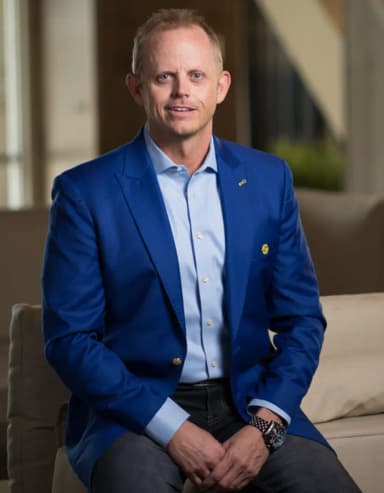
Welcome back to the Daily Mastermind. George Wright III here with your daily dose of inspiration, motivation, and education. I hope you are off to a great start this week. I hope you had a great weekend. Looking forward to some of the topics that we're going to be talking about this week. And we'll be covering things like overcoming your fears and creating your own destiny. and then I've got a book review of Thinking Grow Rich where we're going to really dig into some detail. Surprisingly, I had a few individuals that I know tell me that they had not read Thinking Grow Rich and so I feel like it's something that we'd want to highlight right away here. Okay, so let's start with the Daily Mastermind quote of the day. If you don't have the mobile app, go ahead and download that. It's free and you've got all kinds of stuff in there. In fact, we've added a whole bunch of new e-books and audio books as well for On the Go, Motivation and inspiration. That's the Daily Mastermind mobile app, and you can get that on pretty much any platform. So the Daily Mastermind quote of the day is by Napoleon Hill, and it's, every failure brings with it the seed of an equivalent success. Every failure brings with it the seed of an equivalent success. And I love that quote because it really just teaches us to view failure as an opportunity, and that's a common message that we have here. So today, what do we want to cover today? What I'd like to do is I'd like to talk to you about the idea of, excuse me, about, you know, recognizing the freedom you have, no matter what your circumstances are, no matter where you live, no matter what kind of environmental constraints you have, the freedom that you have to choose your destiny rather than have your destiny chosen for you. And what I want to do in order to emphasize this message for you is I'm going to read from you a It's a really short speech by John F. Kennedy. Now this was a speech given back in September of 62 but it was a really infamous speech and it just goes to show you that there are certain topics and ideas that are timeless but that are etched in history And I really want to read you this because if you haven read it or you haven heard it before many of you may have heard it you know, it really emphasizes this idea that you can choose your destiny rather than having your destiny chosen for you. And it also emphasizes the idea that we choose things that are hard for a reason. So let me read you this and then I'll give you a couple of thoughts and we'll get your day off to a great start. He starts by saying, a time span of just a half a century, and then stated in these terms, we know very little about the first 40 years, except at the end of them, advanced man has learned to use the skins of animals and covered them. Then about 10 years ago, if we're talking in terms of a half decade, half century, then about 10 years ago, under this standard, man emerged from his caves to construct other kinds of shelter. Only five years ago, man learned to write and use a car with wheels. Christianity began less than two years ago, and the printing press came this year. And then less than two months ago, during this whole 50-year span of human history, the steam engine provided a new source of power. Newton explored the means of gravity, and last month, electric lights and telephones and automobiles and airplanes became available. Only last week we developed penicillin and television and nuclear power. This is a breathtaking pace and such a pace cannot help but create new ails as it dispels old So it not surprising that some would have us stay where we are a little longer to rest to wait If this capsuled history of our progress teaches us anything it is that man in his quest for knowledge and progress is determined and cannot be deterred. We shall send to the moon 240,000 miles away, a giant rocket, more than 300 feet tall, on an untried mission to an unknown celestial body and then return it safely to earth. But why, some say the moon, why choose this as our goal? And they may well ask, why climb the highest mountain? Why 35 years ago fly the Atlantic? We choose to go to the moon. We choose to go to the moon. We choose to go to the moon in this decade and do the other things not because they are easy. Listen to this part here. Not because they're easy, but because they're hard. Because that goal will serve to organize and measure the best of our energies and skills because that challenge is one that we're willing to accept, one we are unwilling to postpone. And therefore, as we set sail, we ask God's blessing on the most hazardous and dangerous and greatest adventure that man has ever gone. Now, as you know, and that's the speech, it's pretty short, but pretty infamous, if that's the right term to use. But listen, this was designed to help gain support for the Apollo program, which is the program that Kennedy wanted to use to send a man to the moon. But I want to highlight a couple things here, and I think these are really, really good success principles. One is that we choose things because they're hard, not because they're easy we choose things because they're hard because they're gonna challenge us because they're gonna give us the best possible outcome the best possible version of ourselves that's why we choose hard things the other thing that it points out is that we choose not to postpone that we choose to take action see procrastination is the enemy of greatness And what you need to do is you need to learn to take action and not postpone your dreams and goals and desires and things that you have. Because if you postpone them, you're postponing your own happiness, your own fulfillment. So I encourage you, I encourage you with this, the ideas from the speech, to choose the difficult path, to choose to take action and not wait, and to choose things that are hard for that very reason, because they're hard. Because we know that in order to create the best version of ourselves, we have to get outside our comfort zone. We have to do things that are difficult. We have to challenge ourselves. That's why we do things. We do things to challenge ourselves. And when you adopt that as your philosophy, and you adopt that as your philosophy or operating system for you to grow in your life, in your business, in your personal and professional life, you're going to find that you're going to be so much happier. And then, you know, sort of like Kennedy said in his speech, all the other areas of your life are going to align around this hard, difficult, driven goal that's out there. Your mind, your body, your spirit, your relationships, your business, your activities, everything's going to align because you're going to be striving for greatness. So that's the idea that I want to plant in your head for this week. Later this week, we're going to cover a lot of different details, but that's a strategy, a thought, a principle that I want you to really consider throughout your week and throughout your life. Are you striving for the difficult? Are you taking action rather than postponing? And are you looking for the challenge? That's my message for today. Do me a favor. Go over and share this podcast and then go hit me up on The Daily Mastermind on Facebook or Instagram. Let me know your thoughts. Let me know what it is that you struggle with. What can we do to help you in our ongoing effort to provide you with inspiration and motivation every single day? Anyway, this is George Wright III. This has been The Daily Mastermind. Have a phenomenal day.