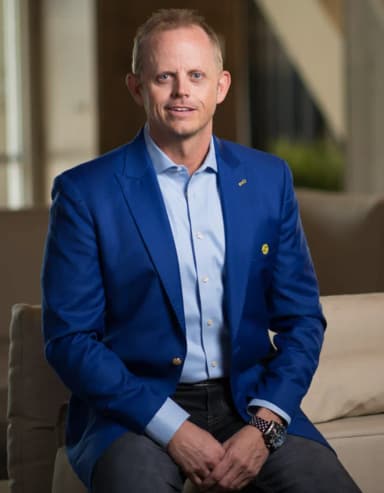
All right, welcome back to The Daily Mastermind. George Wright III with your daily dose of inspiration, motivation, and education. And we are going to get into some really good stuff today. I'm super excited to have a special guest on the show, Donny Case. How are you doing, Donny? I'm doing just fine. You doing okay? I'm doing great. I'm doing great. I'm excited. You've got such a great background to get into some of this stuff. We got people that, you know, because we have people that listen to our show that are CEOs, business owners, investors, funding sources. But at the end of the day, they're always looking for those strategies, the stories, and you've got a great one. So let me give you a little intro before we get into it. For those of you just joining, by the way, if you haven't already, make sure you hit that like and subscribe button so we can make sure you don't miss any of these episodes. But I'm going to talk to you today with our special guest, Donnie Case. And just to give you some of his background, he's a HVAC industry veteran. I mean, he's had a career we're going to go deep into, but he's also the founder of Air Scientist Solutions. And he's an inventor, an innovator, a global impact leader, because just under his leadership, the company's grown to serve multiple continents, impacting millions of lives. And he recently won the award, the 2024 Global Recognition Award for his contribution in tech-driven sustainability. So he's super passionate about what he does and he's got some great stories. So Donnie, I'm really glad you're here, man. Thanks for taking some time. It's my pleasure. Well, listen, let's do this. Can you do me a favor and just share a little bit of your journey? Because I'm sure some people are thinking, okay, HVAC industry, and now he's a founder, scientist, inventor, whatever. Share us your background and what took you into this field on some of these cool innovations we're going to talk about today. Okay. It's kind of a long story and I'll make it brief. I'm a military veteran. I picked up my first set of Freon gauges when I was in 82 in the Navy. I got out of the military and I went into the HVAC technician and I owned my own company. And during the time that I was owning my own company, I was noticing a lot of things about it. So later, after a long term of noticing things, I went to college in 2009. I came out of college with a master's degree in 2015. I think outside the box, I didn't want to go in. I already had an engineering background from what I had been doing. I knew the HBH industry. I went and got a master's in environmental policy and legal studies. During the time that I was in there, I'd done research on indoor air quality. Doing the research on the indoor air quality, during that time, I was also doing research, was going out and doing jobs, doing things, and looking at the overall operation of how its systems were and how they had been the same for years on year. And wanting to do an impact on air quality, health, and all these different things with a science degree and applying it to the mechanical side, I turned over to working with doing, Instead of changing the environment outside, I figured I couldn't do that. It's going to take nations. I would change the environment inside. Changing the environment inside, I noticed that a lot of the things that were put in in air conditioning back in the very beginning were totally obsolete, outdated, and they stayed on that track. So I came up with a method and a plan of total change. And I have an excess of about 40 something patents that I'm going to be coming out with. The first one that I came out with is the Wi-Fi smart unit. And the first one is going to be in a retrofit. So it'll go into a new unit or it can go into an existing unit. And that's where I'm at now. Yeah, no, I love that. And actually, I want to dig into a bit of that, but I want to point something out to people here, because one of the reasons I asked Donnie to be on the show, and as you guys know, there's not very many people that I'll interview on the show, because usually what I'm looking for are these success pieces that most people overlook. And what I wanted to point out is you, so there's a lot of people in HVAC, there's a lot of people in engineering, there's a lot of people, but you were not only inquisitive, this is the point I want to make to people. He was questioning how things work, how they weren't working. He really wanted to understand. But the other thing that I really love about what you just said, and I don't know if this is just something you've been your whole life or not, but you also didn't just accept the way things were working. You were asking yourself, this doesn't make sense. And it's the most successful people out there are the ones that don't just take at face value why we do things we do. Most people go their whole lives. They don't even know why we do things we do. But you were questioning that, and had you not been doing that – no, correct me if I'm wrong – had you not been questioning that, you probably would have never come across this technology, this new solution, and things like that that drove you to that direction, right? Were you just always an inquisitive person? I have during the time of uh uh before I went to college I I had a a thing about the indoor air quality and all the products and stuff that they had going on with it and I just didn't feel that it was doing what it should and I had to know a lot more about it so yes I had to have answers that I wasn't able to attain just being in the field. I had to have a degree and the capstone, the studies to go behind it. And I'd done it from aspect of science because I didn't want a mechanical degree, which is what most heating and air people do. They got a mechanical, electronic degree or something of that nature. Mine was a science degree. Yeah, so you actually just made a great point I also want to point out to people, and that is that don't assume the path. And also you got passionate about air quality, right? Most people hear HVAC and they think business, engineering, whatever. But there was actually some interest and passion behind air quality and you found the avenue you could affect it in. Okay, cool. So let's talk about this new Wi-Fi technology, this first patent that you said you're bringing to market. Tell us what that is and how is it different than what people normally know? Tell us what the product is and how it works. But what it is, is it's a board that will go inside the HVAC unit and it will communicate information from your unit to your telephone to an app. If people, I don't know if people are familiar with the Wi-Fi, the Wi-Fi smart thermostat. I'm assuming people are. Like the Nests or things like that. I don't want to make up brand names. Definitely not a competitor. Not only that, but you know what's interesting? I don't want to interrupt you, but I want to say this. People are innovating things on the surface like Wi thermostats right Where you innovating things to re it So keep going Well here the thing A Wi smart thermostat is on the wall It very limited to what it can do. It cannot gather information other than what's inside the house, like the temperature, room temperature. And it saves you energy because it does what it does from the house. It might turn your unit off a little early on a hot day so that it'll start not running so much till it cools down that evening or something. I've studied the thermostat. I'm not impressed. They call it artificial intelligence that they use, and they're right. It's artificial. It's not real intelligence. It's artificial. With a Wi-Fi smart unit, the unit is talking to the board that's talking that actually what's going to save you more money, cutting the unit off or making sure it's running efficiently. When you have over 80% of the unit in the world that are operating in an improper setting, they may be a few degrees off superheat. They may be a little bit off airflow. Something may not be right with that unit. If it's running an extra two hours a day because something's not right inside that unit, it doesn't matter how efficient it is. It's not smart. Wow. So, okay. Now, I got to read this back to you because I'm not techie at all, right? but I think I got you here. Well, this is crazy because what people have been doing in the industry with what we think is technology, you know, smart thermostats or control your phone, or actually the real purpose of that is just convenience for me. What you're saying is you develop something that is more integrated that actually will create real solutions by, you know, analyzing how efficient things are. So what does that do? Does that translate to better, efficiency for your costs for a homeowner, as well as how you're regulating and all that? Let's say this. Let's say that your filter gets a little dirty. And I procrastinate a lot myself. And I know being in the business, most people will know their filters time for change and they won't get up and really do a lot about it. With a Wi-Fi smart unit, your unit's going to say, it'll send you a message you're running 80% efficient now I don't know if most people are like me or not I'm assuming some may be if I'm sitting there and I think my filter's dirty and I need to change it I might procrastinate but when my phone sends me a message telling me that the unit's running 80% efficient I'm going to change that filter plus most people don't even know period that even if you're not thinking about it. You don't have to. We don't need you to think about it. You're just going to hear that. That's kind of cool. I like that. How else will it help people overall? So it diagnoses everything. It'll help you with efficiency. What else? There's a lot of things that it does, a bunch, and I'm going to try to label some of the more impressive things that it'll do. There's different stages of the Wi-Fi smart unit. It's like a car with a lot of added options and less often depending on what you get. But let's say that your message shows up that you're running 80% efficient, right? And it says you need to have, check it. So the first thing you're going to check is your filter. And you check your filter and it's not dirty. And it still says it's running 80% efficient on your phone. So you call a company. The company sends a technician out there. The technician comes out there. He's only done it for a couple of years. He don't really know what he's doing. He goes around your unit. he pulls with it for a while and he comes back around and he hands you a bill for 400 he tells you it's fixed he changed the part you take out your phone you pull it up you go no it's not it's still running 80 efficient it keeps companies honest it protects your pocketbook it protects you and it they don't are not able to leave saying that it is big when it's not donnie that's huge because i can tell you i mean that's my opinion right disclosure 90 of people i know would be like Like there's no way I'm having a guy come out because he's going to charge me for something that doesn't need to be done. And I don't even know anything about it. So I wouldn't know any better. And, and this is kind of like, it's funny because I go ahead. We've got something for that too. Well, it keeps them honest, right? It does. But here's another part to it. We have a process in there. And in that process, what will happen is they pay a subscription to Air Scientist Solutions. Aircraft is solutions to give them an assigned company. Oh, like a watchdog. Yeah, we're like a watchdog. We monitor what this company, we make sure that they know what they're doing, in a fence. And I'm going to cover that. What happens is in all the units, you've got little things that something goes wrong, it flashes the light and it tells the technician what to look for and everything. Well, here's what we've done. And we've taken this information stuff. It's already in the unit, pretty much. And minor changes, add the board, make it a smart unit, communicate with your phone. Your unit tears up. It says it's running 80% or 75% or whatever it is. You call the company assigned to you. They'll say, give me a password to get in your unit. The homeowner controls how long that company can go in that unit. It locks out after two hours or whatever. They go in the unit. they have a code from us that code allows them to go into the tech center of a smart unit the tech center data center will tell that company what's wrong what the unit's found they can pick up the part call the homeowner say we're on our way out there put your part on go out there they say it's a ton of trouble a lot of troubleshooting and it's not perfect i mean there maybe a time or so that it won't hit, but, uh, that is just the same theory behind getting your car checked with one of them little devices that you plug under the dash. Yeah. And you know, what's funny is if, if, uh, this is crazy because think about this process. Normally you have to pay money to have someone come out to figure out what it is and you're paying money and you don't even know what it is. And it could be something you could have fixed or you can't fix or you can't afford to fix, but you have to pay the money anyway. Here's what's crazy, and then we'll kind of move on. I love the idea that technology is being applied to a lot of things. What I think I want to highlight about you and your technology is you're not adding efficiencies and things. Yes, you're doing that. You're re-engineering the whole thought process, and I think what's happening in the current marketplace is more and more people are seeing that things are innovating at such a fast level that they're being re-engineered. And that's what I love about what you're doing. I love that it's, you know, sustainability, efficiency, cost, ease, convenience. But does this, one last thing on this, and then we'll kind of move more into a business side. How does this affect, you know, sustainability and your original passion for air quality and those kinds of things? Does that still hit that mark for you? It does. This doesn't really reach into the air quality end of it. As far as sustainability, it takes a lot to build the fancy pretty thermostat that they have to hang on the wall. They call it a smart thermostat. We're building a board. It's more like the Jeep to do the job not to look And there doesn have to be a wire run from the unit going up inside the house in the wall and mounting it on the wall It all in the unit So when you go out there you cutting your labor down You cutting your time down You cutting everything down So that's money. And that's your fixation. That's all added in. Well, it's transparency too. You have transparency on cost, efficiency, everything, right? And a lot of people, they have to sometimes when they want something worked on, they want it worked on during the day. They're at work. They take off work and come home and get it done. And with a Wi-Fi smart unit, you wouldn't necessarily have to do that. You can call in and say, my unit's not running right. I want to check. Oh, my God. And you can get the password. They can look at it from a distance and say, well, this is what you got wrong. It's funny. I just recently, I have a condo that I had to have somebody come out and check the air. They give you a window that's like freaking all day long. And then they never come during the window. So anyway, okay. So let's move on to something here because it's clear you've got some really cool cutting. There's no way we could possibly go through all the stuff you have, but cool stuff coming. I want to ask you for the listeners, what kind of challenges did you face? Because I think it's one thing to come up with a really cool next-gen thing, but to innovate, what kind of challenges are you facing bringing this thing to market for your business? What did you have to overcome? What are some things that you've had to do in order to really establish yourself as a player in the industry? Give us just some of your challenges or obstacles, because most people in business, they're dealing with obstacles, and you're knocking these obstacles down. What are some of the biggest ones you've had to deal with? Some of the biggest ones are bringing aboard investors and people coming into it that want to get behind this. It's a startup. It's deep tech, it's very complex, but it's very big, and it's gonna be a massive change of an industry is what it's gonna be. That chain has been a thing. The other obstacle that we hit was going out and trying to figure out who was going to want to buy this or who was gonna want to move on it. if we were wasting our time or if people would really consider that. So we had to do that. And we approached different retailers, different heat and air companies. We've done like a survey of heat and air companies and people in general. And we didn't really have any negative feedback. And from the ones that we approached and talked to, they were indicating a very willing large order for a stock surplus. Yeah, so what did you guys decide to do? Like, did you, I mean, and maybe it's all of the above, but are you going through distributors straight to retail? Are you doing things, like, tell me what your channel is you're starting to go through. We're going, we're not going to take it straight to the public. we're planning on selling to distributors and retail distribution centers or whatever. Yeah. But this is a global solution, right? I mean, I'm assuming, I don't know much about HVAC. We have one company that is very, very interested in it. They've got like 13,000 outlets globally, 13,000 outlets. and they're looking at the potential of their first order. If we get it where we can handle that kind of an order, they're looking at a first order of about a million dollars. Yeah, so guys, listen, this is one point I wanted to make, and this is the challenge that a lot of businesses have, especially if they have something as innovative as what Donnie's talking about, is make or buy, what channel, and then usually if you have something big, you know, some of the things that hold people back is they don't have the ability to fulfill. And yet a deal like that could take you next level. So it is very interesting to look at. But I also think what you've done is a good job of really methodically, you know, going after this. And I do think that I know just from talking to you before the show, I know you have a lot of people looking at this. So there's a lot of interest and a lot of people that are looking to go. Because when you see trends and innovations in industry, especially with the patents you have and the tech and stuff that just makes logical sense, a lot of people, like if you're listening to this show, you're thinking to yourself, man, I don't have to know a whole lot about this detail when I know that trend is a no-brainer. That's what happens. So what have you done? What have you done? Because I know you've gotten a lot of awards. Tell me about this Global Recognition Award. And just do you think that that's because you also have this passion behind what you're doing? Or is it strictly tech? Or is it both? The awards and recognition you're getting. I don't think it's as much the passion behind it as the attention that it gained, that it picked up. So we have a wow factor, and all of the media, the outlets that were going to carry the story, there was a wow factor with them. So I was going to ask you. I interviewed a guy that is just known as being an inventor, and he talked about different things. And so I don't know this, but I just thought I'd ask you as long as we're on. Are these design patents? What kind of patents and trademarks and things do you have on this product? But currently now, we've got a patent attorney, and he's trying to patent for it and managing that. So you brought in experts to be able to do it, which is what most businesses should do. We have a complete law firm that's doing it. And we had a pitch deck made up by a third-party professional outfit. But then the pitch deck, it breaks it down. And the pitch deck is on our website. But the pitch deck, it goes into the potential. You know, they check everything out to make sure that what you're saying is what you tell them. They only want a fact. And they came out with the order based on what we said. We had like four companies looking at a $5 million order, first order. Wow. That were interested in it. And they said, if all the companies follow suit with what they did, there are 9,600 similar outfits like this in the United States alone, that would total something like $7.6 billion or somewhere there about. How big is the HVAC industry? I'm curious how big like our, or this industry you're in. It's enormous. I mean, if we start going and doing licensing with this where units come out and that's where we're thinking it's headed eventually the thermostat's going to be obsolete you'll get a unit it'll it'll show up it'll be a smart unit which makes more sense yeah it'll be a smart unit there won't be a thermostat with it and we'll have licensing with all the unit manufacturers to to put this in their unit from the factory wow and and then we got an open sale of the retrofit kit which will go on any older unit you can take a 20 year old unit that they're running and make it it a smart unit with less trouble than changing the thermostat on the wall. Wow. There's a huge well and efficiency of units because replacement of units is just is a big cost for homeowners So it interesting Well you know it I love your story because you know you got a background in this niche but you don have to you know you brought in experts you bringing in marketing and branding you bringing in attorneys you bringing in patent people This is something that most entrepreneurs or business owners listening to this need to realize is that secret sauce is around things you're passionate about and that you can innovate. and you've always kind of had those questions. What advice would you give entrepreneurs that are maybe looking to innovate or get into industry? Is there any personal advice you'd kind of give them? You would do differently maybe or over if you could do it again? Well, I don't know that I would, I don't know that there'd be a really different way that I would do it. It's been a journey and a fight all the way through. All I can, the only advice I give is believe in what you do and stay with it. Don't give up. Whatever the fight is, stay in the fight because it's going to be a rollercoaster ride. It's going to be ups and downs. Stay in the fight. Believe in yourself. How do you keep yourself motivated? How do you keep your, because, you know, look, you're running a business, you're running businesses, you got patents, you got knowledge, you got this thing. How do you keep yourself motivated? I say focused on the positive things. I stay focused on the goals and achievements and the ultimate goal of what I'm trying to get out of this. And that is the main thing behind what I'm doing. America, I'm an ex-military man, as I stated earlier. I took an oath in the military to to protect and defend this country against the enemy foreign and domestic. And one of the big things for me is I never thought that the enemy that I would be fighting would be for jobs and for the small town and for good paying jobs and for American made. So the one big thing with this is I'm going to have something that we can put out there. We'll put manufacturing center in various places around the United States and areas that need it. that need jobs that need income and put American made back in these small towns. I love it. That's the ultimate goal that I'm after. So I'm not just after it in this for my own gain. It's to help people. And it goes back to my military days. What a great answer. Yeah, what a great answer. I started up a C corporation. So we really have, you know, if you take, I call them vampire chain store. They come in and they open up and they close down all the mob and pop operations and they drain a community because they're taking money out, taking money out. Every time you shop there, money leaves town. With what I'm doing, we're going to go in and we're going to drop a manufacturing and a shipping center in a community and they will go to work. They'll make good money and that manufacturing is going to be selling globally. So it's not going to be draining that community. it's going to be pumping money into the community. I love it. There's a big difference, yeah. Yeah, well, you said two things that I think are very worth noting, and I think this is helpful for entrepreneurs. I noticed this the first time I talked to you because you kept talking about how big this is going to be and how much opportunity and all this stuff out there, and it's the common element I hear from some of the most, not talking about, I'm talking about the most successful people, not people wanting success. They say the same thing you did. the vision of what you're creating is what motivates you through the journey. And so if you don't have a big vision, like Donnie's talking about with his thing, it is hard to get motivated. But when you have a big vision and you're focused on that vision, it carries you forward instead of just constantly getting through the minutia. So that's the first thing. The other thing is you do have a why and a purpose behind it. And, and I think even when the road's rough, it's hard to see your vision and this and that, when you got a purpose behind it and you're not doing it just for the dollar or just for yourself, I think that's what sustains you as well. And, and I didn't actually know that even though we had talked and I knew you had this air quality vision and stuff, your, your military background and made in America and things like that drives you. And I think most people ultimately in life get to a point, we're both a little older, right? We realize that you got to do it for a reason. And Simon Sinek has this book called Start With Why. People will buy into the vision, invest in the company, do all kinds of things when they know there's a reason to do it because the detail is going to be easy to figure out. So I appreciate you sharing that because it helps people know that you have a big vision and that you have a purpose and a reason and a passion behind it more than just making money, which, by the way, I think you'll make a ton of money. So I definitely wish you the best of luck on that. Well, I know we're out of town, so before we go on, Donnie, is there anything else you would like to add for the listener about what you're doing or any last thought? Well, the one thing that I would like to add, with anything that we do, it is ultimately about people. So that is my big thing. I've got plans for helping homeless, helping doing a lot of different things that I can't do without making something big. I have to have something big to have the things that I want to, uh, a homeless. You can do more good with something big than with them, right? Exactly. People over profit. I sit back and watch people not, they're living on the street, they're having a hard time, they can't eat, they don't have, and I can do something if I've got something to do with. And that's one of the big things. So it's not just about providing jobs as much as it is helping people in general, whether it be a job or have them get on their feet or for their home anything anything in that nature well listen uh i i love to hear that and and if you're listening to this show you know you might have started out wondering you know what what we're talking about hvac for but i think you're realizing pretty quickly that you know the innovation the way you think how you do anything is how you do everything and so whether you're listening to this and you're saying you know hey hey, that's stuff I like to be a part of, or I'm an investor, or I'm a homeowner, or I'm this or that. If any of you want to connect with Donnie, I talked to him about this earlier in the show. I'm going to put a link in the show notes to his website, to his content, to his information. I encourage you to get out there and connect with him. Maybe you just learn some stuff about what it takes to create a vision bigger. I mean, he's got a vision bigger than the industry itself. So, Donnie, I appreciate you being here, man. This has been very helpful. I think there's a lot of insights people have gotten. I appreciate you being here. This has been great. And listen, if you're listening to this show, please do me a favor and share the show. And we appreciate you supporting us. We appreciate you being part of the Daily Mastermind. And with that said, Donnie, I just want to say thanks one more time. Okay, thank you. It was an honor to talk with you. All right, guys, have a great day. We'll talk with you soon. People use感覺 which they'm not quite interested in. Employers and micropofol.