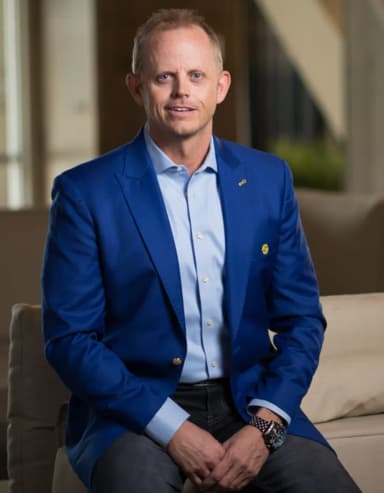
George Wright III
Brad Sugars: [00:00:00] I wrote a book called "Billionaire in Training" because I wanted people to understand your personal growth [00:00:05] path, 'cause we all start out as students, right?
And we're learning to be in business as a [00:00:10] student, but mostly what we're learning to is get a job, so we become an employee. And I teach all young people, [00:00:15] as an employee, you should be looking at it as an apprenticeship, right? And, and [00:00:20] forget how much you make in your first four or five jobs. Be, "Where can I learn the [00:00:25] most?"
Because if you get a job where you've got a great mentor or a great learning opportunity, that will [00:00:30] set you up for life sort of thing,
George Wright III: [00:00:35] All right, [00:00:40] welcome back to "The Daily Mastermind." George Wright III with your daily dose of inspiration, motivation, and [00:00:45] education. I've been trying to line this interview up for a while. Brad Sugars, how you doing, brother?
Brad Sugars: Wonderful to be [00:00:50] with you today
George Wright III: Yeah, listen, a couple of busy guys, but I'll tell you what, um, you know, if you are [00:00:55] listening to this and you wanna build a business that works without you, and you wanna be able to get some direction, this is [00:01:00] what we're gonna be talking about today.
So let me give you a quick intro to Brad, uh, and his amazing, um, [00:01:05] topic. But also makes- actually do me a favor, guys. I wanna hear from you. Hit me up on "The [00:01:10] Daily Mastermind." If you haven't, uh, already subscribed to the podcast, we've got some great stuff coming up. [00:01:15] But Brad, um, is one of those guys... Look, he's the founder of ActionCOACH.
Um, he built [00:01:20] ActionCOACH into a global organization, 1,000 offices over 80 countries. You know, over 30 [00:01:25] years of experience with entrepreneurs, businesses, you know, author, educator. He's [00:01:30] written numerous books on business growth and leadership, and he's host of "The 100 Million, uh, Entrepreneur" [00:01:35] podcast. So I'm just glad to have you here, brother, and I, I want you to just tell our audience what [00:01:40] brought you into this whole space in the first place.
We don't have to take a ton of time on
it, but I, I-- wanna get your perspective.
Brad Sugars: it [00:01:45] was an, it was purely by accident, you know? I, uh, Rob Kiyosaki asked me to go and teach, uh, [00:01:50] when I was 20 or 21. And, uh, so 1993 he put me on stage [00:01:55] because when you're a young man and you achieve stuff in business, people are like, "All right, there must be a trick to what [00:02:00] you've done. It couldn't just be hard work and learning and stuff."
But so yeah, when Robert put me on [00:02:05] stage, uh, in Hawaii, I just fell in love with the idea of teaching and, and, and [00:02:10] also, dude, I got paid and they paid me to travel around the world
George Wright III: Uh, the best
Brad Sugars: [00:02:15] everyone tells you, "Wow, that was amazing." It's like, yeah. So that's what started it. I started Action [00:02:20] Coach in 1993. You know, now we've done, uh, 2.7 billion [00:02:25] in total sales and, you know, we're the OGs of the business coaching space.
So
George Wright III: You [00:02:30] really are. And the thing is, is you get... The, the interesting thing is as you help all these businesses grow, you learn so [00:02:35] many, y- you know, lessons and ideas and what works and what doesn't. [00:02:40] But one of the biggest concepts, the re- main topic I wanna talk to you about is, you know, why do so many entrepreneurs end up [00:02:45] creating a job for themselves?
Brad Sugars: Yeah, look, uh, mostly what happens is, so [00:02:50] there's three phases in business. Phase one is getting to your first million, which most people never do [00:02:55] because they do create a job for themselves. See, what works in the beginning is you hustling, you [00:03:00] doing the work, you being the center of the business, and that works to several [00:03:05] hundred grand sort of thing.
You can do that, you and a few helpers. And, and great. [00:03:10] The problem is what got success in the beginning will stop you going [00:03:15] further because instead of you being the controller or the central hub, you become the [00:03:20] bottleneck. And so that bottleneck thing means that you've gotta learn to [00:03:25] build managers in the company, and that also means letting go.
And so most people [00:03:30] don't wanna do the growth. They don't wanna do the learning and the changing because every new goal [00:03:35] requires a new you. That's why, you know, it's-- you've gotta grow into your goals, and that's why [00:03:40] we live in an epidemic of wimpy goals because it's easier to stay where you are, do what [00:03:45] you do, and just keep grinding it out sort of thing.
And so, you know, what I teach [00:03:50] people is how to build a business that can run without you. You know, my, my definition of a business [00:03:55] is a commercial profitable enterprise that works without you. Um, and jokingly, it's, you [00:04:00] know, I, I had to learn this as a young man. If I have to be there, it's not a business, it's a job, and I work for an [00:04:05] idiot.
Um, you know
George Wright III: Yeah, exactly. We know that, right?
Brad Sugars: [00:04:10] Yeah. W- many, many people w-listening to this will be going, "That's not motivating." No, it's not. It's the... But it's [00:04:15] true,
George Wright III: But it's me. Yeah, like this is what they're thinking because they can't get back because they're so, they're so [00:04:20] convinced that they, if they let go of the strength that they use to get them where they want, it's gonna hurt their [00:04:25] business, right?
Brad Sugars: Yeah, and so this is where your phases of growth. So as i- in the [00:04:30] beginning, you're the manager, right? Phase two is you build managers. They get the job done whether you're [00:04:35] there or not sort of thing. And then phase three is you've gotta become the leader to build the [00:04:40] managers and, but then phase three is where you have to become a leader of leaders.
It's where you [00:04:45] become the CEO, and the only way you can be a CEO is if you have other C-level executives in the [00:04:50] company. No other C-level execs, you're still the leader
George Wright III: You're it. Yeah, yeah
Brad Sugars: [00:04:55] But those phases of growth come with different strategies as well, and [00:05:00] so I think understanding that your job is to learn to be [00:05:05] an owner, not learn to be an operator, not learn to be a technician, but [00:05:10] learn to be a business owner, and that's tough.
That's hard to learn to own [00:05:15] a thing that can run without you
George Wright III: Yeah, so, uh, I mean, [00:05:20] look, over the years you have, um, grown your business substantially. You've helped a lot of [00:05:25] businesses grow. And so I know you have several, but is there a kind of a specific framework [00:05:30] or sequence that you like to start businesses at? And, uh, and I'm also curious, [00:05:35] are you having businesses come to you that are coming through all these cycles?
Because we probably have [00:05:40] several of these l- different phased businesses listening to this podcast, so I wanna be able to [00:05:45] help all of them. Is there a, is there a framework or a sequence you kinda take all businesses through?
Brad Sugars: Yeah, so we [00:05:50] built a thing called the operating system. It's called the Action Coach Business Operating System, ACBOS for [00:05:55] short. And what it takes people through is six phases of business growth. The first being mastery, [00:06:00] where really what you're doing is getting control of the business. Rather than it running you, you start [00:06:05] running it.
So if you go back to my definition, that's where we build a commercial enterprise sort of thing. [00:06:10] Because in the beginning of business, you've got a product, product market fit, pricing [00:06:15] fit. You know, you got a proof of concept basically is phase one, but you've gotta build [00:06:20] profitability right there in the beginning, and a lot of businesses think they'll grow into profitability, and you [00:06:25] don't grow into profitability.
You start with profitability, and then you start growing sort of thing [00:06:30] And then the second phase is from mastery we go to marketing, and marketing, [00:06:35] what we have to do there is t- get control of cash. You know, how does cash go in and out [00:06:40] of the business? 'Cause the lifeblood of any business, and I'm preaching to the converted with you, is [00:06:45] marketing, because how you, how you get and keep customers is [00:06:50] fundamental core to the business, you know?
If, if we really break business right down, it's [00:06:55] two things: get and keep customers, get and keep people. You know, that's really what business [00:07:00] is in our simple world of, of what we try and break it down. So marketing then I break [00:07:05] into, uh, leads, conversion, transactions, average sale, and [00:07:10] margin. So I'm looking at the five things that are the core aspect of any marketing, and [00:07:15] most people don't know those numbers, so they're like, "Well, how do I get there?"
"Well, tell me your [00:07:20] conversion rate." "Well, I don't know my conversion rate." "Okay, first of all, let's know your numbers. Numbers is the [00:07:25] language of business, right? What is your average dollar sale?" "I don't know." "Okay, what's your repeat [00:07:30] business rate?" "I don't..." "Okay, let's learn those things." So that's why we built the operating [00:07:35] system and why, I mean, it's full software these days, you know.
It runs the business for people. You get [00:07:40] in, you get up in the morning and you look at... We have two dashboards, one that's working on your business [00:07:45] and one that's working in your business. So the, uh, that, the other one's called APEX, the ActionCOACH [00:07:50] Planning and Execution System. So you're looking at both of these dashboards every day.
You've got [00:07:55] clarity. You can see what's going on. Your team's plan is right there. You know who's doing what [00:08:00] by when. You look at your numbers and you go, "Hey, if we hire someone," again, let's punch it into the system, [00:08:05] and we hire someone. "Nope, that's gonna mess with cashflow. We're gonna go here, here." "All right, [00:08:10] when can we hire them?"
"Okay, in two months we can hire them." When... So those sorts of things. But then [00:08:15] phase three is systems. You know why? Because phase one is getting those [00:08:20] first two things done, and that should get you to your first million, doing mastery and marketing. [00:08:25] And then getting to your 10 million, it's about systems and then team.
So, uh, to [00:08:30] build managers, you've gotta build people and build systems sort of thing. So you go from, [00:08:35] in the beginning you're running the business 'cause that's what you do, you're running, right? And then you go into [00:08:40] build mode, and then you go into growth, and then you go into scale. So, you know, [00:08:45] that's, scale is step five, and there's five core disciplines of scaling a [00:08:50] business, and most people don't build the first four building blocks, and then they go [00:08:55] into scale and they wonder why.
It's like, "Dude, you're, you don't have your team set. You don't have your systems in [00:09:00] play yet. We can't scale yet 'cause you..." If there's two things you cannot scale in [00:09:05] business, it's you cannot scale chaos and you cannot scale genius. And, you know, you know [00:09:10] when there's chaos because there's complexity. And complexity, it's like, I, I [00:09:15] love using the example of Steve Jobs coming back to Apple.
Apple at the time had 300 and something [00:09:20] products. Steve Jobs walks in and goes, "Yeah, yeah, we wanna have..." I think he took it down to, [00:09:25] like, less than 20 products, and it's like, okay, now we're ready to scale 'cause we [00:09:30] got rid of all the dumb stuff that we should not be doing and, um, put it into [00:09:35] practice. But then you can't scale genius, meaning, like when I first started ActionCOACH, [00:09:40] everything was in my head, right?
So the first job was get it all out of my head so other people [00:09:45] can do it. But what I learned over the years, we started to stagnate at about 140 [00:09:50] million a year, and I'm like, "Why are we stagnating? Why are we not growing?" And it was like, duh, [00:09:55] it's no longer my genius. It's now my team's genius. And so I then had to [00:10:00] build the full software suite and build all those things so that I didn't need genius coaches to deliver.
We [00:10:05] still have a lot of genius coaches, but I can now take a person with five years [00:10:10] business experience and put them into the system, and they can be as good or a better coach than I [00:10:15] am because the system does the work. And now with AI helping them, it's, like, even [00:10:20] easier. It's like, let's analyze, and this is why we live in a time called digitize or die.
If you [00:10:25] haven't digitized your business, then AI can't help you
George Wright III: Yeah. Yeah, I [00:10:30] love these steps, and I love how you've put them too. I, I, uh, especially like, as you mentioned, [00:10:35] that step two is marketing, because even what you're finding nowadays in business, uh, if you're looking for funding, you're [00:10:40] looking to invest, I mean, the business plan isn't as important as the marketing plan. Um, and so this is, this [00:10:45] is so important. But I, I do like how, you know, the set up and the build and the scale. Um, I'm curious, [00:10:50] do you... And this has just been my experience. Do you find that as businesses are growing [00:10:55] through these phases and through these steps and your operating system, that there's a [00:11:00] big mindset shift that they have to do?
Is that one of the big obstacles, and how do you address that to [00:11:05] help people move from this idea of being an operator to an owner kind of a deal? What-- From a [00:11:10] mindset perspective, and then we can talk about systems as well.
Brad Sugars: Yeah. Look, I think it all starts with a [00:11:15] mindset of understanding that eventually you will exit your business. Once [00:11:20] we teach people that, look, you are going to exit, right? And if you ha- if you don't plan your exit, [00:11:25] then you're gonna have a negative exit. Either you kill it or it kills you, right? So that's the negative [00:11:30] exit, which happens to way too many business people.
The positive two exits are a [00:11:35] passive exit, and this is the sixth and final step of freedom. A passive exit where it [00:11:40] can run without you, or a financial exit where you sell the business type thing. Now, once we [00:11:45] get them to set a date by which they're gonna sell the business or have it able to be [00:11:50] sold. You don't have to sell it.
You can keep it forever, you know, but by what date will it be [00:11:55] able to be sold? In other words, it can run without you, right? Now, that might be [00:12:00] three, seven years down the road, but then we set the next goal of, okay, by what date will you get off the [00:12:05] tools? Okay? And they're like, "What do you mean?" I'm like, "Well, you're a plumbing contractor.
By what [00:12:10] date will you no longer need to wear steel cap boots to work type thing?" And they're like, [00:12:15] "I can do that?" I go, "Yes." But the biggest emotional shift, [00:12:20] George, is the letting go, you know? And that's the shift, and that's why, you know, [00:12:25] anyone can go learn stuff, but it takes a coach to help you work through the, the [00:12:30] emotional, mental things of, "But, but Brad," like [00:12:35] I was chatting with someone last night who's selling his business, and I said, "You know that most business sales [00:12:40] crash because the owner just doesn't wanna let go."
Like, uh, "But this is my baby. What if they [00:12:45] mess it up? What if, what if..." No. Look, there is a lot of shifts. [00:12:50] You've gotta go from-- And I, and I teach it in, uh, I wrote a book called "Billionaire in Training" because I [00:12:55] wanted people to understand your personal growth path, 'cause we all start out as students, [00:13:00] right?
And we're learning to be in business as a student, but mostly what we're learning to is get a job, so [00:13:05] we become an employee. And I teach all young people, as an employee, you should be looking at [00:13:10] it as an apprenticeship, right? And, and forget how much you make in your first four or five [00:13:15] jobs. Be, "Where can I learn the most?"
Because if you get a job where you've got a great [00:13:20] mentor or a great learning opportunity, that will set you up for life sort of thing, and [00:13:25] that's... You know, I was lucky enough to, my first real job was with Paul Dunn as my mentor and, [00:13:30] and like the guy taught me stuff, and I'm like, "Oh my God. Thank God." You know?
I had him at the company's [00:13:35] 29th birthday, and, uh, and, and it was just great to sort of see [00:13:40] that, uh, full circle moment. But once you get to be an [00:13:45] employee, your job is to be an apprentice business owner. And so when you [00:13:50] get into business, though, your first business is generally you're not an owner, you're a self-employed person.[00:13:55]
It's you, and you gotta do the taking out the trash. You gotta lick the stamps. You gotta do [00:14:00] the whole dang thing is you, right? But then you move to manager, where you start employing people. [00:14:05] Now, in the beginning, you work for them because you don't know enough at this point to have systems and [00:14:10] team and stuff like that, and you gotta work extra hard just to pay their salary in the beginning.
But [00:14:15] eventually it turns over, as long as you keep learning and growing. Eventually they start [00:14:20] working for you, and they start making the money for you, and you can step back and do management [00:14:25] jobs and start working on the business, not in the business. And then finally you can hit that [00:14:30] phase called owner, right?
Where it runs without you. You can take a week [00:14:35] or a month off and it- it'll, you'll come back and it's bigger than when you left sort of thing. But then [00:14:40] there's two other phases above that, which is investor and entrepreneur. An entrepreneur [00:14:45] you can go to scale-preneur too. Like, you know, the whole idea eventually is to be at a [00:14:50] point where you Ray Kroc something, where you find a great business and you just open it in thousands of [00:14:55] locations.
'Cause there's, there's no such thing as a billion-dollar company, George. There's a two million... Like [00:15:00] McDonald's is a $2 million company done in
George Wright III: Duplicated. Yeah.
Brad Sugars: You know, they've got tens of [00:15:05] thousands of $2 million joints. Subway is a $600,000 joint done tens of [00:15:10] thousands of times, you know? So you start looking at it from that perspective, and that's really all I do today.
I [00:15:15] buy companies that are good multimillion-dollar companies, and I'll put 'em in hundreds [00:15:20] of locations. That's essentially my goal every day, so
George Wright III: Yeah, I love how you break it [00:15:25] down because I think it really is systems and processes that are then duplicated. [00:15:30] And, and you're right, um, you know, that mindset shift takes a lot because people don't wanna let go. They don't wanna let their [00:15:35] baby go. But at the same token, there's a big difference between executing these plans and [00:15:40] systems, um, and, uh, a- a- and actually consistently doing it, right?
Like knowing it [00:15:45] and doing it are two totally different things. So you have, um, individuals that come in at [00:15:50] different phases, and I think everyone listening to this might be at different phases. But what are some of the [00:15:55] first systems, you know, that, that an average business should be looking to systematize?
Like what are [00:16:00] these, what are these first and, you know, beginning systems that an entrepreneur needs to [00:16:05] do in order to remove themselves from the business?
Brad Sugars: Yeah, I think it's really important to [00:16:10] understand that basic systems are checklists, right? Don't think about having to have massive [00:16:15] crazy systems. Start with checklists. Every pilot has them, you know, and they, they train with it within an inch of [00:16:20] their life, but a pilot still has a pre-fri- pre- pre-flight checklist.
You know what I mean? [00:16:25] So I would say where you start systematizing is, uh [00:16:30] things that happen most often. I, as a young man, I met Mike Bash. He was a [00:16:35] founding vice president of Federal Express, and he said, "Brad, 80% of business is routine. [00:16:40] Systematize it. 20% , 20% of business is, needs humanizing, so train it." You [00:16:45] know?
And today it's like 80% of business is robotic. Your computer does [00:16:50] 90% of your accounting today. You don't do the accounting sort of thing. Uh, you go to a car [00:16:55] manufacturing facility, it's 80% robots or more than 80% robots these days, and that's really [00:17:00] where we're heading. AI robots will do 80% of business, but that's where the [00:17:05] 20% now has become so dang important.
So if I was starting to [00:17:10] systematize today, I would do three things. Number one, a list of the most routine [00:17:15] tasks. Okay? So what are the things that happen every hour, every day? And you start by [00:17:20] systematizing the things that happen most often. You know, if it's a thing that happens every hour, like in our [00:17:25] restaurants, I have restaurant businesses, the cooking happens every five minutes.
So [00:17:30] how you h- the recipe and the system for making the sausage rolls at our Irish [00:17:35] bar, that thing better be systematized within an inch of its life 'cause you're doing that [00:17:40] 100 times a day sort of thing. You know? The stuff that happens once a month, not as big a [00:17:45] priority to systematize as the stuff that happens most often.
Second thing I would be [00:17:50] doing is digitizing every single thing you have. Go back and find every old marketing [00:17:55] plan, every old business, every report you ever wrote, and get it all [00:18:00] into an AI brain, okay? Because until it's all in there, it can't, can't be [00:18:05] helped, right? And there's enough... AI can take it. Now, if you...
The third thing I would be [00:18:10] doing is videoing stuff and feeding it to AI. So let's say I'm in the restaurant, right? [00:18:15] And I wanna do the making of the sausage roll, the system for making the sausage [00:18:20] roll. I'm gonna videotape it four times, the chef doing it. I'm gonna [00:18:25] get the recipe. I'm gonna have chef explain to me, I'm gonna ask chef 20 [00:18:30] questions on the, on, on this thing.
I'm gonna record it. I'm just gonna feed it all into AI and say, "Okay, [00:18:35] d- make this a system for me." And it'll use the video and take stills and [00:18:40] photographs. Like I'll, I'll probably take photographs as well. Like that's how fast you can create a [00:18:45] system today. You just got to video, audio, photograph, [00:18:50] document, question, and AI will turn that into a documented system [00:18:55] for you.
Say, "Give me a checklist on how we build the sausage roll." You know? It's so, [00:19:00] it's so much faster today than it was when, you know, when we first started and it was like, okay, how do you [00:19:05] create a system? ISO 9000. No, that stuff's bad. That stuff's too much [00:19:10] crazy, you know? But yeah, that's where I would start.
George Wright III: Okay, yeah, I, 'cause I, I do. I think sometimes [00:19:15] people overthink SOPs and
systems. You hear this term SOT, create your SOPs. [00:19:20] I love that you started with just checklists, capturing the stuff, automate it. [00:19:25] Go ahead.
Brad Sugars: One other thing, start with things that impact the customer journey [00:19:30] first. Things that impact getting and keeping customers. It could be [00:19:35] sales scripts, marketing strategies. You know, that stuff has to be done [00:19:40] first, um, because the money-making side of it is really important. People [00:19:45] think that the first thing they should systematize is how you deliver the product.
I would [00:19:50] do how you get the customer and how you keep the customer first because that's the money side [00:19:55] of
George Wright III: Brad, I'm so glad you just said that. That, you nailed it, 'cause I just made a note and I said, because I think a lot of [00:20:00] times, um, especially entrepreneurs, they gravitate towards, well, uh, because they think of [00:20:05] lists, right? "Well, I can knock that out." And they feel like they're productive, but they're not.
They're just [00:20:10] active. They're, they're being busy, and they're creating all these things. Now, now we of course need to systematize those [00:20:15] too, but at the end of the day, if you do it with relation to things that impact the business in a [00:20:20] result with profit, with sales, with customers, with long-term retention, so it's still customers that you've [00:20:25] already captured, right?
Brad Sugars: Mm-hmm. Like you think about systematizing sales [00:20:30] today. Record your best salesperson 20 times. Give it to AI [00:20:35] and say, "Turn this into a script everybody can use."
George Wright III: Yeah.
Brad Sugars: You know? And by script I don't [00:20:40] mean documented every single word, I mean, you know, an outline of these are the things that, these are [00:20:45] the things that George does when he's selling that makes it effective, you know?
And [00:20:50] it's even... But you can take AI and use it in leadership. I have AI record my meetings, [00:20:55] and it's like, okay, what percentage of the time was I talking? And I, I found out when I [00:21:00] first started recording, I was talking 40% of the time in a 12-person room, and it's like, "Oh my God, [00:21:05] shut up, Brad." You know? "Don't talk.
You're, you're crushing your [00:21:10] own meetings by being the guy talking all the time. Shut up." And now I've got it [00:21:15] down to below 20%, so I'm like, "Fantastic," you know? It's... And which means I'm just asking [00:21:20] questions. That's another thing I asked it. Am I... When I talk, am I asking questions or am I s- you know, [00:21:25] espousing things?
And it's like, "Yeah, you're talking." And I'm like, "Oh, dang."
George Wright III: [00:21:30] This is why the,
Brad Sugars: asked it like, "Do, do I cut people off?" And it's like, "Yeah, you cut people off too [00:21:35] often." I'm
George Wright III: you know what? We, yeah, you and me both. Um, but you know, it's interesting because now you don't have to [00:21:40] overthink it for sure. So I, I like, I wear a wearable, and I can, I, and I just connect it to my, um, to [00:21:45] my Claude and my second brain and, you know, I can just say, "Hey, who did I talk to yesterday, and what were all the transcripts, and [00:21:50] what can we feed those into and gain from it?"
So you don't have to overthink it. You just have to be willing to [00:21:55] capture what you're doing. Otherwise, you're like, "All right, I got a sales call coming up. I'm gonna record that." No, [00:22:00] take all your Zoom meetings you had, throw them in there. Uh, l- you know, ask for the ones that are sales [00:22:05] related and pull them together. I do think that there's... You, you talk about this a bunch. You say, [00:22:10] and so there's a little bit of a transition because I, I don't wanna lose the thought we had with creating systems, [00:22:15] but I think a lot of entrepreneurs, and you've mentioned this, they don't really have a strategy problem, they have an [00:22:20] execution problem. And so when it comes to getting things done and doing it, knowing what to do but [00:22:25] doing it consistently, what do you say to that, and how do you help individuals realize they [00:22:30] gotta stop planning sometimes and just start executing?
Brad Sugars: Yeah, so go back to the [00:22:35] 80/20 rule. 20% of life should be getting ready to work, and 80% of life should be doing the work. [00:22:40] So you got Monday, the first half a day Monday, and the final half a day Friday is [00:22:45] your working on time, right? And, and doing the plan, doing [00:22:50] the learning, doing the things, all that stuff.
Get ready to do the work, and then [00:22:55] Friday afternoon, plan the next week and get ready to do the work, if that makes sense, you know? Uh, I [00:23:00] like to teach people work from home Wednesday as well, because it's like, okay, I... on Wednesday, I want you [00:23:05] to stop going to your office or your store. I want you to work from home where you work on, not in [00:23:10] type thing, and you start doing the planning and the systemization.
But when we talk about [00:23:15] people having an execution problem, it comes back to one main relationship problem, [00:23:20] and that's called you, your relationship with the owner and the CEO. So if you're the [00:23:25] CEO and the owner of the business, you do a bad job at both, right? You cannot hold [00:23:30] yourself accountable. I've only ever met one person or two people in life.
One was Jay Cutler, who [00:23:35] was, you know, Mr. Olympia, like however many times, and, uh, David Goggins. [00:23:40] Those two guys, they have self-accountability levels
George Wright III: Yeah
Brad Sugars: Rest of [00:23:45] us? No, we don't. We don't have... Like, for me, when I'm-- if I've got my trainer [00:23:50] working out, I'll work out at least twice as hard as I would if I'm doing it by myself.
You know? Then he's [00:23:55] like, "Do two extra. No, make it four extra." And I'm like, "Damn it, I hate you." You know? But [00:24:00] that's the thing, and that's why coaching works. You know? Coaching works for three reasons. One is that [00:24:05] you get the accountability, and where execution is lacking is where the accountability [00:24:10] is lacking.
I see that all the time. You know? If there's no accountability, there's not gonna be execution. And if you're [00:24:15] the owner and the CEO, there is no accountability to... other than just pay the bills. As long [00:24:20] as you're paying the bills and making wages, there's no accountability for you to grow. But the second [00:24:25] reason coaching works is the knowledge they bring, and that's again, you know, when people ask me about [00:24:30] how do I systematize, I can teach them.
Or I say, "Oh, you can just get our ActionCOACH Business Operating System. The [00:24:35] software'll, it'll make you systematize the whole business right there," sort of thing. But the [00:24:40] third reason coaching works is that you got an outside perspective. You know, most business [00:24:45] owners' biggest challenge is they can't diagnose the problem.
You know, when I look at [00:24:50] a business owner who... And this is why, you know, we give everyone two weeks free coaching in the beginning [00:24:55] because we say, "Look, let's just see if we can diagnose the problem first." And [00:25:00] usually, oh, now we're getting philosophical around business owners. Most business [00:25:05] owners think the solution is doing something else, doing another tactic, another [00:25:10] strategy, another this, another that, right?
At least 80% of the time when we [00:25:15] come into the business, the solution is stop doing dumb stuff and [00:25:20] unclog these bottlenecks. So if we find two or three bottlenecks, [00:25:25] that usually will allow a business to double and triple its profitability. Like, when I go [00:25:30] into, as, a company and look at its sales and marketing, it's not doing more [00:25:35] marketing or doing more sales.
It's unclogging the point where the customer gets choked. [00:25:40] You know? Find the bottlenecks, and that's where an outsider can see that [00:25:45] stuff way easier, and stop doing the dumb things. You know? It's the, the number of [00:25:50] businesses where you walk in and go, "Well, why do you guys do that?" "I don't know. We've always done it that [00:25:55] way."
Yeah, well, let's not do that anymore, okay? 'Cause that's killing your customer [00:26:00] flow. Like, that's killing repeat sales, and repeat business is profit. If there's no [00:26:05] repeat business, there's no profitability.
George Wright III: I think most business owners recognize that sometimes they [00:26:10] can't see the forest through the trees, especially if, like you said, they're the owner and the CEO. But I love that you brought those three things [00:26:15] up because where people listening to this might be thinking, "Okay, coaching makes sense, accountability, [00:26:20] experience, outside perspective," they're far underestimating the power of that because [00:26:25] accountability is...
Look, there's a reason world-class athletes have coaches and trainers. There's a [00:26:30] reason that, you know, experience, when you're trying to build something that's outside your [00:26:35] comfort or your knowledge zone, that experience helps you. But, but that perspective I think is critical [00:26:40] because I don't think that y- I mean, I can't tell you how many [00:26:45] times I've been with people and I, and I give an observation that's obvious, and they're like, "Man, yeah, you're [00:26:50] right."
You know? And I'm like, "Bro, you didn't see that in the first place?" But that's the power of outside [00:26:55] perspective. So this is not just a, an amazing, you know, reason for coaching. It's, it's truly [00:27:00] business growth 101. You know, accountability, you know, experience, and outside [00:27:05] perspective. Those are three really critical points.
I, I agree with you.
Brad Sugars: Well, if you travel to Rome, you don't [00:27:10] wanna get a tour guide who landed there the same day as you and, uh, just bought the book. You [00:27:15] actually wanna have someone taken. So if you're trying to build a business to a size you've never done before, which is [00:27:20] all of us, right? You know, if you're going for your first million, you need someone who's been there before.
If you're [00:27:25] going for your first 10 million, you need someone who's been there before you sort of thing. You want a guide [00:27:30] that knows what they're doing. And this is why for me, when I create the education for [00:27:35] people, it's like I, I've-- Yes, we do 100 million a year every year. We've done it for [00:27:40] many years, so hundreds of millions.
If you want me to coach you there, I know how to get there 'cause I'm [00:27:45] doing it sort of thing. You know what I mean? It's like... A-and that's where, um, [00:27:50] you know... I also think one other aspect for business owners that adds to it is community. [00:27:55] Too many business owners hide out. They get on their own. They think they gotta solve everything [00:28:00] themselves and be the hero, and hero-itis or superhero-itis kills a lot of [00:28:05] companies.
I think admitting-- Like, I personally have three coaches. I have a, a [00:28:10] mindset coach, I have a financial coach, and I have a business coach. Now, my business coach, she [00:28:15] every single month takes me through the same process on every one of my companies, and [00:28:20] the fact that she asks me the questions means, "Oh, dang it, I didn't think about that."
You know [00:28:25] what I mean? It's
George Wright III: Yeah
Brad Sugars: And, and here I am, I, you know, I've got nine [00:28:30] companies and, and that I run and, and I still have a coach. I want [00:28:35] p- Admitting to the fact that you need to be in a group or in an environment where [00:28:40] people will help you is important, and having that community around you is so important.[00:28:45]
Realizing that you're not on your own is so important in
George Wright III: Yeah, that's a huge one, and I'm [00:28:50] gonna kinda comment on what you just said a minute ago because I think a lot of times people think they reach out to a coach 'cause they have a need. [00:28:55] But think of it this way. Like I, I have a trainer at the gym. It's not because I don't know what I'm doing, and it's not [00:29:00] because I'm not harder on myself than probably most people.
It's because I don't wanna think about it.
I just wanna show [00:29:05] up, and they give me all this perspective. They push me, hold me accountable, ask me what I was eating, you know, [00:29:10] all these kind of things. So you can't think of it as just a need. Uh, it's a resource. It's a co- [00:29:15] So I like that you have, uh, I do as well, mindset, business, and, and money.
But I think the community [00:29:20] aspect that you mentioned is good for one other reason, not just so you're not doing it on your own, but [00:29:25] I think it sometimes pulls you out of the weeds. You know, you can get out... Y- yeah, you're getting perspective. Yeah, you're [00:29:30] getting help. You're getting support and all these things. But a community's huge because you're pulled out of the [00:29:35] weeds, and you can really get some fresh perspective. Most of us have a lot of the answers ourselves [00:29:40] as well, but you can't if you can't get pulled out of the weeds to just have some time to do that. So community [00:29:45] does that for you.
Brad Sugars: And it's the other challenge, 'cause business ownership is [00:29:50] possibly the loneliest job on the
George Wright III: Yeah
Brad Sugars: Because who do you talk to? You can't talk to your staff [00:29:55] about the problems. You don't wanna take your problems home and worry your spouse with it sort of thing. You're not [00:30:00] gonna go to the banker and tell him all your problems.
In fact, you're gonna hide them all from your banker. Um, you know, [00:30:05] so when you get into a community of other business owners and you start talking, 'cause this is the thing, you said it, [00:30:10] we have the ideas in our head, but unless you start talking, the ideas don't
George Wright III: work [00:30:15] through them. Yeah, '
Brad Sugars: Cause as humans, unfortunately, we have so much [00:30:20] going in that we don't give ourselves quiet time to just sit and [00:30:25] think, right?
That's why the best ideas come out in the shower or just when you're falling asleep at bedtime, [00:30:30] 'cause it's the only time you don't have incoming. You know? There's so much going in in this [00:30:35] digital age, and it's like, whoa, give yourself time to think. And also as an entrepreneur, [00:30:40] give yourself time to learn.
And this is, 'cause my formula for success is dream, goal, [00:30:45] learn, plan, act, right? So you build the dream, the vision for the [00:30:50] business. You set the goals, and again, sometimes it needs coaching to get you to actually put that [00:30:55] on paper sort of thing. But then the third is formu- third part of it is learn. [00:31:00] Y- the only reason we set goals is so we know what to learn.
[00:31:05] You know? And this is where I think scientists get it right. They form a hypothesis, [00:31:10] goal, and then they go and do the research to find out if the, if it's true or not. They [00:31:15] do the experiments, and this is where, like in marketing, George, we test and measure. We don't just [00:31:20] go... Like, the best
George Wright III: Your opinion doesn't matter. Test and measure, right?
Brad Sugars: it's like, okay, [00:31:25] Brad, why do you write?
Like, we just, uh, do a new ad series, and I recorded 40 [00:31:30] hooks, two middles, and 10 call to actions. Now, people are like, [00:31:35] "Why do you do that?" Well, 'cause the middle is not as important as the hooks, right? [00:31:40] So those 40 hooks will get run with the m- both middles, so there's 80 ads straight [00:31:45] away, and we'll do all of them with a single call to action.
We'll find out which hook works the [00:31:50] best, which middle works the best, and then we'll go, once we got the hook and the middle done, then it's like change out [00:31:55] the call to actions. Like, we do 4 or 500 ads to find a [00:32:00] winner, and people are like, "Yeah, but I ran two ads." Yeah, no.
George Wright III: Yeah, yeah,
Brad Sugars: never [00:32:05] gonna succeed.
George Wright III: your net is never gonna be big enough, yeah.
Brad Sugars: This is why AI today running my [00:32:10] ads, AI running my ads is brilliant. I feed it the 40 hooks. I feed it the two middles. I feed it [00:32:15] the 10 call to action and go, "Test all of that shit for me and..." Sorry.
George Wright III: No, and on
Brad Sugars: the [00:32:20] Australian in me coming out.
George Wright III: But on top of that, it's also at the same time seeing what is working in the [00:32:25] marketplace, and you just couldn't do that yourself. So AI, great point with that.
Um,
Brad Sugars: like thank you [00:32:30] Meta for creating that system for me. Like, dear Mark, you, you're making it easier for me to [00:32:35] spend money with you, absolutely
George Wright III: which is making you money, so it's a good time. Um, well, hey, I, I [00:32:40] mean, I wish we had a lot of time, but I do wanna ask you another question before we get rolling, and that was, [00:32:45] um... And by the way, I've, I've got like, I've I got a ton of notes, so we're gonna have to, we're gonna have to have you back. [00:32:50] But, um, I wanna make sure I point out this perspective, and I want yours on it, and that is, [00:32:55] I think people need to understand this more, so I wanna ask you, like what is the difference between creating [00:33:00] a profitable business and building an asset that creates real wealth? [00:33:05] You know, what, what... I mean, it's a little bit of a nuance, right? But I
Brad Sugars: Yeah, no, there's so, [00:33:10] there's, there's what I call gaps, okay? And these are value drivers. So there's six [00:33:15] value drivers in business sort of thing. And so profit is only one [00:33:20] of the value drivers. So your EBITDA determines value. But [00:33:25] owner independence is another value driver. So, you know, if, if I look to [00:33:30] sell a business and I wanna get a multiple above eight, right?
Above [00:33:35] eight is, you gotta be a certain size, but also you gotta have all of the value [00:33:40] drivers in place. So, um, here's, here's what I will do though for [00:33:45] everyone listening. Jump on bradshugars.com, go to free downloads, and I have an e-book there called [00:33:50] The Six Value Drivers. Anyone can just get it for free, right?
Now, when [00:33:55] you look at this and you start to say, "Okay, what creates a business that [00:34:00] sells versus a business?" Now, it actually takes three years for [00:34:05] a substantial size company to be sold, two years to prepare the business, and [00:34:10] one year to do the actual sale. All right? And this is where people think, "Oh, I'll, I'll [00:34:15] just sell it one day."
No, it doesn't work that way. You've gotta build the business so it can be [00:34:20] sold. And so owner independence, EBITDA, uh, [00:34:25] customer value, right? So what's the, do you have a customer [00:34:30] dependency level? Like I've got 500 customers. No, I've got four big customers. Okay, [00:34:35] that business isn't gonna sell for as much as a company with 500 customers.
Uh, repeat [00:34:40] business level, who's, you know, if I buy a business where I gotta go and get new customers every day, I, [00:34:45] I don't pay a lot for that. If I buy a business that's got... You know, this is why SaaS companies sell for a [00:34:50] lot, and that comes back to then, you know, there's 13 business strategies [00:34:55] that actually, or business models, that actually have strategy built in that mean [00:35:00] it's a scalable enterprise.
Every other strategy doesn't work sort of thing. So [00:35:05] that's, th- these are some of the things to answer your question. But I would [00:35:10] say one of the biggest is understanding where you get and keep your customers. If you [00:35:15] can explain that to someone and you can show that to someone, they will pay a lot for your business.
But [00:35:20] the reason they're buying, and I'll, I'll finish it with this. There's a big difference [00:35:25] between a financial buyer and a strategic buyer. A financial buyer is gonna pay you [00:35:30] based on profitability, right? It's an EBITDA transaction. It's a venture capital fund, [00:35:35] maybe a family office. A strategic buyer is buying you for [00:35:40] one of, uh, there's eight main reasons, but if I just give you two of them, um, geogra- [00:35:45] geographic expansion.
So one of my clients in the UK, they were a, a [00:35:50] logistics company, and they had a Japanese company wanting to buy. Now, he had the license to [00:35:55] go onto the port, and they, they're not issuing any more licenses sort of thing. So their, their [00:36:00] geographic expansion, he was trying to sell it to them based on EBITDA, and he asked me, and I went, "Well, [00:36:05] that's dumb.
How d- how much did you value the license for?" And he- Looks at me and goes, "I didn't value the license." I said, "Dude, [00:36:10] that's what they're buying." So he got 37 times EBITDA [00:36:15] because it was a strategic sell, not that. Or so maybe one [00:36:20] is geographic. Maybe they're buying you because of your software that you built.
It's cheaper to [00:36:25] buy the software. See, think of this, right? If I'm expanding a business, George, it is often [00:36:30] cheaper for me to buy 1,000 customers at a time than it is to buy one at a time through [00:36:35] marketing. If I go and buy a company that has 1,000 customers, [00:36:40] that is cheaper than doing marketing to get 1,000 customers.
George Wright III: I [00:36:45] agree. Yeah
Brad Sugars: that blows people's minds when they think of it. They go, "So hang on. [00:36:50] If I wanna open in a new city, it's cheaper for me to buy a business than it is to do marketing?" [00:36:55] Yes. 'Cause if you open it brand new, you gotta do marketing to hire the [00:37:00] staff, you gotta pay the wages for the HR company that, that...
Anyway, we could spend [00:37:05] days and days on this
George Wright III: you're right. but
I do love your perspective because if you're listening to this right now, what he's, what he's [00:37:10] really saying here is that so many people are wrapped up in creating a profitable business. But when you're truly [00:37:15] creating an asset, then you're looking at more of the strategy.
You're looking at more the [00:37:20] exit.
I'm excited about our, our mastermind we're having, um, in a couple of weeks down in Dallas at the [00:37:25] Ritz, is we'll have Tim Storey, we'll have Roland Frasier, Perry Belcher, and you know, a lot of these guys are [00:37:30] talking about how to prepare for an exit. And like you said, this isn't something you just sell [00:37:35] one day. So if you're building a bus- in my opinion, if you're building a business, of [00:37:40] course you want it to be profitable, but why are you not also focused on building an asset, a [00:37:45] business asset that creates wealth through massive exit? So I really do appreciate your feedback on [00:37:50] that. I mean, you're, you're, you're kind of the master when it comes to some of these things, and you have so many...
Uh, you, you [00:37:55] think a lot like me, 'cause I like the strategies, the tactics, the steps, the strategies. Um, and so I [00:38:00] appreciate that. And if you didn't catch that, we're gonna put some stuff in the show notes, um, to go over to his site, and you can, [00:38:05] you can click that free download. But he's got... You've got a bunch of downloads there.
So, um, I'll kinda [00:38:10] give you, um, you know, if there's anything else now, Brad, you wanna kinda mention before we take off. Is there any other [00:38:15] thoughts you would give someone that is really just excited about growing, they've seen some value from what we're [00:38:20] doing? Um, any words of advice in the current market or anything you'd like to leave them with?
Brad Sugars: [00:38:25] Huh. Remember that the m- the market has changed, and it's changed [00:38:30] dramatically. Marketing used to be 20% of the job of mar- [00:38:35] marketing used to be 20% of the sale, now it's 80% of the sale. What I mean by that is marketing's [00:38:40] old job was get the name, email, or name and phone number, and then sales did the heavy [00:38:45] lifting.
Today, customers do all the research themselves. They're gonna be 60, 70, [00:38:50] 80% of the way through the sale before they speak to a salesperson, if they speak to [00:38:55] one at all, right? So we're currently at just over 40% of the market [00:39:00] does not wanna speak to a salesperson, and the younger they are, the higher that percentage [00:39:05] is.
So you gotta remember that every video you create, every [00:39:10] article you write, all of that content compounds. Content is [00:39:15] marketing today. So let your customer do the research themselves, and then they'll reach out [00:39:20] to you to buy, to, to be the person they buy from
George Wright III: God, that's such great advice. Yeah. Thank you so much, [00:39:25] and I appreciate you having it on. And, and guy- guys, listen, the-- I hope that you've [00:39:30] gotten the message from the podcast here today that the goal is not just to build a bigger business. It's to build a better [00:39:35] business that gives you freedom, resources, opportunity. You know, Brad's been demonstrating this over the last three [00:39:40] decades, and it doesn't happen by accident. You actually have to build it through leadership, [00:39:45] systems, accountability, and discipline. So stop building your business that needs you for everything. Start building a [00:39:50] business that creates value whether you're there or not. Um, Brad, thank you so much for being [00:39:55] here, man. I really appreciate you.
Brad Sugars: Brilliant, George. And, uh, next time you're doing a party like that, [00:40:00] uh, with, with Perry and those guys, I expect an invitation to be on the stage with y'all.
George Wright III: I'll get you, I'll get [00:40:05] you, uh,
uh, handled. I gotta get in your schedule. But anyway, listen guys, hit me up on the Daily Mastermind. Let [00:40:10] me know what you're doing. Let me know what you're struggling with, but also what you're winning at. Let's celebrate some wins. Share the [00:40:15] episode, and I look forward to talking with you again soon.
You've been here with George Wright and Brad Sugars. Have an amazing [00:40:20] day.
[00:40:25] [00:40:30]