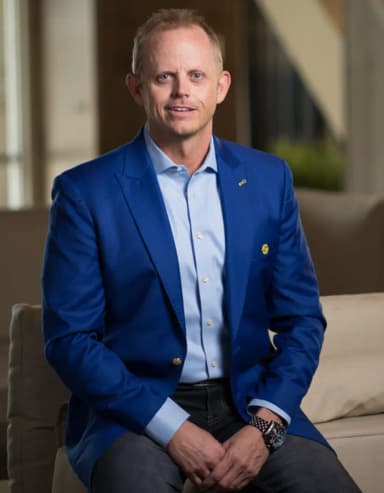
In this solo episode of The Daily Mastermind, George Wright III opens the new year with a foundational challenge: stop letting life steer you and start steering it yourself. The message is simple but demanding. If you want to create the life you envision, you have to begin each day with that vision front and center, before your phone, before the news, before the pressures of the day flood in.
George frames this not as a motivational idea but as a practical discipline rooted in one of his 12 Prosperity Pillars: "I create my life." Until you genuinely believe that life doesn't happen to you but happens for you, you will remain reactive. And reactive living is a recipe for waking up one day far off course.
Why Most People Let Life Happen to Them
We live in an environment engineered to pull your attention in every direction. Social media, as explored in the Netflix documentary "Social Dilemma," is not just influencing your choices; it is literally wiring your neurons toward reactivity and self-comparison. Technology, which was supposed to simplify life, has accelerated it instead. Add in the real pressures of relationships, business, and finances, and it becomes clear why so many people feel like passengers in their own lives.
The answer is not to unplug from the world. It is to get your hands back on the wheel before the world gets hold of them each morning.
The Sailboat and the Iceberg
George uses two vivid analogies to make this concrete. The first is the sailboat. An experienced sailor does not simply go wherever the wind blows. They set their sail deliberately, which means they can travel in any direction they choose, including directly into the wind.
It's not the direction of the wind that determines where they're going. It's the set of their sail.
The second is the iceberg. Early sailors were puzzled by icebergs traveling against the wind and current. The reason: 90 percent of an iceberg's mass is below the water, and it is the deep underwater currents, not the surface wind, that move it. Your deep core beliefs work the same way. Build them strong enough, and your life will move in the direction you choose regardless of the circumstances swirling on the surface.
What Dr. Joe Dispenza and Stephen Covey Both Teach About Mornings
George draws on two well-known frameworks for starting your day with intention. Stephen Covey's principle, "begin with the end in mind," is the foundation. You cannot build toward a destination you haven't clearly defined.
Dr. Joe Dispenza adds the neurological dimension. As George explains it:
Thoughts are the language of the mind, but feelings are the language of the body.
Most people wake up and immediately absorb feelings from their environment: stress, anxiety, social comparison, the weight of the inbox. Dispenza's insight is that if you can first anchor your thoughts to a vivid picture of the future you want, those thoughts generate corresponding feelings, and when thought and feeling align, your body responds with energy and motivation. Tony Robbins demonstrates this at his events by guiding people into a powerful positive memory and letting them feel how quickly the body follows the mind. The same principle applies to your future vision.
How to Build a Vision That Actually Motivates You
A vague idea of what you want is not enough. The clearer and more detailed your vision, the stronger the feelings it produces, and the stronger the feelings, the more drive you carry into your day.
George's suggestion is to start by writing. Pick up a journal or open a notes app and begin documenting the life you want to create. Describe each major area: your relationships, your lifestyle, your work, your health. Go into detail. What does it look like? What does it feel like? Project five, ten, twenty years out. Even if you already have a rough vision, writing it down forces more specificity and reveals gaps you haven't filled in yet.
The quote that opens the episode, from Kamilah Stevenson, sets the stakes:
Don't wait until you're dying to think about living.
This is consistent with Stoic philosophy's practice of reflecting on mortality, not as a morbid exercise but as a clarifying one. When you genuinely reckon with the fact that time is finite, you become far more intentional about how you use it.
Making the Morning Ritual Work in Practice
Once you have a written vision, the daily practice is straightforward: before you reach for your phone, before you check email, before you let the day's agenda crowd in, take a few minutes with your eyes closed and build that vision in your mind. Make it vivid. Let it generate a feeling in your body. Use that feeling as the fuel for your day.
This does not need to be a long ritual. A few focused minutes is enough to shift your neurological state from reactive to intentional. The key is doing it before your environment does it for you.
Action Steps
- Write down your vision across the major areas of your life: relationships, lifestyle, work, finances, and health. Include enough detail that you can feel it, not just see it.
- Commit to a brief morning vision practice this week: before reaching for your phone, close your eyes and spend two to three minutes picturing your future clearly.
- Check your screen time on your mobile device and identify which apps are consuming the most attention. Awareness is the first step to changing the pattern.
- Read or review your written vision at least once this week to add detail, fill in gaps, and sharpen the picture.
- If you feel off course right now, recognize that the moment you put your hands back on the wheel, you can begin to correct direction. You do not need to have everything figured out to start.
It is never too late to start living the life you were meant to live. The direction of your life is not set by your circumstances; it is set by the sail you choose. Adjust it this morning.